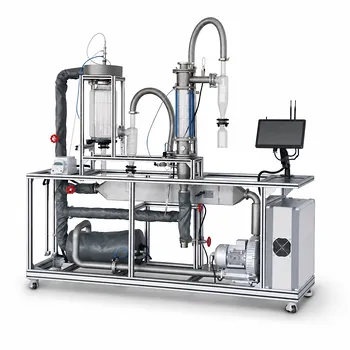
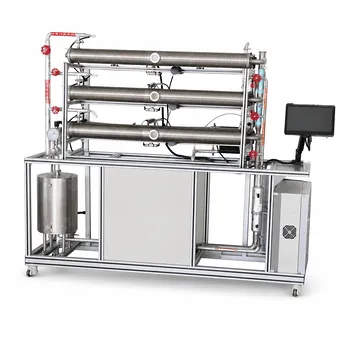
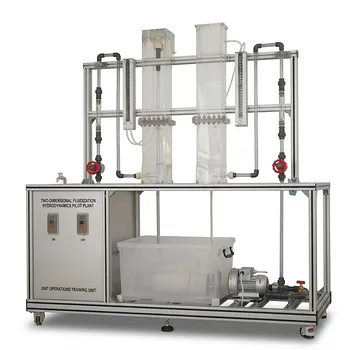
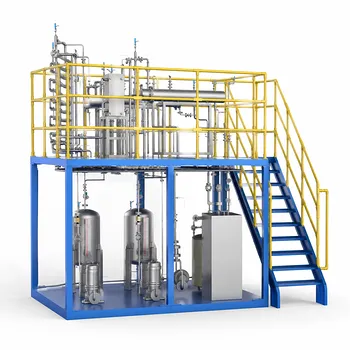
The key to selecting unit operations for a chemical engineering pilot plant is understanding that these units must form an integrated, safe, and flexible teaching platform. Educational institutions should evaluate potential equipment based on how well it mirrors real industrial process flows, enables hands-on exploration of core chemical engineering principles, and aligns with the specific skills students need to develop. The selection process must prioritize process integration, material compatibility, operational flexibility, and safety to create a training environment that bridges theory and industrial practice.
A successful educational pilot plant is not a catalog of isolated hardware—it is a carefully orchestrated system that reproduces the logic of industrial manufacturing. The core criteria for selecting unit operations are: whether the equipment can be linked into a complete process chain, whether it safely exposes students to realistic operational challenges, and whether it offers the flexibility to adapt to evolving curricula without prohibitive cost.
Define Educational Objectives Before Equipment Selection
Before evaluating any unit, clarify what students must learn and experience. A pilot plant designed for teaching batch specialty-chemical synthesis has different requirements from one focused on continuous petrochemical processes.
Align Equipment with Learning Outcomes
Map each unit operation to a specific pedagogical goal. A reactor should illustrate residence time distribution, heat management, and kinetic modeling. A distillation column should demonstrate staging efficiency and hydraulic limits. Avoid equipment that is too automated; students need to observe cause and effect, not just monitor a screen.
Distinguish Between Demonstration and Hands-On Operation
Some pilot plants are designed for instructor-led demonstrations, while others support student-led experimental campaigns. Decide early whether the units will be used for open-ended projects or fixed laboratory exercises. This influences the need for modularity, rapid changeover, and data acquisition capabilities.
Design for an Integrated, Industrial-Scale Process Flow
The most valuable pilot plants mimic the logical sequence of industrial manufacturing. A disjointed collection of stand-alone skids teaches far less than a system that can be configured to run a continuous flow path.
Cover All Core Process Stages
Select units that together form a complete chain: raw material preparation (e.g., feed preheating, filtration), a reactor, separation/purification (distillation, extraction, crystallization), recovery of unreacted reactants (recycle loops), and waste treatment. This complete view lets students see how upstream decisions cascade through the plant.
Enable Capacity Balancing and Recycle Loops
Choose equipment sizes and control schemes that allow students to experimentally balance throughput across units and optimize conversion rates. Incorporating a recycle stream from a separator back to the reactor teaches the industrial reality of maximizing raw material utilization.
Integrate Automated Control and Data Logging
For the plant to behave as a genuine process system, select units with continuous monitoring sensors (flow, pressure, temperature, level) and a centralized control architecture. This enables experiments on control loop tuning, alarm management, and steady-state detection—skills directly transferable to industry.
Make Safety and Durability Non-Negotiable Criteria
In an educational setting, safety is the overriding requirement. Equipment must protect students while withstanding repeated use by inexperienced operators.
Prioritize Material Compatibility and Corrosion Resistance
Match materials to the chemicals you will use. For non-corrosive training fluids, carbon steel is economical. However, for even mildly corrosive substances or humid laboratory environments, stainless steel (304 or 316) is essential to prevent rust and ensure longevity. All wetted parts—reactors, pipes, gaskets—must be chemically compatible to avoid leaks or catastrophic failure.
Verify Pressure Ratings and Overpressure Protection
If the plant will operate under pressure (e.g., reactors or vapor systems at 10–25 bar), verify that every vessel comes with certified pressure relief valves, burst discs, and pressure transmitters with alarms. Pressure boundaries must be robustly designed and documented, with interlocks that shut down the process if limits are exceeded.
Incorporate Transparent Sections for Visual Learning
Where safe, choose units with glass sight glasses or columns—for example, in distillation or absorption. This allows students to visualize hydrodynamic phenomena like flooding, weeping, or packing wetting, making abstract concepts concrete. Ensure all transparent components meet the system’s pressure and temperature limits.
Choose Between Batch and Continuous Operation Strategically
The decision between batch and continuous units shapes the entire pedagogical scope. Most effective training plants blend both.
Batch Flexibility for Diverse Formulations
Batch reactors and separators are highly versatile. They allow multiple products to be made in the same equipment, making them ideal for teaching specialty chemicals, pharmaceuticals, or bioprocessing. Batch units also offer easier cleaning and sterilization, which is critical for fermentation teaching. Initial capital costs tend to be lower for small-scale batch setups.
Continuous Systems for Realistic Process Control
Continuous pilot plants teach students how industrial facilities run 24/7 with 90–95% utilization. They are essential for demonstrating steady-state kinetics, advanced control loops, and the dynamic response to disturbances. Select continuous units with variable-speed drives and flow control loops so students can explore the full operating envelope.
Combine Batch Reactors with Continuous Downstream Units
For comprehensive vocational training, select a configuration where a batch reactor feeds into continuous separation units. This mirrors many real pharmaceutical and fine-chemical processes, teaching both batch recipe management and continuous unit operation in one campaign.
Focus on Instrumentation, Control, and Data Collection
Modern engineering increasingly relies on data-driven decision-making. The pilot plant must be a platform for digital skills as well as physical operations.
Choose Modular, Interchangeable Column Internals
When selecting distillation or absorption columns, opt for designs that allow swapping between tray and packed internals. Packed columns demonstrate low pressure drop and absorption phenomena. Tray columns are ideal for teaching multi-stage equilibrium calculations and visualizing flooding or weeping. A dual-configuration unit with sight glasses maximizes hands-on learning.
Integrate Real-Time Data Acquisition
All key process variables should be captured electronically. This enables students to perform heat and mass balances, calculate efficiencies, and fit kinetic models using real data. The ability to trend parameters over time reinforces understanding of transient behavior.
Verify Utility and Infrastructure Readiness
Even the best pilot plant will fail if the laboratory cannot support its utility demands. This evaluation must happen in parallel with equipment selection.
Map Utility Requirements in Detail
Before purchase, document the required electricity (voltage, phase, amperage), cooling water (flow rate, inlet temperature, pressure), steam supply, compressed air, and drainage needs. Cross-check these against the facility’s available capacity. Under-dimensioned utilities will force derated operation and invalidate experimental data.
Ensure Proper Ventilation and Waste Handling
Pilot plants that involve volatiles or trace chemical releases must have adequate local exhaust ventilation. Waste streams—even benign training fluids—must have a safe, approved disposal path. Planning drainage and ventilation upfront prevents later safety and compliance issues.
Embed Scalability and Industry Relevance
Students increasingly need to grasp how lab-scale behavior translates to commercial production. Choose equipment that supports this conversation.
Select Units That Allow Scale‑Down/Scale‑Up Analysis
Opt for reactors and separators with well-defined geometries that permit dimensionless analysis (e.g., Reynolds number, Damköhler number). When students can change scale or flow regime systematically, they learn to predict mixing, heat transfer, and mass transfer changes using mathematical models.
Expose Students to Predictive Engineering Concepts
The industry trend is toward modeling and simulation before building. A pilot plant that can be easily instrumented for model validation—comparing CFD or process simulation results with experimental data—teaches modern scale‑up methodology and reduces reliance on trial‑and‑error.
Common Trade‑offs and Pitfalls to Avoid
No single pilot plant can meet every goal perfectly. Understanding the inherent trade-offs helps institutions make informed choices.
Realism vs. Student Accessibility
Highly automated industrial equipment can be a black box. If students only interact with a touchscreen, they miss mechanical understanding. Balance automation with manual valves, sample ports, and transparent sections that reveal underlying physics.
Budget vs. Long‑Term Adaptability
Low‑cost, single‑purpose units may save money initially but limit future curricula. Investing in modular, skid‑mounted systems with interchangeable components often pays back through extended service life and expanded teaching possibilities. Prioritize durable stainless‑steel construction and standardized connections.
Breadth vs. Depth of Coverage
A plant that tries to include every unit operation (reactor, distillation, extraction, evaporation, filtration, crystallization) may become too complex to maintain and operate. Focus on core reaction‑separation‑recycle sequences, and add specialized units only if directly aligned with the program’s focus area (e.g., bioprocessing, petrochemicals).
Making the Right Choice for Your Program
The final configuration must match your institution’s educational philosophy and resource constraints. Use these goal‑based recommendations to guide your final selection.
- If your primary focus is teaching fundamental process dynamics and control: Prioritize a continuous reactor‑distillation loop with extensive instrumentation, variable drives, and a modern DCS interface. Include a recycle line to add realistic complexity.
- If your primary focus is covering a broad range of unit operations for a general plant design course: Select modular, bench‑top skids (batch reactor, tray/packed distillation, heat exchanger, liquid‑liquid extraction) that can be quickly reconfigured, emphasizing transparent sections and simple data logging.
- If your primary focus is bioprocessing or specialty chemicals training: Select a high‑grade stainless‑steel batch reactor with CIP/SIP capabilities, paired with continuous downstream filtration and chromatography modules, to teach GMP and sanitary design principles.
- If your primary focus is maximizing safety and durability with limited budgets: Choose a single‑fluid training plant (e.g., water/air systems) with robust carbon‑steel construction, full transparency for hydraulics, and extensive pressure relief on any closed circuits. This minimizes chemical hazards while still teaching core principles.
A thoughtfully configured pilot plant becomes the heart of a chemical engineering program, transforming theoretical knowledge into practical competence and preparing students for the complexities of modern industrial operations.
Summary Table:
| Selection Criterion | Key Focus Area | Educational Value |
|---|---|---|
| Process Integration | Linked continuous/batch flows & recycle loops | Teaches real-world process logistics & mass balances |
| Safety & Durability | Stainless steel, pressure reliefs, & glass sections | Ensures student safety while enabling visual learning |
| Automation & Control | Sensors, real-time data logging, & DCS interfaces | Develops critical process control & troubleshooting skills |
| Flexibility & Scalability | Modular skids & interchangeable column internals | Adaptable to evolving curricula and scale-up studies |
Build Your Next-Generation Training Lab with LABPARK
Ready to configure a high-performance chemical engineering pilot plant? LABPARK provides state-of-the-art Educational and Vocational Unit Operations Pilot Plants tailored for chemical engineering, bioprocess & biotech, and environmental & water treatment.
We design safe, durable, and flexible training platforms that help universities, research institutes, and enterprises bridge the gap between classroom theory and hands-on industrial practice.
Contact LABPARK today to discuss your curriculum requirements and request a customized equipment configuration!
Related Products
- General Purpose Cosmetics Production Unit Operations Training Pilot Plant
- Multi Pump Fluid Transport Process Piping Unit Operations Training Pilot Plant
- Multi-Functional Drying Educational Unit Operations Pilot Plant
- Fixed-Bed Chemical Reaction and Gas Dust Tar Removal Unit Operations Pilot Plant
- 100L Continuous Loop Hydrogenation Educational Unit Operations Pilot Plant
People Also Ask
- Why is the chemical plant startup schedule crucial? De-risk scale-up with pilot plants.
- How do deviations in estimating latent heat impact pilot plant thermal systems? Avoid hardware mis-sizing.
- When to transition from PID to adaptive control in pilot plants? Key process indicators.
- Why Compare Predicted and Experimental Excess Enthalpy? Key to Accurate Pilot Plant Scale-up
- Why Use PTFE & Hastelloy in Chemical Pilot Plants? Prevent Corrosion & Ensure Safety