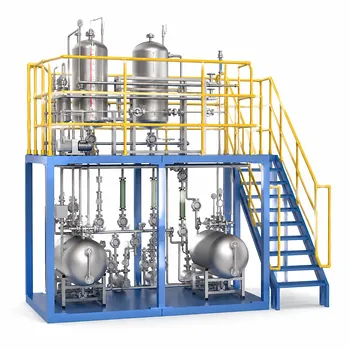
The selection between a fixed-roof and floating-roof tank in a pilot plant is not just a storage decision—it’s a fundamental lesson in vapor management. The demonstration method hinges on the modeled fluid’s volatility. Fixed-roof systems teach inerting and pressure control for stable liquids, while floating-roof systems physically eliminate the vapor space to prevent evaporative loss and explosion hazards for volatile liquids.
The core educational takeaway is that the tank’s design must solve a specific thermodynamic problem. If the liquid naturally evaporates into a hazardous or valuable gas, the engineering control mechanism is either to dilute/inert that gas (fixed-roof) or to prevent its formation entirely (floating-roof). A pilot plant should make this physical principle visible and measurable to students.
Moving Beyond a Simple Container: Teaching Process Fundamentals
The true purpose of a pilot-plant storage module is to transform a seemingly static piece of equipment into a dynamic process system. The goal is not just to hold fluid, but to manage its changing physical state safely and efficiently.
Visualizing the Invisible Hazard
The biggest educational challenge is that vapor is often invisible. A well-designed pilot plant turns vapor pressure into a tangible, measurable variable.
Students must see that a tank is a reactive system, not a passive bucket. The primary reference correctly identifies that fixed-roof and floating-roof systems are selected based on this very reactivity. The demonstration must center on what happens in the space above the liquid.
Demonstrating the Fixed-Roof Tank: The Art of Inerting
For non-volatile or slightly volatile liquids like water, treated process streams, or some acids, the fixed-roof tank is the standard. The pilot plant demonstration shifts focus from managing evaporation to managing the headspace atmosphere.
The Role of Nitrogen Blanketing
This system’s educational value lies in teaching contamination control. A nitrogen blanket demonstrates how to keep oxygen or moisture out of a product.
Students operate a regulator and observe a conservation vent. They learn that the primary operational goal is maintaining a slight positive pressure of inert gas to create a barrier against atmospheric contamination. The lesson is about purity preservation, not loss prevention.
Mastering Pressure and Vacuum Relief
Every fixed-roof tank is vulnerable to the laws of thermodynamics. A critical lesson here involves thermal in-breathing and out-breathing.
Demonstrate a pump-out scenario to trigger a vacuum relief event. Show how the tank would implode without proper venting. Then, pump liquid in or heat the contents to trigger overpressure. This teaches that a tank is a coded pressure vessel with defined mechanical limits, a crucial safety lesson for industrial plant operations.
Demonstrating the Floating-Roof Tank: Minimizing Loss
When working with volatile or flammable model fluids—like an ethanol-water mixture—the floating-roof tank becomes essential. The demonstration goal here is to showcase a purely mechanical solution to evaporative loss.
Eliminating the Vapor Space
The primary physical principle is direct contact. The roof rests on the liquid surface, literally leaving no room for a vapor cloud to form.
In a pilot plant, this is best demonstrated with a transparent tank wall. Students visually confirm the roof’s position rising during filling and falling during discharge. The immediate realization is that no air-vapor mixture exists, thereby intrinsically eliminating the threat of an internal explosion or major evaporative loss.
Seal Systems and Maintenance Education
The “floating” mechanism introduces a complexity not found in simpler tanks: the rim seal. This is the primary source of emissions and the key maintenance point.
The demonstration should involve inspecting a secondary seal or measuring the vapor concentration at the rim. It teaches an inverse principle: while the floating roof eliminates the large vapor space, it introduces a small, focused annulus where a tiny leak always exists. The operation skill is learning to manage this trade-off between overall efficiency and localized maintenance.
Understanding the Critical Selection Trade-offs
The choice between these two storage methods is a classic engineering trade-off. Students must understand that no single design is universally superior; the selection is entirely dictated by the fluid’s hazard profile and the operational budget.
Simplicity vs. Loss Prevention
A fixed-roof tank is mechanically simpler and cheaper to build. Its trade-off is operational complexity: it requires a continuous nitrogen supply and a sophisticated venting system. A failure in the inerting system can lead to a catastrophic contamination event or an unsafe atmosphere.
A floating-roof tank addresses the safety issue mechanically. Its trade-off is capital cost and maintenance. The roof can bind on its guide poles, sink if the deck drains plug, or allow rain to pool. The educational pilot plant must model these failure modes—like simulating a stuck leg—to show that a floating roof solves the fire hazard but creates a mechanical maintenance burden.
Product Purity vs. Environmental Control
The fixed-roof model, with its nitrogen blanket, teaches concepts of absolute product purity. It is the correct choice when air contamination is unacceptable. The floating-roof model teaches concepts of environmental emissions control. It is the correct choice when the liquid’s value or hazardous nature means you cannot afford to let any of it escape as vapor, or when you cannot safely store it under pressure.
Making the Right Choice for Your Educational Goal
Incorporating these systems into a unit operations lab requires defining your primary teaching objective. The selection of training equipment should directly map to the core engineering principle you want the students to internalize.
- If your primary focus is process safety and inerting logic: Prioritize a fixed-roof tank setup with a fully instrumented nitrogen blanket. The lesson is controlling the atmosphere of a confined space through pressure regulators, conservation vents, and oxygen analyzers.
- If your primary focus is environmental loss control and mechanical design: Prioritize a transparent floating-roof tank with a visible seal system. The lesson is the direct physical elimination of an explosion hazard and the reduction of working losses through mechanical innovation.
- If your primary focus is comparative thermodynamics and operational cost: Build both systems side-by-side. Charge them with the same liquid and challenge students to measure evaporation rates, inert-gas consumption, and the frequency of vent actuation to quantify the trade-offs between capital complexity and operational expense.
A unit operations pilot plant transforms abstract storage concepts into tactile engineering reality, giving students the permission to safely observe both mechanical failure and thermodynamic protection.
Summary Table:
| Feature | Fixed-Roof Tank | Floating-Roof Tank |
|---|---|---|
| Target Fluids | Low-volatility/stable liquids | High-volatility/flammable liquids |
| Vapor Control | Inerting & pressure relief | Eliminating vapor space mechanically |
| Key Lesson | Nitrogen blanketing safety | Loss control & seal maintenance |
Enhance Your Lab with LABPARK
Equip your students with hands-on process safety skills. LABPARK provides premium Educational and Vocational Unit Operations Pilot Plants in chemical engineering, bioprocess & biotech, and environmental & water treatment. Designed specifically for universities, research institutes, and enterprises, our systems bring complex thermodynamic and storage concepts to life.
Contact our team today to discuss your curriculum needs and build the perfect pilot plant for your institution!
Related Products
- Comprehensive Fluid Mechanics Educational Unit Operations Pilot Plant
- Two-Dimensional Fluidization Hydrodynamics Educational Pilot Plant for Unit Operations Training
- Multi Pump Fluid Transport Process Piping Unit Operations Training Pilot Plant
- Fluid Transport and Piping Dynamics Practical Training Unit Operations Pilot Plant
- Multi-Reactor Educational Pilot Plant for Reaction Engineering Unit Operations
People Also Ask
- How do changes in pipe diameter & local head losses affect gradients? Pilot plant insights.
- How does fully developed flow and entrance length apply to fluid mechanics pilot-plant design? Improve measurement accuracy
- How do pilot plants teach U-tube manometers? Master Differential Pressure Calculations
- How does viscous boundary layer thickness scale with kinematic viscosity and characteristic time in fluid mechanics unit operations pilot plants?
- Why Custom Pilot Plants Beat Used Equipment in Vocational Labs: Achieve Safe, Effective Learning