The key to scaling up chromatography is a deliberate shift in particle geometry.
For analytical work, you select small particles (e.g., 3–10 µm) to minimize diffusion path lengths and achieve razor-sharp peaks. When moving to a bioprocess pilot plant, you must choose larger particles—typically in the 30–100 µm range—to avoid prohibitive column backpressure at the elevated flow rates pilot operations demand. But the most strategic approach goes beyond a simple size increase: if your system is rated for high pressure, smaller particles can dramatically boost specific productivity, letting you run shorter columns and faster cycles for the same throughput.
The core of media selection during scale-up is not a fixed rule but a rigorous trade-off between efficiency and system pressure. While conventional pilot plants favour larger particles to manage backpressure, modern high-pressure systems unlock the productivity gains of smaller beads—provided your columns, pumps, and packing infrastructure are built to handle the mechanical load.
The Physics of Scale-Up: Pressure Drop and Plate Height
Understanding why particle size matters at scale requires linking two fundamental chromatographic principles: the pressure drop across a packed bed and the Height Equivalent to a Theoretical Plate (HETP).
The Pressure Drop Penalty of Small Particles
Pressure drop in a column scales inversely with the square of particle diameter.
When you swap a 10 µm analytical bead for a 60 µm process-scale bead, the pressure drop can plummet from roughly 40 bar to just 3 bar under similar conditions.
For a pilot plant running high volumetric flow rates, this relationship is critical.
An analytical column packed with sub-5 µm particles would generate a pressure drop that exceeds the limits of standard pilot-scale pumps and columns, causing pack-compression, bed collapse, or safety risks.
HETP and the Efficiency Trade-off
The overarching goal during scale-up is to maintain the solute concentration profile’s shape for high recovery and purity.
This is quantified by the Height Equivalent to a Theoretical Plate (HETP)—the lower the HETP, the more efficient the column.
HETP rises when you increase particle size because mass transfer and eddy diffusion become less favourable.
So while larger particles tame pressure drop, they inherently reduce separation efficiency, forcing you to compensate with longer columns or compromised resolution.
Selecting Media for Pilot-Plant Operations
Your choice of resin particle size, mechanical backbone, and chemical compatibility dictates the entire operational window of the pilot plant.
Particle Size: Finding the Sweet Spot
For most conventional pilot plants, picking larger carrier particles is the de facto standard.
They keep backpressure well within the pump and column ratings, enabling stable, reproducible runs even at high flow rates.
However, the landscape is shifting.
If your pilot plant is equipped with high-pressure-rated columns, pumps, and slurry packing systems, you can deliberately select smaller particles (e.g., 15–30 µm) to capture a step-change in productivity.
This reduces column dimensions and solvent consumption for the same throughput, a crucial lever in cost-sensitive bioprocess development.
Mechanical Strength and Chemical Stability
Pilot-scale resins must survive hundreds of cycles, including aggressive cleaning-in-place (CIP) protocols.
Media with poor mechanical stability will fracture under the alternating pressure loads of injection and CIP, creating fines that clog frits and increase backpressure irreversibly.
Chemical stability is equally non-negotiable.
The resin must resist swelling, leaching, and functional-group degradation when exposed to the harsh alkali or acidic wash solutions used to sanitise bioprocess columns between batches.
Understanding the Trade-offs: Productivity vs. Resolution
The central tension in pilot-plant media selection is between the desire for high throughput and the need to meet purity specifications.
When Smaller Particles Win
Using a smaller sorbent particle (e.g., moving from 60 µm to 10 µm) can dramatically increase specific productivity.
You achieve equal or better resolution in a fraction of the bed height, shortening run times and enabling more batches per campaign.
The price is a squarely higher system pressure drop.
You must verify that every hardware component—from the pump head to the column wall thickness—is rated for the resulting pressures (often exceeding 40 bar for 10 µm media).
The Economic Reality of High Pressure
Operating a high-pressure pilot plant costs more.
The hardware is more expensive, the packing procedures are more critical, and the energy consumption per cycle is higher.
Therefore, the decision to use small particles must be driven by a clear process need: either a hard-to-resolve separation with a low selectivity factor, or a profound throughput bottleneck where shorter cycles justify the capital investment.
Packing, Geometry, and Fluid Dynamics at Scale
Media selection is only half the story—how you pack the bed and design the column determines whether the particle’s potential is realised.
Preventing Channeling and Wall Effects
In a poorly packed pilot column, mobile phase finds the path of least resistance, creating channels that destroy resolution.
Automated slurry packing systems and pressure-controlled flow are essential to achieve a uniform, dense bed free of cracks or air pockets.
As column diameter increases, wall effects become more pronounced.
Specialised distributor plates or baffles are incorporated to promote radial mixing and dampen axial dispersion, ensuring the flow profile remains plug‑like even in wide columns.
Column Design for Different Separation Difficulty
The difficulty of your separation—quantified by the selectivity factor (α)—directly guides bed geometry.
For tough separations where α < 1.15, you need longer, narrower columns to build the plate count required for baseline resolution.
For well‑behaved separations with α > 1.15, throughput becomes the priority.
You can use wider columns with larger diameters, operated at higher loadability, to process more product per unit time without wasting resolution.
Making the Right Choice for Your Goal
Your final media selection must be anchored to your primary process objective. Use the following guide to align particle size, column hardware, and operating philosophy.
- If your primary focus is maximizing throughput with limited column volume: Choose the smallest particle size your entire system’s pressure envelope can safely sustain. This shrinks bed height and cycle time, boosting productivity per unit footprint.
- If your primary focus is achieving the highest possible resolution for a difficult separation: Use a smaller particle size in combination with a longer, narrower column to drive down HETP. Accept the higher pressure drop as a necessary trade-off for meeting purity targets.
- If your primary focus is robust, low‑maintenance operation with frequent CIP cycles: Select a chemically inert, mechanically rugged resin with particle sizes >50 µm. This minimises backpressure drift and particle generation over hundreds of sanitation cycles.
- If your primary focus is training and demonstrating scale‑up principles: Implement columns with adjustable bed heights and interchangeable flow distributors. This lets you show how particle size, packing quality, and column geometry interact dynamically in real‑time pilot runs.
The milestone is not just picking a particle size; it’s building a pilot‑scale environment where the resin, the hardware, and the operating philosophy are fully integrated to meet your purity, productivity, and robustness targets.
Summary Table:
| Feature / Goal | Small Particles (15–30 µm) | Large Particles (30–100 µm) |
|---|---|---|
| Pressure Drop | High (Requires high-pressure hardware) | Low (Suitable for standard pumps/columns) |
| Separation Efficiency | High (Lower HETP, sharper peaks) | Lower (Higher HETP) |
| Throughput & Speed | Faster cycles, higher productivity | Slower cycles, larger column volume |
| Best Used For | Difficult separations & high-pressure systems | Robust, routine operations & frequent CIP |
Scale Up Your Bioprocess Training and Research with LABPARK
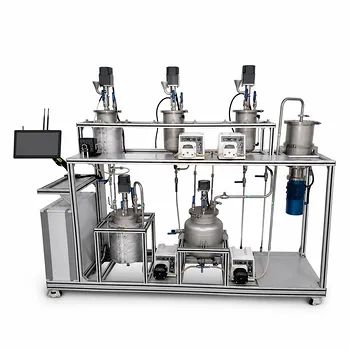
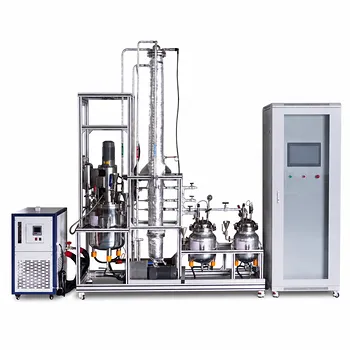
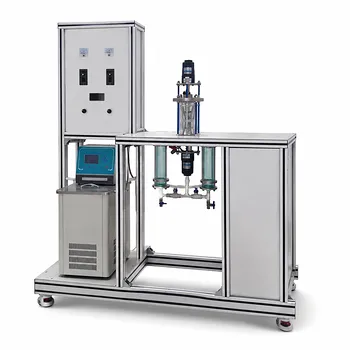
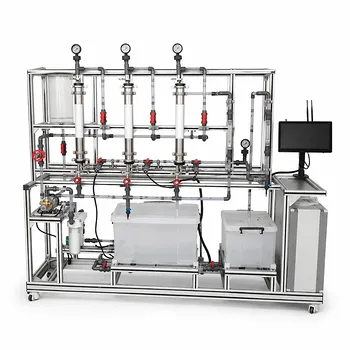
Transitioning from lab analysis to pilot-scale operations requires the right equipment to simulate real-world challenges. LABPARK provides advanced Educational and Vocational Unit Operations Pilot Plants in chemical engineering, bioprocess & biotech, and environmental & water treatment.
Designed specifically for universities, research institutes, and enterprises, our systems help students and researchers master chromatography column packing, fluid dynamics, and pressure-efficiency trade-offs in a hands-on environment.
Ready to equip your facility with industry-grade pilot plants? Contact us today to request a quote!
Related Products
- Bio-fermentation Ethanol Production Practical Training Unit Operations Pilot Plant
- Natural Product Extraction Unit Operations Training Pilot Plant
- Polymerization Granulation and Pellet Processing Educational Unit Operations Pilot Plant
- Multi Functional Membrane Crystallization Educational Unit Operations Pilot Plant
- Multi-Functional Special Distillation Educational Pilot Plant
People Also Ask
- Why Use PTFE & Hastelloy in Chemical Pilot Plants? Prevent Corrosion & Ensure Safety
- Why Compare Predicted and Experimental Excess Enthalpy? Key to Accurate Pilot Plant Scale-up
- Why is the chemical plant startup schedule crucial? De-risk scale-up with pilot plants.
- When to transition from PID to adaptive control in pilot plants? Key process indicators.
- Why must batch and fed-batch fermentation pilot plants be designed to accommodate changing rheological conditions?