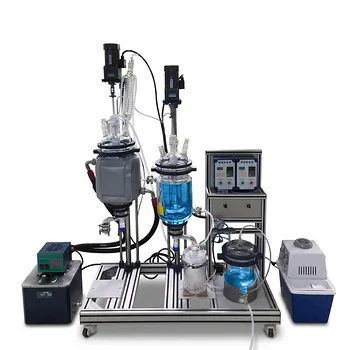
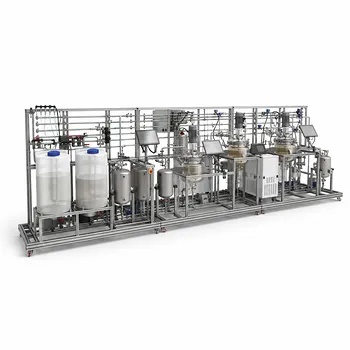
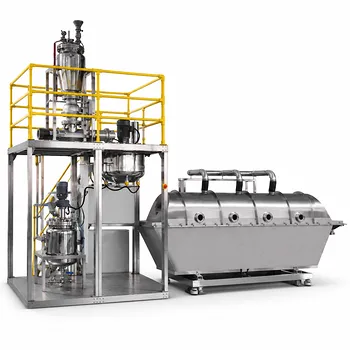
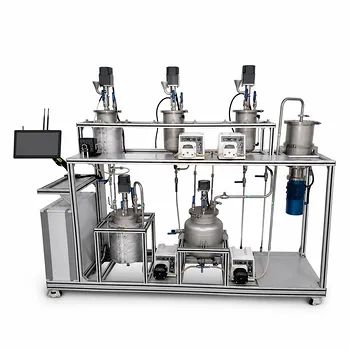
The solubility curve is your configuration blueprint. For solutes with a steep positive temperature dependence—where solubility rises sharply with heat—the pilot plant must be configured around a controlled cooling crystallization system using jacketed vessels and precise temperature ramps. For solutes with flat or inverse solubility curves, where cooling alone yields little recovery, the plant must instead employ an evaporative crystallization setup to remove solvent and force supersaturation.
The solubility-temperature relationship of the solute is the single most important driver of pilot-plant configuration. A steep positive slope calls for a jacketed cooling crystallizer; a flat or inverse slope demands an evaporative crystallizer. Misaligning the method with the solubility curve wastes energy, slows throughput, and can even prevent crystal formation entirely.
The Solubility Curve: Your Process Roadmap
Why Temperature Dependence Drives Configuration
Crystallization is fundamentally a supersaturation-generation problem. How you create that excess solute concentration depends on what happens to the solute’s solubility as you change temperature.
When solubility drops sharply with decreasing temperature—as with potassium nitrate or copper sulfate—removing sensible heat is the most direct and energy-efficient path to the metastable zone. The driver is thermodynamic: the dissolved mass can no longer stay in solution, so it crashes out as pure crystals.
When solubility barely changes with temperature (sodium chloride) or rises as you cool (calcium sulfate above ~40 °C), heat removal alone does almost nothing. You must instead remove solvent—typically water—to concentrate the solution and push it beyond the solubility limit.
The Two Archetypal Pilot Plant Configurations
A well-designed pilot plant therefore houses at least two core unit operations that map directly to these two curve types:
- Cooling crystallization loop: A jacketed stirred vessel served by a chiller or temperature-control skid, capable of executing controlled linear cooling ramps and holding precise isothermal steps.
- Evaporative crystallization loop: An evaporator body with a heated circulation loop, condenser, and vacuum system, designed to boil off solvent while managing the slurry density.
Modular educational and research plants often integrate both loops into a single skid, allowing students to switch between modes simply by routing the process fluid differently.
Configuring for Cooling Crystallization (Positive Solubility Slope)
Equipment Essentials: Jacketed Vessels and Precision Control
The heart of a cooling crystallization pilot plant is a jacketed crystallizer. The jacket carries a heat-transfer fluid whose temperature is programmed to follow a cooling profile tailored to the solute’s solubility curve.
Critical design elements include:
- High-accuracy temperature sensors placed directly in the slurry, not just in the jacket outlet, to avoid lag-induced control errors.
- A variable-speed agitator sized for gentle but uniform suspension. Too little shear causes classification; too much breaks newly formed nuclei and creates excessive fines.
- A wash-coated thermowell or turbidity probe to detect the onset of nucleation (the cloud point), giving the operator real-time feedback on when supersaturation is being consumed.
Operating Strategy: Controlled Supersaturation via Heat Removal
The operating sequence begins by fully dissolving the solute near the high-temperature end of the solubility curve. The clear solution is then cooled at a defined rate—often 5–15 °C per hour for laboratory-scale systems—to stay just inside the metastable zone.
If cooling is too fast, the system overshoots the metastable limit and generates an unwanted shower of fines. If too slow, productivity suffers. Pilot-plant trials map this operating window by measuring induction times and crystal size distributions at different cooling rates, generating the data needed for scale-up.
Configuring for Evaporative Crystallization (Flat or Inverse Solubility)
Equipment Essentials: Vacuum-Distillation or Forced-Circulation Evaporators
For sodium chloride or other flat-curve solutes, the pilot plant replaces the cooling jacket with a solvent-removal train. Common configurations are:
- Forced-circulation evaporator: A shell-and-tube heat exchanger raises the solution to its boiling point, and a flash vessel downstream separates vapor from the concentrating slurry.
- Vacuum evaporative crystallizer: Operating under reduced pressure allows boiling at lower temperatures, which is essential when the solute itself is heat-sensitive or when inverse solubility demands that you avoid hot-wall deposition.
A condenser and vacuum pump complete the loop, while a draw-off leg at the vessel’s base removes thick slurry for further dewatering.
Operating Strategy: Solvent Removal to Reach the Metastable Zone
In this mode, supersaturation builds not by changing temperature but by maintaining a steady boil-off rate. The operator controls the feed rate of fresh solution and the vapor-removal rate to keep the slurry density in a target range.
Key pilot-plant measurements are the boiling-point elevation (which rises with concentration), the heat-transfer coefficient across the evaporator tubes, and the crystal habit under different residence times. All of these inform the design of production-scale forced-circulation units, where scaling and encrustation are major reliability concerns.
Understanding the Trade-offs and Pitfalls
Energy and Throughput Considerations
Cooling crystallization is inherently more thermodynamically efficient when the solubility slope is favorable—it only moves heat, not mass across a phase-change boundary. Evaporative crystallization, by contrast, must supply the latent heat of vaporization, typically making it 5–10 times more energy-intensive per kilogram of crystal produced.
However, energy logic can flip. A flat-curve solute forced into a cooling-only setup produces almost no yield, making the per-kg energy cost astronomical. The pilot plant must therefore be configured for the method that actually works, not the one that looks cheaper on paper.
Risk of Scaling and Encrustation
Evaporative crystallizers suffer from wall-scale growth, particularly at the tube-liquid interface where boiling nucleates. Pilot-plant validation of anti-scalant strategies, polished surface finishes, and periodic flush cycles is critical.
Cooling crystallizers, on the other hand, face the “cold finger” problem: the jacket wall is the coldest surface, encouraging a hard crystal crust that insulates the vessel and kills heat transfer. Proper agitation design and temperature-differential limits are your first line of defense.
When Cooling Isn’t Enough: Supplemental Modes
For solutes with moderate positive slopes that are heat-sensitive, a vacuum adiabatic cooling crystallizer can be used: a flash evaporation step simultaneously cools and concentrates the solution. And for solutes with very poor intrinsic solubility, antisolvent or reactive crystallization configurations—adding a miscible non-solvent or reacting precursors—may be integrated into the pilot skid. These are specialized cases, but a flexible pilot plant designed with modular ports and reagent-dosing systems can accommodate them without a full rebuild.
Making the Right Choice for Your Pilot Plant
The configuration you choose must align with what you are trying to learn or demonstrate.
- If your primary focus is teaching thermodynamic principles: Build a modular plant with switchable cooling and evaporation loops, allowing direct comparison of yield and crystal quality for a single solute in both modes.
- If your primary focus is process development for a specific molecule: House the plant with the method that matches the solute’s solubility slope, and invest in the instrumentation needed to map the metastable zone width and nucleation kinetics.
- If your primary focus is scale-up risk reduction: Include both primary and secondary configurations—cooling as the base case, evaporation as a back-up—so you can generate side-by-side engineering data on heat transfer, fouling, and particle size robustness.
A pilot plant is not a one-size-fits-all asset. Let the solubility curve guide the hardware, and then let the operational data guide the scale-up. That’s how you turn a benchtop chemistry observation into a robust, industrial crystallization process.
Summary Table:
| Feature / Parameter | Cooling Crystallization Setup | Evaporative Crystallization Setup |
|---|---|---|
| Solute Solubility Curve | Steep positive temperature dependence | Flat or inverse temperature dependence |
| Primary Driver | Sensible heat removal (cooling) | Solvent removal (boiling/distillation) |
| Core Equipment | Jacketed vessel, variable-speed agitator, chiller/TCU | Evaporator body, heating loop, condenser, vacuum pump |
| Energy Intensity | Low (only transfers heat) | High (requires latent heat of vaporization) |
| Main Operational Risk | "Cold finger" encrustation on jacket walls | Tube-wall scaling and encrustation |
Optimize Your Process Scale-Up with LABPARK
Designing the right pilot plant configuration is critical to translating benchtop chemistry into robust industrial processes.
LABPARK provides state-of-the-art Educational and Vocational Unit Operations Pilot Plants in chemical engineering, bioprocess & biotech, and environmental & water treatment. Tailored specifically for universities, research institutes, and enterprises, our flexible and modular crystallization skids allow students and researchers to easily switch between cooling and evaporative modes.
Ready to elevate your engineering lab or research capabilities? Contact LABPARK today to discover our custom pilot plant solutions and request a technical consultation!
Related Products
- Multi Functional Membrane Crystallization Educational Unit Operations Pilot Plant
- Potassium Salt Thermal Dissolution and Crystallization Separation Educational Unit Operations Pilot Plant
- Multi-Functional Special Distillation Educational Pilot Plant
- Ethyl Acetate Synthesis Unit Operations Pilot Plant for Practical Training
- Multi-Modal Distillation Unit Operations Training Pilot Plant
People Also Ask
- Control Crystallization Pilot Plant Secondary Nucleation: 4 Key Adjustments
- Why is precise temperature control critical in crystallization pilot plants? Key to Scale-Up Success
- What key factors should be considered when configuring a crystallization unit operations pilot plant?
- What are the benefits of integrating online PAT tools like ATR-FTIR into crystallization unit operations pilot plants?
- How to use crystallization pilot plant agitation speed to identify diffusion vs reaction growth?