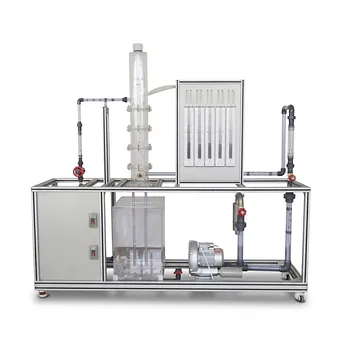
The choice is not about finding a single “best” tray. It hinges on mapping the unique traits of sieve, valve, and bubble cap trays to your pilot plant’s true purpose—whether that’s demonstrating hydraulic limits to students or exploring variable separation conditions in research. Sieve trays offer the lowest cost and pressure drop but the narrowest operating window, valve trays provide a flexible middle ground, and bubble cap trays guarantee stability at vanishingly low vapor rates at the expense of higher cost and pressure drop.
The decision matrix is straightforward: prioritize economies and low pressure drop for steady-state teaching; pick valve trays for variable-feed research that demands a wide turndown; select bubble cap trays when you absolutely need a constant liquid seal at near-zero vapor flow. The deepest value, however, comes from aligning the tray’s inherent hydraulic and economic profile with your educational or research objectives.
Understanding the Performance Triangle: Cost, Pressure Drop, and Flexibility
Each tray type occupies a distinct corner of the cost–pressure drop–flexibility triangle. Evaluating them against these three criteria provides the factual foundation for your decision.
The Sieve Tray Advantage: Lowest Cost and Pressure Drop
Sieve trays are the most economical choice. They are simple perforated sheets, making them inexpensive to fabricate and install.
Their open-hole design also generates the lowest pressure drop of the three tray types. This is a critical advantage for vacuum distillation demonstrations or when you want to isolate the effects of other hydraulic components.
The trade-off is a restricted operating range. Sieve trays typically provide a useful turndown of only about 50%–120% of the design flow rate. Below this, significant weeping occurs, compromising separation efficiency and giving a vivid lesson in hydrodynamic limits.
Valve Trays: The Flexible Middle Ground
Valve trays (fixed or floating) balance the extremes. They cost slightly more than sieve trays but are still far less expensive than bubble cap designs.
Their pressure drop is higher than sieve trays but acceptable for most atmospheric and moderate vacuum pilot work. The real advantage is operational flexibility: the valves adjust their opening with vapor flow, delivering a substantially wider turndown ratio.
This flexibility makes valve trays the natural pick for pilot plants that need to study variable feed conditions, start-up transients, or multiple separation scenarios without switching internals. They bring industrial relevance into the lab, as modern large-scale columns heavily use this technology.
Bubble Cap Trays: Stability at the Expense of Cost and Pressure Drop
Bubble cap trays carry the highest manufacturing cost and the largest pressure drop. The intricate cap-and-riser structure requires precision fabrication, which pushes the cost exponent higher than that of sieve trays.
However, they maintain a constant liquid seal even at extremely low gas flow rates. Because the cap always keeps the liquid level above the vapor exit, weeping is virtually eliminated, allowing stable operation down to near-zero vapor throughput.
This near-perfect seal makes them ideal for batch distillation or absorption processes requiring high liquid holdup and stable mass transfer regardless of vapor velocity. In education, they showcase how classical design overcomes weeping, but that lesson comes at a premium.
Aligning Tray Selection with Educational and Research Objectives
Cost, pressure drop, and flexibility are the “what.” The real question is “why” you need them. Your pilot plant’s mission determines which trade-offs are acceptable.
Teaching Fundamentals: Visualizing Hydraulics and Limits
For unit operations labs that focus on basic mass transfer principles, sieve trays are invaluable. Their proneness to weeping and flooding at off-design conditions makes them the perfect tool to demonstrate hydrodynamic limits firsthand.
Students can visually observe the collapse of the liquid head and measure the exact vapor velocity where efficiency tanks. This visceral experience cements the concepts of turndown ratio, pressure drop, and tray efficiency far better than a design textbook. The low cost also eases the budget for multiple columns or setups.
Research Flexibility: Dealing with Variable Conditions
When the pilot plant serves process exploration, kinetic studies, or catalyst screening, the ability to run stably over a wide flow range becomes paramount. Here, valve trays shine.
They allow you to vary feed rates without risking weeping or premature flooding, collecting reliable efficiency data across a broad operating envelope. For evaluating tray dynamics under real conditions, the valve tray’s balance of efficiency and flexibility means you can validate design correlations like the Erwin two‑film method with confidence, capturing both gas‑phase and liquid‑phase transfer contributions.
The Case for Modular Interchangeability
A forward-looking strategy is to invest in a column with interchangeable tray sections. This architecture lets you swap sieve, valve, and bubble cap decks in the same shell.
Comparative hands‑on experience solidifies student learning. Researchers gain a single platform to measure pressure drop, weeping, and separation efficiency for each tray type, generating their own design data. The slightly higher capital cost of a modular system is often offset by decades of flexible use.
Common Pitfalls and Trade-offs to Consider
Even a well-reasoned choice can fail if you overlook secondary constraints.
Overlooking Turndown Ratio Needs
A common mistake is specifying a tray based solely on steady-state design flow, forgetting that pilot plants often run at low turndown during start‑up, cleaning, or solvent recovery. If your experiments regularly dip below 60% of vapor design, a sieve tray’s weeping will corrupt efficiency measurements and frustrate users. Bubble cap or valve trays prevent this hidden source of error.
Underestimating Pressure Drop Impacts on Experiments
Pressure drop doesn’t just affect energy consumption; it alters the relative volatility curve along the column height. In vacuum distillations or heat-sensitive separations, the higher pressure drop of bubble cap trays can significantly shift the operating pressure and degrade product quality. Sieve trays are far gentler, keeping the process closer to the intended vapor‑liquid equilibrium.
Cost vs. Durability in Academic Settings
Bubble cap trays are highly susceptible to fouling and corrosion, yet academic labs often use process liquids that leave residues or cause minor corrosion. The resulting cleaning effort can far outweigh the tray’s flexibility benefit. Sieve and valve trays are easier to clean and maintain, making them more practical for multi‑user pilot facilities with unpredictable fluid handling.
Making the Right Choice for Your Pilot Plant
The optimal tray is the one that best serves your primary goal. Use these goal-oriented filters to decide.
- If your primary focus is minimizing capital cost and demonstrating weeping/flooding limits to students: Choose sieve trays. They give the clearest, cheapest lesson in hydrodynamics.
- If your primary focus is supporting diverse research with wide flow variations and reliable efficiency data: Select valve trays. They provide the operating envelope and industrial relevance needed for variable‑condition studies.
- If your primary focus is guaranteeing stable operation during batch distillation or at near-zero vapor rates for specialized absorption experiments: Invest in bubble cap trays. Their liquid seal allows data collection where other trays would weep completely.
- If your goal is to future-proof the pilot plant for both teaching and research: Prioritize a modular column with interchangeable sieve, valve, and bubble cap sections. This transforms a single installation into a multi‑purpose learning and data‑generation platform.
Every tray type makes a clear promise. Pick the one whose promise matches the core mission of your laboratory.
Summary Table:
| Tray Type | Relative Cost | Pressure Drop | Turndown (Flexibility) | Best For |
|---|---|---|---|---|
| Sieve | Lowest | Lowest | Narrow (50-120%) | Demonstrating hydraulic limits & weeping |
| Valve | Medium | Medium | Wide | Variable-feed research & dynamic studies |
| Bubble Cap | Highest | Highest | Widest (Down to near-zero) | Batch distillation & high liquid holdup |
Ready to optimize your chemical engineering lab? LABPARK provides state-of-the-art Educational and Vocational Unit Operations Pilot Plants in chemical engineering, bioprocess & biotech, and environmental & water treatment. We design tailored, modular systems that help universities, research institutes, and enterprises achieve academic excellence and reliable research data. Contact us today to find the ideal distillation and absorption column setup for your facility!
Related Products
- Continuous Sieve-Plate Distillation Pilot Plant for Unit Operations Laboratory Education
- Multi-Functional Special Distillation Educational Pilot Plant
- Plate Column Hydrodynamics Tray Demonstration Educational Pilot Plant
- Multi-Modal Distillation Unit Operations Training Pilot Plant
- Dual-Mode Rectification Pilot Plant for Practical Training Unit Operations
People Also Ask
- How do distillation pilot plants validate VLE data? Achieve reliable solvent separation scale-up.
- Why is condensate subcooling critical in pilot plants? Expert Design & Control Guide
- Why is experimental validation on a distillation unit operations pilot plant essential? Reduce azeotropic scale-up risk
- Why is vacuum operation capability an essential feature for a distillation unit operations pilot plant? Unlock Efficiency
- How can real-time carbon number prediction improve distillation pilot plants? Optimize control.