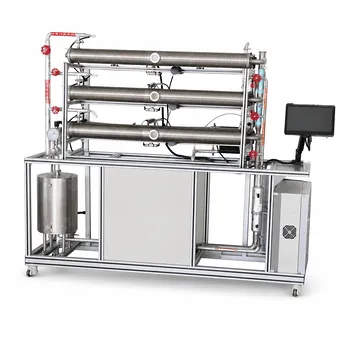
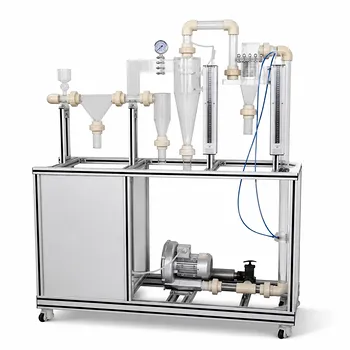
The centrifuge is not just a separation device; it's a pedagogical instrument that teaches students about force, phase behavior, and process control. When choosing between tubular, scraper discharge, and piston pusher centrifuges for a university pilot plant, the decision must be driven by a clear understanding of your feedstock’s physical properties, your desired throughput and operational mode, and the specific unit operation concepts you need to demonstrate.
A pilot plant centrifuge selection is a deliberate trade-off between separation intensity, particle integrity, and operational flexibility. Tubular centrifuges deliver extreme G‑forces for emulsions and fine particles but operate in batch mode. Scraper centrifuges offer automated, full‑cycle operation at the cost of crystal breakage. Piston pusher models provide gentle, continuous cake filtration yet demand remarkably tight feed control.
Understanding the Three Centrifuge Options
The Tubular Centrifuge: Extreme Force, Minimal Throughput
Tubular centrifuges generate an exceptionally high separation factor—typically 15,000 to 60,000 g—by spinning a long, slender bowl at enormous speeds.
This intense force field makes them ideal for separating immiscible liquids (emulsions) or clarifying dilute suspensions containing very fine particles. They can polish a liquid stream to a degree that no other configuration can easily match.
The penalty is low volumetric capacity. A tubular centrifuge is inherently a batch machine; once the bowl’s limited solids-holding space fills up, you must shut down, disassemble, and manually clean it. This makes them perfect for demonstrating high‑G separation physics but impractical for any process requiring significant throughput or continuous operation.
The Horizontal Scraper Discharge Centrifuge: The Automated Workhorse
A horizontal scraper centrifuge operates as a fully automatic batch machine that executes every step—feeding, separating, washing, and scraping—all while the basket spins at full speed.
This confers high throughput and gives students a front-row seat to a complete, industry‑relevant duty cycle. The machine literally scrapes the cake off the filter medium with a mechanical blade, then re‑accelerates for the next batch.
The critical limitation: the scraper mechanism damages crystals and fragile particles. If your research or teaching demonstration requires preserving particle size distribution or crystal structure, this aggressive cake discharge method is non‑negotiable. The scraper will fracture your product.
The Piston Pusher Centrifuge: Gentle, Continuous, but Deeply Fussy
The piston pusher centrifuge achieves true continuous operation by pushing accumulated solids axially off the basket in small, discrete strokes without stopping the rotation.
It runs on low power consumption and causes minimal crystal damage, making it the configuration of choice when you need to demonstrate continuous cake filtration with product integrity intact.
However, it imposes a razor‑thin operating window on feed concentration. A feed that is too dilute will fail to form a coherent filter cake inside the basket, while an overly concentrated feed causes poor flow distribution and excessive vibration. This sensitivity can be a powerful teaching point, but in a pilot plant environment it demands an upstream suspension preparation system that can reliably hit the target concentration every time.
The Decision Matrix: Matching Centrifuge to Mission
Feedstock Properties: What Are You Actually Separating?
Your raw material dictates everything.
Tubular is the only serious choice when dealing with stable emulsions or extremely low solids concentrations where particles are smaller than a few microns.
Scraper discharge excels with moderately concentrated, fast‑settling, robust solids that can tolerate mechanical scraping. It is a poor fit for needle‑like crystals or any particle with commercial value tied to its size.
Piston pusher is designed for free‑flowing, crystalline solids that filter rapidly and form a competent cake at intermediate slurry concentrations. If your feed is a sticky, amorphous solid or its concentration wanders, you will fight the machine constantly.
Throughput and Operational Mode: Batch vs. Continuous
Your curriculum may need to demonstrate either batch processing cycles or continuous steady‑state operation.
A tubular centrifuge is an unbending batch device, ideal for labs where the focus is on the separation quality of a single sample.
The scraper centrifuge automates batch operation to a high degree, allowing students to program and observe a multi‑step cycle (fill–spin–wash–spin–scrape) in a single lab period.
A piston pusher centrifuge is a true continuous machine. It is the right choice if you must demonstrate material-in/material-out operation, teach steady‑state mass balances around a continuous filter, or integrate the centrifuge with a continuous upstream reactor.
Academic and Research Outcomes: What Concept Steals the Show?
Each centrifuge type illuminates a distinct physical principle.
Select tubular when your core educational goal is to teach Stokes’ law, high‑G clarification, and the difference between sedimentation and filtration at a fundamental level.
Select scraper when you need to showcase full‑cycle automation, cake washing efficiency, and the influence of filter media on industrial batch processing.
Select piston pusher when you want students to grapple with continuous cake filtration, feed conditioning, and the hydraulic design of a moving bed—and to experience first‑hand the drama of a filter cake that won’t form or that refuses to leave the basket gracefully.
Understanding the Trade-offs
The Capacity Gorge: Tubular’s Inherent Bottleneck
The tubular centrifuge’s minuscule solids holding volume makes it wholly unsuitable for pilot‑scale production runs.
You must budget for extensive downtime between runs for manual cleaning, which limits how many student groups can use the equipment in a single day. Its unique ability to spin out difficult emulsions often forces labs to accept this severe capacity constraint.
Crystal Mutilation: When a Scraper is the Enemy of Innovation
Any research project involving crystallization of pharmaceuticals, fine chemicals, or bioproducts where crystal size distribution is a critical quality attribute must categorically avoid a scraper discharge centrifuge.
The blade’s mechanical action introduces unpredictable crystal breakage that cannot be modeled or scaled. Teaching students that this damage is an inherent trade-off of automation is itself a valuable lesson, but it is a painful one if your own research product depends on intact crystals.
The Goldilocks Feed: Piston Pusher’s Sensitivity Trap
A piston pusher centrifuge demands that the feed concentration be “just right.” Too dilute, and you will watch a slurry shoot straight through the filter, failing to form a bed; too thick, and the pusher mechanism will bind or vibrate destructively.
In a teaching lab, where students themselves may prepare the feed, this sensitivity can become a source of frequent operational failure unless you install a robust upstream thickening or dilution stage and invest heavily in training. The machine’s elegance comes at the price of uncompromising feed discipline.
How to Align Your Choice with Your Lab’s Mission
Your final selection emerges directly from your primary educational and research objectives.
- If your primary focus is demonstrating ultra‑high‑G separation of emulsions or fine particle suspensions: Choose a tubular centrifuge. Accept its batch, low‑capacity nature as the price of an unmatched separation factor that makes fluid physics tangible.
- If your primary focus is teaching full‑cycle automated batch operation with cake washing and drying: Choose a scraper discharge centrifuge, but only if particle breakage is acceptable or even a deliberate teaching point about industrial realism.
- If your primary focus is showcasing continuous, high‑throughput cake filtration with minimal particle damage: Choose a piston pusher centrifuge, and pair it with a precisely controlled feed system. Use its extraordinary sensitivity to turn every misformed cake into a troubleshooting masterclass.
- If your curriculum or research portfolio spans several of these extremes: Consider configuring the pilot plant with two complementary units—for instance, a tubular centrifuge for emulsion studies and a piston pusher for crystalline product work—understanding that no single machine masters all separation challenges.
The centrifuge you choose becomes the central character in a story your students will tell about forces, flow, and the practical art of separation. Choose the one that best narrates the chapter you need them to remember.
Summary Table:
| Centrifuge Type | Operating Mode | G-Force / Separation Intensity | Key Strength | Main Limitation |
|---|---|---|---|---|
| Tubular | Manual Batch | Extreme (15,000 - 60,000 g) | Ideal for emulsions & fine particles | Low capacity; manual cleaning required |
| Scraper Discharge | Automated Batch | Moderate | High throughput; automated cycling | Causes crystal/particle breakage |
| Piston Pusher | Continuous | Moderate | Gentle filtration; steady-state run | Highly sensitive to feed concentration |
Equip Your Lab with Precision Engineering from LABPARK
Selecting the right separation technology is critical to bridging the gap between classroom theory and industrial reality. LABPARK designs and provides premium Educational and Vocational Unit Operations Pilot Plants in chemical engineering, bioprocess & biotech, and environmental & water treatment.
Whether you represent a university, research institute, or enterprise, we deliver custom-engineered pilot solutions designed to meet your precise teaching curricula and research specifications.
Ready to optimize your lab configuration? Contact our technical experts today to find the perfect system for your institution.
Related Products
- Centrifugal Pump Performance Determination Educational Unit Operations Pilot Plant
- Chemical Pipeline Assembly and Fluid Transport Practical Training Unit Operations Pilot Plant
- Natural Product Extraction Unit Operations Training Pilot Plant
- Constant Pressure Filtration Educational Unit Operations Pilot Plant
- Multi-Functional Drying Educational Unit Operations Pilot Plant
People Also Ask
- Why start a centrifugal pump with a closed outlet valve? Protect your pilot plant motors.
- How can cavitation and slurry erosion be studied and mitigated using fluid transport and centrifugal pump pilot plants?
- How does fluid density affect pump head and pressure? Avoid Pilot Plant Motor Overload
- How does fluid viscosity affect centrifugal pump performance? Key pilot plant correction methods.
- How does fluid density affect centrifugal pump performance & motor safety in pilot plants?