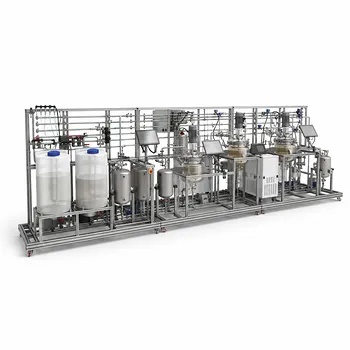
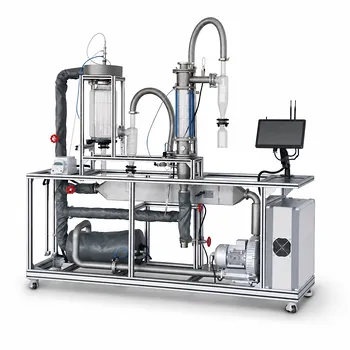
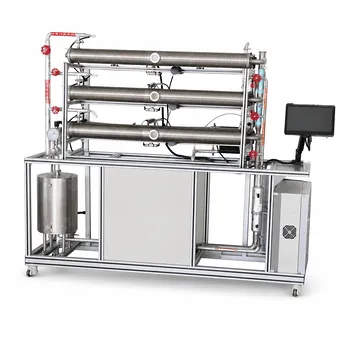
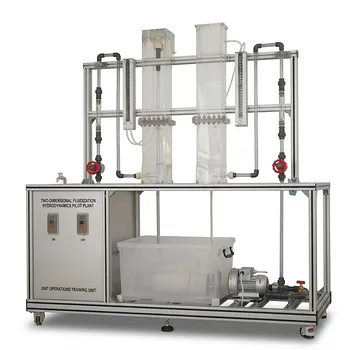
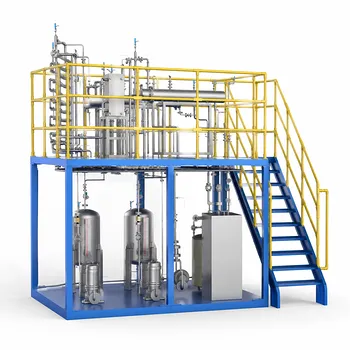
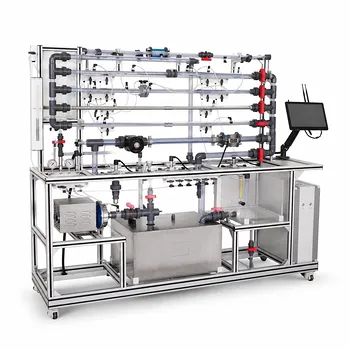
The answer lies in shifting the focus from merely measuring final product attributes to actively mapping and controlling the relationship between raw material properties and the process itself.
In a unit operations pilot plant, QbD isn't taught as a passive theory but as an active physical investigation. Students deliberately introduce systematic variations in raw materials—like different particle size distributions, bulk densities, or moisture contents—into the first unit operation. They then use the downstream train of connected unit ops (milling, blending, granulation, drying) to observe and measure how that variability propagates. By applying statistical Design of Experiments (DoE) and multivariate analysis, they establish the quantitative, cause-and-effect link between a raw material's multidimensional properties and the final product's Critical Quality Attributes (CQAs). This creates a functional model that defines which raw material characteristics are truly "critical" and the exact process adjustments needed to neutralize their impact.
The core insight is that QbD treats raw material variability not as a problem to be eliminated, but as a known input to be managed. Pilot plants teach this by letting students physically build a "design space"—a proven, multidimensional operating envelope where process parameters flex to absorb that variability, consistently delivering a quality product.
The Core QbD Philosophy Shift: From Detection to Design
The traditional approach tests quality in after the fact. QbD, as implemented in a pilot plant, requires a completely different mindset.
Proving Variability's Impact, Not Just Assuming It
A pilot plant’s primary educational value is its ability to turn "what-if" scenarios into observable data. Students don't just read that an inconsistent particle shape causes poor blend uniformity; they run two batches with otherwise identical fixed conditions, changing only the particle shape.
By measuring the downstream impact—segregation in the blender, tablet weight variation in the compactor—they gain physical, intuitive proof of the linkage. This transforms an abstract concept into a tangible engineering problem that demands a systematic, science-based solution, not just a workaround.
Defining the True Design Space
The ultimate goal is to move beyond single-setpoint operation. The pilot plant becomes a physical calculator for defining a multidimensional Design Space.
This space isn't just a chart of acceptable process parameters (temperature, flow rate, RPM). It's a matrix showing the safe combinations of raw material properties and their corresponding process setpoints. A batch of material with a high fines content might be shown to need a lower granulation spray rate, while a batch with larger crystals needs a higher compaction force. The pilot plant experiments map these specific control strategies.
Hands-On Methodology: How Variability is Studied
The teaching method is deeply experiential and builds a complete competency around managing complexity.
The Dependency on Multivariate Thinking
Raw material variability is never univariate. A new lot might simultaneously have a different particle size, a higher moisture level, and a lower bulk density. A pilot plant's connected sensors show that these factors interact.
Students use Latent Variable Modeling (LVM) to analyze the correlated data streams from the pilot plant's sensors. They learn that you can't optimize for particle size alone; you must model the combined, latent property that actually drives process behavior. This is a critical leap from textbook theory to industrial reality.
Developing a Feedforward Control Strategy
The real implementation of QbD is in proactive control. The pilot plant software is used to close the loop. Students will measure an incoming raw material property—say, the real-time particle size from an upstream analyzer.
This data is then fed into a model that automatically calculates and adjusts a downstream Critical Process Parameter (CPP), like the mill’s impeller speed. They observe how this feedforward control loop compensates for the raw material's deviation before it ever has a chance to create a non-conforming product, directly simulating advanced industrial automation.
Bridging ICH Guidelines to Physical Reality
Regulatory frameworks like ICH Q8 become operational, not just aspirational. The pilot plant translates the formal QbD lifecycle into a physical project. Students start by defining a Quality Target Product Profile (QTPP), then run the plant to identify CQAs and CPPs.
They physically execute a DoE to map the design space and finally, they intentionally introduce disturbances to test a control strategy on the actual hardware. This end-to-end experience demystifies the "science- and risk-based" language of the guidelines, grounding it in the practical challenges of material handling, sensor delay, and process dynamics.
Common Pitfalls and Trade-offs
A truly objective understanding of this method requires acknowledging its limitations and potential for misapplication.
The Trap of Over-Engineered Models
A significant risk is creating a statistical model so complex it becomes impractical. Students may be tempted to link every measurable raw material property to every process parameter. A key lesson from the pilot plant is to distinguish between a statistically significant variable and a practically relevant one. A connection that the pilot plant reveals as having a minuscule effect on the final CQA, even if statistically valid, is noise that shouldn't clutter a control strategy.
The Representation Gap
The data from a pilot-scale excipient caking event might not perfectly mirror a full-scale production hopper's behavior. The physical forces (e.g., wall friction in a large bin vs. a small funnel) don't scale linearly. Effective teaching with a pilot plant must explicitly address this scale-up risk. The principle of managing variability holds, but the precise numerical control models developed at pilot scale are a starting point, not a finalized commercial solution, for certain unit ops.
Sensor and Analytics Suitability
The ability to implement a real-time control strategy is only as good as the sensors available on the pilot plant. If the most critical raw material attribute is a subtle polymorphic change, but the plant only has a simple particle size analyzer, the observed "design space" will have a dangerous blind spot. Students must learn to critically assess the limitations of the analytical technology in situ and understand that what you can't measure online, you can't control in real time.
Making the Right Choice for Your Learning Objective
Your approach to using a pilot plant to teach QbD should be driven by the specific skill you want to build.
- If your primary focus is developing basic process understanding: Run a simple full-factorial DoE with one raw material attribute and two process parameters. Focus on manually plotting the resulting CQA data to visualize the edges of a simple, three-dimensional design space.
- If your primary focus is building advanced control skills: Use a pilot plant equipped with a flexible automation platform. Integrate an incoming material analyzer with a feedforward control loop on the next unit op, and challenge students to write the model equation that links the two.
- If your primary focus is on regulatory application: Structure the entire lab session around the formal ICH Q8 steps. Require students to produce a documented filing just as they would for a regulatory submission, including the QTPP, risk assessment, DoE plan, and a statistically justified design space to demonstrate process robustness.
True mastery is demonstrated when a student can independently prove, on the pilot plant floor, that a robust process isn't the one with the tightest fixed setpoints, but the one that intelligently adapts to the allowable, multifaceted variation in its raw materials.
Summary Table:
| Learning Objective | Pilot Plant Implementation Focus | Key Student Outcome |
|---|---|---|
| Process Understanding | Run simple DoE with raw material attributes | Visualizing design space edges |
| Advanced Control Skills | Integrate analyzers with feedforward loops | Writing predictive model equations |
| Regulatory Application | Align plant runs with ICH Q8 guidelines | Documenting QTPP, CQAs, and CPPs |
Bring Industrial-Grade QbD Training to Your Lab
Teaching Quality by Design (QbD) requires hands-on, physical experimentation that textbooks simply cannot replicate. LABPARK provides state-of-the-art Educational and Vocational Unit Operations Pilot Plants in chemical engineering, bioprocess & biotech, and environmental & water treatment.
Developed for universities, research institutes, and enterprises, our plants enable students to physically map raw material variability, run DoEs, and implement real-world feedforward control.
Ready to elevate your laboratory? Contact us today to configure the perfect pilot plant for your institution!
Related Products
- General Purpose Cosmetics Production Unit Operations Training Pilot Plant
- Multi Pump Fluid Transport Process Piping Unit Operations Training Pilot Plant
- Multi-Functional Drying Educational Unit Operations Pilot Plant
- Fixed-Bed Chemical Reaction and Gas Dust Tar Removal Unit Operations Pilot Plant
- 100L Continuous Loop Hydrogenation Educational Unit Operations Pilot Plant
People Also Ask
- How do deviations in estimating latent heat impact pilot plant thermal systems? Avoid hardware mis-sizing.
- Why is the chemical plant startup schedule crucial? De-risk scale-up with pilot plants.
- When to transition from PID to adaptive control in pilot plants? Key process indicators.
- Why Compare Predicted and Experimental Excess Enthalpy? Key to Accurate Pilot Plant Scale-up
- Why Use PTFE & Hastelloy in Chemical Pilot Plants? Prevent Corrosion & Ensure Safety