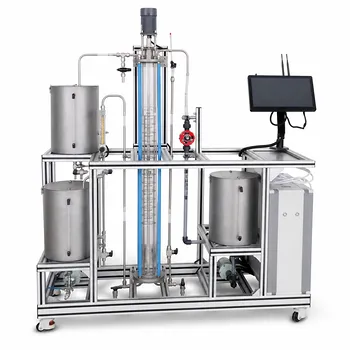
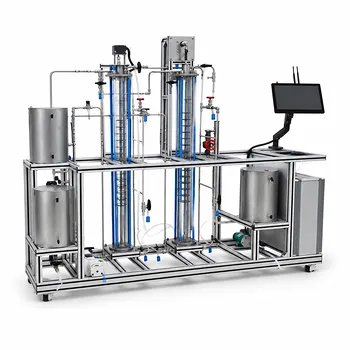
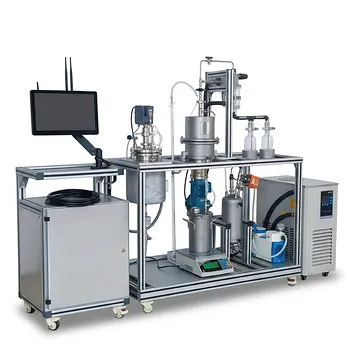
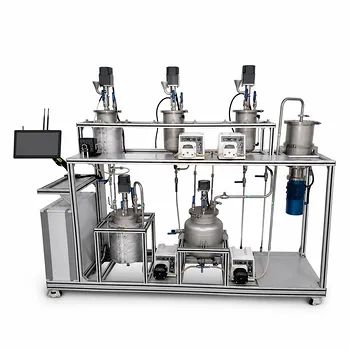
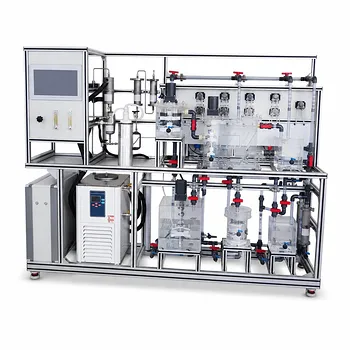
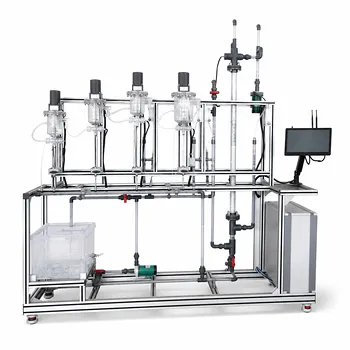
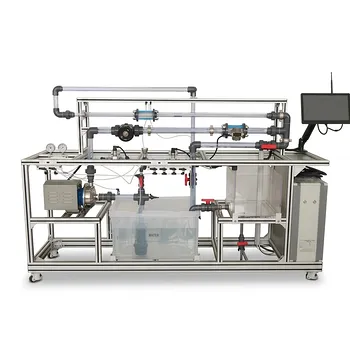
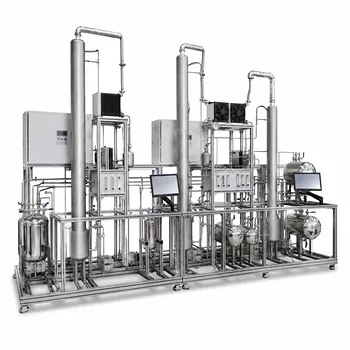
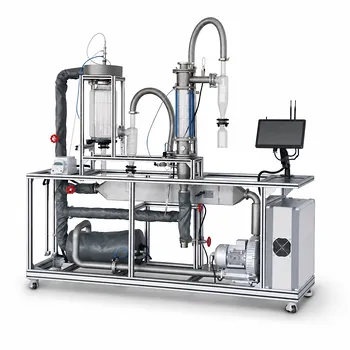
The familiar spin of a lab rotary evaporator is, at its core, a delicate balancing act of thin-film evaporation and controlled vacuum. In chemical engineering education, this benchtop concept is scaled up using industrial pilot-scale falling film evaporators, rising film evaporators, and batch distillation columns. These unit operations pilot plants transform the simple lab technique into a robust teaching platform, allowing students to tackle real-world parameters like heat transfer coefficients, steam economy, and condensation efficiency under continuous or semi-batch conditions.
The laboratory rotary evaporator's principle — maximizing surface area under vacuum to gently strip solvents — is directly mirrored in pilot plants by thin-film and forced-circulation evaporators. This transition shifts the educational focus from a single vapor-removal step to the comprehensive study of energy integration, mass balance, and industrial solvent recovery, preparing students for the scale of chemical and pharmaceutical manufacturing.
From Benchtop to Pilot Scale: The Core Transition
The Rotary Evaporator in the Lab
In a teaching lab, a rotary evaporator spreads a solvent mixture into a thin film on a heated flask wall under reduced pressure. The rotation prevents bumping and maximizes the heat transfer area, while the vacuum lowers the solvent’s boiling point. This gentle, batch-wise concentration step is perfect for small volumes and thermally sensitive extracts.
The Industrial Analogy: Unit Operations Pilot Plants
To scale this for education, chemical engineering pilot plants replace the glass flask with continuous, large-surface-area evaporators. A falling film evaporator, for example, distributes the feed liquid as a thin film down the inside of heated tubes, precisely replicating the lab’s thin-film principle on a continuous basis. Rising film and forced circulation evaporators offer alternatives for different feed properties. Batch distillation columns, another common choice, handle solvent recovery and purification in a single tall column, teaching vapor-liquid equilibrium and reflux control.
What Students Learn: Bridging Theory and Industrial Reality
Heat Transfer Dynamics and Steam Economy
Pilot plants make abstract theory tangible. Students directly measure overall heat transfer coefficients by logging steam consumption, feed rate, and temperature profiles. They evaluate steam economy — the kilograms of solvent evaporated per kilogram of steam used — a critical metric for minimizing energy costs. Comparing a single-effect evaporator with a multi-effect setup or vapor recompression teaches them to optimize thermal efficiency, directly linking thermodynamics to operational decisions.
Vacuum System Management
Managing a plant-scale vacuum system is far more complex than a lab pump. In a pilot distillation column or falling film evaporator, students must balance vacuum level against the risk of foaming, entrainment, and thermal degradation. They learn to adjust steam pressure and condenser cooling water to maintain stable pressure, uncovering how vacuum leakages and non-condensable gases can cripple solvent recovery rates.
Process Control, Purity, and Metrics
Hands-on experience with reflux ratios, column packing dynamics, and continuous feed rates teaches students to achieve target solvent purity and recovery yields. They can also calculate Process Mass Intensity (PMI) and evaluate energy-to-purity trade-offs. By comparing atmospheric distillation, vacuum pressure swing distillation, or even vapor permeation across different pilot runs, they develop the ability to design sustainable, closed-loop industrial processes where recovered solvent quality dictates the economic and environmental outcome.
Understanding the Trade-offs in Pilot Plant Design
Pilot plant instruction also confronts students with real engineering compromises.
- Residence time vs. degradation: For thermally sensitive feeds, falling film or scraped film evaporators are preferred because their short residence time and low liquid holdup minimize heat damage. In contrast, a simple batch distillation may hold the liquid at boiling point for much longer, causing loss of target compounds.
- Fouling and cleansability: Solutions prone to scaling demand forced-circulation evaporators with high tube velocities (typically 2.0–3.5 m/s) to reduce deposit formation. These units are designed for mechanical cleaning, but they consume more pumping energy.
- Flexibility vs. operational simplicity: A multi-purpose batch distillation pilot plant can teach a wide range of separation techniques (azeotropic distillation, solvent exchange), but its start-up and shutdown times are longer compared to a dedicated continuous film evaporator, influencing class scheduling and experimental throughput.
- Cost vs. realism: Larger, fully instrumented pilot plants replicate industrial conditions closely but require significant utility infrastructure (steam, cooling towers, robust vacuum systems). Smaller educational units may sacrifice some realism for safety and space, yet still demonstrate the core principles.
How to Apply This to Your Educational or Research Goal
Choosing the right pilot-scale setup depends on what you need your students or researchers to internalize.
- If your primary focus is energy efficiency and cost analysis: Prioritize a pilot falling film evaporator equipped with a steam meter and multi-effect capability. It directly teaches steam economy and heat integration.
- If your primary focus is high-purity solvent recovery for demanding separations: Select a batch distillation pilot column with adjustable reflux ratio and multiple feed points. This enables study of fractional separation, azeotropic behavior, and solvent exchange.
- If your primary focus is handling heat-sensitive or viscous materials: Implement a scraped-film or falling film evaporator with precise temperature control. Students will learn to balance evaporation rate with product quality.
- If your primary focus is waste minimization and closing the solvent loop: Integrate the pilot plant into a process flow that includes extraction and purification steps. Let students measure PMI and test strategies like reducing solvent diversity to simplify recovery.
The rotary evaporator teaches a single technique; a well-chosen unit operations pilot plant teaches the entire decision-making framework behind industrial solvent management.
Summary Table:
| Feature / Metric | Laboratory Rotary Evaporator | Unit Operations Pilot Plant |
|---|---|---|
| Operation Mode | Batch-wise (small volumes) | Continuous or semi-batch (industrial scale) |
| Film Mechanism | Rotating glass flask | Heated tubes (falling/rising film or scraped film) |
| Focus Area | Solvent removal & basic extraction | Heat transfer coefficients, steam economy, reflux control |
| Control Systems | Manual/simple vacuum control | Advanced vacuum management & integrated process control |
Bring industrial-scale learning and research to your laboratory with LABPARK. We design and manufacture high-quality Educational and Vocational Unit Operations Pilot Plants in chemical engineering, bioprocess & biotech, and environmental & water treatment. Built specifically for universities, research institutes, and enterprises, our systems bridge the gap between benchtop concepts and industrial reality. Ready to enhance your engineering curriculum or process development? Contact our team of experts today to find the perfect pilot plant solution for your facility!
Related Products
- Educational Rotary Disc Liquid-Liquid Extraction Pilot Plant
- Comprehensive Liquid-Liquid Extraction Pilot Plant for Engineering Education
- Rising and Falling Film Evaporation Educational Unit Operations Pilot Plant
- Natural Product Extraction Unit Operations Training Pilot Plant
- Supercritical High-Gravity Flash Evaporation Educational Unit Operations Pilot Plant
People Also Ask
- How do density and IFT affect liquid-liquid extraction pilot plants? Optimize Column Performance
- How are ternary phase diagrams and LLE data applied in extraction experiments? Optimize Pilot Plant Scale-up
- In a liquid-liquid extraction pilot plant, how is a ternary-phase diagram utilized to determine solvent feed requirements?
- How Do Selectivity & Distribution Coefficients Influence LLE Pilot Plant Solvent Choice?
- How to Validate BIPs for LLE Pilot Plants? Steps to Align Simulations with Reality