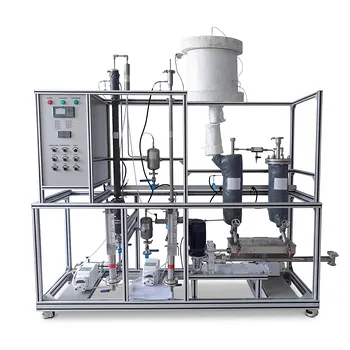
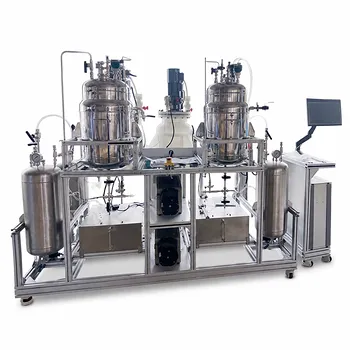
While cooling jackets and coils are the first line of defense, safe temperature control during highly exothermic nitrations in a pilot plant hinges on an integrated strategy. It combines robust heat removal equipment, meticulously controlled reagent addition, real-time chemical monitoring, and hard-wired safety interlocks that prevent the temperature from ever approaching the point of no return.
Safe nitration is not just about having enough cooling power—it’s about engineering a multi-layered safety envelope. The goal is to keep the reaction temperature at a safe distance from the initiation temperature of secondary decomposition exotherms, using both hardware and procedural controls to manage an adiabatic temperature rise that can easily exceed 100°C.
Understanding the Thermal Hazard of Nitration
The Fundamental Energy Release
Nitration reactions are inherently dangerous because they release a massive amount of energy rapidly. For context, the nitration of benzene liberates approximately 134 kJ/mol. This heat comes from the exothermic reaction itself and from the dilution heat of the mixed acids used as the nitrating agent. If this energy is not removed as fast as it is generated, the reaction mass will heat up exponentially.
Why “Just Hot” Becomes “Runaway”
The danger isn’t simply a temperature spike—it’s a cascade. Above a certain critical temperature, the reaction rate accelerates according to Arrhenius kinetics, generating even more heat. For common nitration products, these critical safety limits are well-defined: exceeding 120°C for dinitrotoluene synthesis or 80°C for dimethylnitrobenzene can trigger a thermal runaway. This leads to violent decomposition, hazardous pressure build-up, and potential loss of containment.
Pilot Plant Design for Heat Removal
Direct Heat Exchange Surfaces
The reactor itself must act as a calibrated heat exchanger. In a unit operations pilot plant, this is achieved through two primary surfaces:
- External jackets that circulate a cooling fluid (often chilled water or brine) around the vessel wall.
- Internal helical cooling coils submerged directly in the reaction mixture. These provide a much larger surface area for heat transfer and can handle the high heat fluxes generated by acid dilution and nitration kinetics.
The Gas-Liquid Synergy
In nitrations where gaseous byproducts or sparged air are present, the heat transfer coefficient actually improves. The rising gas bubbles increase turbulence in the liquid film near the cooling coil or jacket wall. This means that in a well-designed pilot reactor, the process-side heat transfer coefficient can be significantly higher than in a bubble-free system, helping to maintain near-isothermal conditions even during intense heat release.
Process Control and Monitoring Strategies
Metered Addition: Starving the Chemistry
One of the most powerful safety controls is to limit the rate of reaction by limiting the addition rate of the nitrating agent. Instead of charging all the mixed acid at once, a metered dosing pump feeds it in gradually. This prevents a large pool of unreacted material from accumulating, ensuring the cooling system can keep pace with the heat generation. For exceptionally hazardous syntheses, a common pilot-plant protocol is to charge no more than 20% of the reagent prior to reaction initiation, then assess the system’s cooling response before proceeding.
Intelligent Automation, Not Just Sensors
Automated cooling systems do more than just read a thermocouple. They use cascaded control loops that modulate coolant flow and temperature based on both the reactor temperature and the rate of temperature change (ΔT/Δt). This predictive logic allows the system to intervene during the initial heat-up phase, applying maximum cooling before the temperature reaches a critical limit, preventing the runaway inflection point.
The Eyes of Spectroscopy
Traditional temperature probes tell you what has already happened. In-line Fourier Transform Infrared (FTIR) spectroscopy tells you what is happening right now. By monitoring the real-time concentration of reactants, intermediates, and products, the system can detect a delayed exotherm—a silent accumulation of reactants that hasn’t yet released its heat. This early warning lets operators halt addition and apply full cooling long before a thermal spike occurs.
Safety Limits and Runaway Prevention
Defining the Safe Operating Window
For a highly exothermic reaction, the safe operating temperature is not an arbitrary number. It is determined by staying a safe distance below the initiation temperature of the secondary decomposition exotherm. This is mapped by differential scanning calorimetry and quantified by parameters like Time to Maximum Rate under adiabatic conditions (TMRad). A TMRad of less than 24 hours defines a highly hazardous process, mandating the strictest controls.
Respecting the Adiabatic Temperature Rise
Even with cooling, an operator must understand the theoretical worst-case scenario. If all cooling were lost and the reaction continued adiabatically, the temperature would spike. For a nitration with an adiabatic temperature rise (ΔTad) greater than 50°C, the cooling system’s capacity and the dosing rate must be designed so that the heat removal always outruns this potential spike. This is a core teaching objective in a unit operations pilot plant.
Understanding the Trade-offs
Cooling Power vs. Reaction Rate
Aggressive cooling to hold the temperature at an ultra-safe minimum can stall the desired reaction kinetics. This prolongs batch time and reduces throughput. The ideal setpoint is a balanced compromise where the reaction proceeds at an acceptable rate while maintaining a comfortable margin from the decomposition temperature.
Internal Coils vs. Cleanability
Internal helical coils dramatically improve heat transfer, but they also introduce challenges. They can impede mixing, create dead zones, and make thorough cleaning between batches difficult—a crucial factor when switching between different nitration substrates to avoid cross-contamination.
Automation Complexity
While automated safety shutdowns are critical, an over-reliance on software without robust hardware failsafes creates a false sense of security. A well-designed pilot plant pairs automated control with independent hard-wired high-temperature cut-off switches and mechanical relief systems, ensuring that a software glitch can never disable the last layer of safety.
Making the Right Choice for Your Pilot Operation
The optimal control strategy depends on the primary goal of the pilot study.
- If your primary focus is maximum inherent safety for a new substrate: Design the batch with a slow, metered addition rate and an initial reagent charge limited to 20% or less. Combine this with in-line FTIR analysis to detect any reactant accumulation before it becomes a thermal runaway.
- If your primary focus is optimizing yield and selectivity under near-isothermal conditions: Maximize heat transfer surface area with internal cooling coils and a high-turbulence jacket. Use cascade control to maintain a tight temperature band within +/- 2°C, suppressing unwanted side reactions like polymerization.
- If your primary focus is educational demonstration of runaway dynamics: Configure the pilot plant to allow safe, controlled upset conditions. Demonstrate the principle of TMRad by briefly pausing cooling and logging the temperature rise, showing how quickly an exotherm can accelerate above a critical threshold.
Mastering nitration temperature control is about building a culture of defense in depth, where every pilot plant run reinforces the instinct that a stable process is a continuously managed one.
Summary Table:
| Control Strategy | Mechanism & Action | Key Safety Benefit |
|---|---|---|
| Direct Heat Removal | External jackets and internal cooling coils | Maximizes heat transfer area to absorb rapid exotherms |
| Metered Addition | Dosing pumps limit initial reactant charge to <20% | Prevents accumulation of unreacted material |
| Cascade Controls | Coolant flow modulated by rate of temp change (ΔT/Δt) | Intervenes predictively before reaching runaway thresholds |
| In-Line FTIR | Real-time spectroscopy monitoring | Detects delayed exotherms prior to temperature spikes |
| Hard-Wired Interlocks | Independent analog high-temperature cutoffs | Ensures fail-safe shutdown even during software failures |
Build a Safer Chemical Engineering Laboratory with LABPARK
Teaching thermal safety and runaway dynamics requires reliable, industry-grade equipment. LABPARK provides state-of-the-art Educational and Vocational Unit Operations Pilot Plants across chemical engineering, bioprocess & biotech, and environmental & water treatment. Built specifically for universities, research institutes, and enterprises, our pilot plants feature industrial-grade safety interlocks, precise automation, and robust heat-removal systems to ensure a secure hands-on learning environment.
Equip your institution with the best in safety and process control. Contact LABPARK today to customize your unit operations pilot plant!
Related Products
- Natural Product Extraction Unit Operations Training Pilot Plant
- Continuous Batch Extractive Distillation Educational Pilot Plant
- Multi-Functional Special Distillation Educational Pilot Plant
- Ethyl Acetate Synthesis Unit Operations Pilot Plant for Practical Training
- Methanol Synthesis and Catalyst Performance Evaluation Educational Unit Operations Pilot Plant
People Also Ask
- How to Demo Solubility Sensitivity in SFE Pilot Plants? Practical Thermodynamics
- How do pilot plants differentiate physical vs chemical extraction? Enhance Chemical Engineering Training
- How are HTU and NTU applied to determine extraction column height? Guide to Pilot Plant Scaling
- How do fluid transport principles apply to pilot plant configuration? Optimize your unit operations.
- How can Hotelling's T² & Q statistics detect pilot plant abnormalities? Optimize Safety