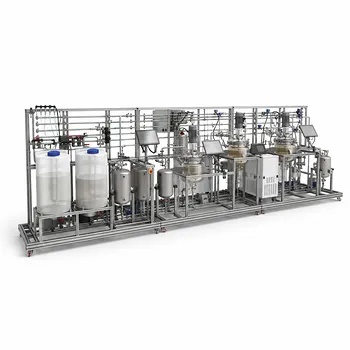
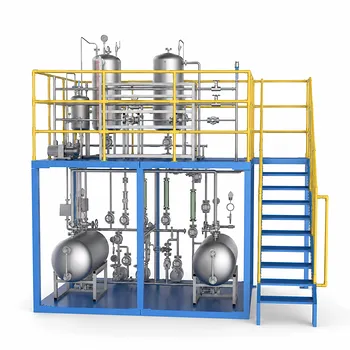
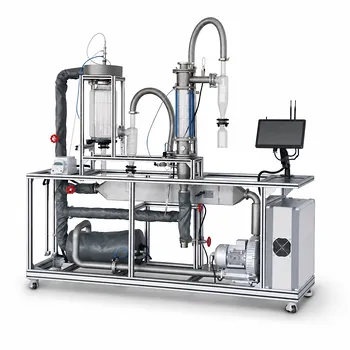
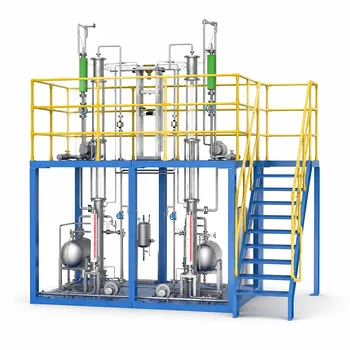
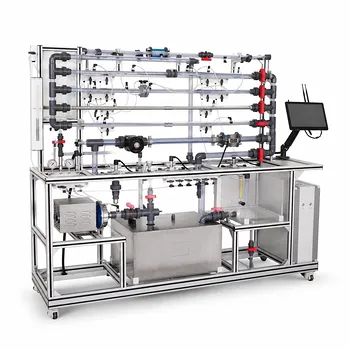
Pilot plants are the critical bridge between a promising sensor and a proven process control strategy. While a laboratory bench can confirm that a near-infrared (NIR) probe can detect moisture in a static powder sample, it falls short of answering the real questions: will that probe survive a 24/7 production environment, can it handle the vibration and flow dynamics of a fluidized bed dryer, and does the resulting data actually enable tighter control? A unit operations pilot plant answers these questions by subjecting Process Analytical Technology (PAT) to the messy, dynamic, and integrated reality of a flowing process, generating the feasibility data and proof of concept needed to justify full-scale investment.
Developing a PAT application is not just about proving a sensor works—it’s about proving it works under process conditions. Pilot plants provide that realistic proving ground, revealing the critical interaction between the analyzer, the unit operation, and the control system, and transforming a theoretical measurement into a practical, risk-mitigated control strategy.
The Feasibility Gap: Why Lab Tests Aren't Enough
The early development of any PAT application typically starts with a promising correlation in the lab. A Raman probe, for example, might perfectly track a reaction’s endpoint in a glass beaker. However, this clean correlation rarely survives first contact with a production environment.
The Hidden Challenges of Process Dynamics
Real process flows introduce variables that are absent in a static lab sample. A twin-screw granulator, for instance, creates a dense, moving mass with varying surface properties and temperatures. The vibration, fouling of optical windows, and sheer speed of material flow can degrade the signal-to-noise ratio of an inline probe to a point where the lab-proven model becomes useless.
This is not a failure of the sensor; it’s a failure to account for the process interface. The feasibility stage must therefore test not just the analytical principle, but the entire measurement chain—from the physical interface with the process stream to the data preprocessing required to handle real-world noise.
Compatibility with Routine Unit Operations
A pilot plant allows you to install a probe in a way that mimics a future production setup. You can evaluate how the analyzer performs during start-up, shutdown, and product changeovers. You can see if the continuous flow of powder in a drying stage causes static charge buildup that interferes with a capacitance measurement, or if a varying reactant feed rate causes spectral shifts that are misinterpreted as a change in product quality.
This compatibility testing is essential feasibility data. It generates a list of practical recommendations: the optimal flush-mount angle for a window, the required air-purge pressure to keep optics clean, or the specific data sampling rate needed to catch a fast-moving deviation.
From Proof-of-Concept to Robust Design Space
Once basic compatibility is confirmed, the development focus shifts to understanding how the PAT data means something. A pilot plant provides the multivariate, real-time dataset that is impossible to collect at the bench.
Defining a "Processing Window" with Multivariate Analysis
A single lab experiment might tell you that a specific NIR peak correlates to moisture content. A pilot-plant campaign, however, reveals that this peak also shifts slightly with changes in particle size distribution and bulk density—effects that are inherent to how the granulator operates over time.
By using multivariate tools like principal component analysis (PCA) on pilot-plant data, you can build models that separate these overlapping signals. This is how you define a true "design space": you don't just control for one quality attribute in isolation; you understand how raw material variability and process parameter interactions propagate through the unit operation and are captured by the PAT tool’s consolidated signal.
Capturing Scale-Up Phenomena
Scale-up is rarely linear. Mixing dynamics, heat transfer rates, and segregation behaviors change profoundly between a 1-kg lab mixer and a 50-kg pilot-scale fluidized bed. Many PAT failures occur because a model calibrated on a small, well-behaved powder bed is applied to a larger system with dead zones and channeling.
A pilot plant intentionally operates at the scale where these phenomena emerge. By monitoring, for example, moisture content at multiple points in a multi-chamber dryer using NIR, researchers can pinpoint where localized over-wetting or over-drying occurs. This data is not just for control; it’s for fundamental process understanding, allowing engineers to redesign the equipment or operation before a failed scale-up.
Training the Human Element of PAT
A sophisticated PAT system is worthless if the operators and engineers don’t trust it or know how to troubleshoot it. The feasibility and development stage is as much about building human confidence as it is about technical validation.
Building Intuition with Real-Time Feedback
In an educational or development pilot plant, users can deliberately induce a process upset—say, a step-change in binder addition rate—and watch in real time as the multivariate score plot drifts toward an "out of specification" zone. This live experience builds a visceral understanding of cause and effect that a static data report never could.
This hands-on practice demonstrates the transition from reactive, end-product testing to proactive, in-process control. Teams learn to interpret process trends, identify the root cause of deviations, and program feedback loops that automatically adjust feed rates or drying temperatures—closing the loop on the Quality by Design (QbD) vision.
Proving Continuous Process Verification (CPV)
A pilot plant allows you to run long-duration campaigns to simulate true continuous manufacturing. You can demonstrate that the PAT-based control system maintains product quality at the source over hours or days, rather than relying on a final lab assay to release the batch. This proof of continuous process verification is a powerful deliverable from a development study, providing direct evidence for a control strategy that can reduce end-product testing in a future GMP environment.
Understanding the Trade-offs and Limitations
A pilot-scale feasibility study is invaluable, but it is not a crystal ball. Objectivity demands acknowledging its boundaries.
The Cost and Time Investment
Pilot-plant trials require significant material, utility, and personnel commitments. Running a statistically designed set of experiments across a continuous granulation-drying line can cost tens of thousands of dollars in raw materials alone. The decision to pilot a PAT application must be balanced against the project’s risk profile and the cost of a potential failure at commercial scale.
The Remaining Scale-Up Risk
While a pilot plant de-risks the process, a 100-kg-per-hour line is not a 1000-kg-per-hour line. Extractive sampling from a pilot dryer might work reliably, but at production scale, the sheer volume of material could overwhelm the same physical interface. A pilot study must therefore be ruthlessly focused on identifying the fundamental, scale-independent principles (e.g., the spectroscopic signature of over-drying) versus the scale-dependent engineering details (e.g., the exact probe housing). The feasibility report should clearly delineate which recommendations are proven facts and which are extrapolations.
Not a Substitute for Fundamental Sensor Evaluation
A pilot plant cannot fix a fundamentally inadequate analytical technique. If a sensor lacks the chemical specificity to distinguish the product from a key impurity, no amount of process flow realism will change that truth. The pilot phase must be preceded by rigorous laboratory specificity and robustness studies. The pilot plant’s unique role is to validate the process interface, not the core analytical chemistry.
Making the Right Investment in Your PAT Development
Your approach to pilot-plant feasibility should be tailored to the specific risks and knowledge gaps in your project.
- If your primary focus is mitigating scale-up risk for a novel continuous process: Invest in a pilot study using the exact same style of inline probes and DCS integration you plan for production. Focus experiments on capturing multivariate interactions under maximum flow variability.
- If your primary focus is training a workforce for a QbD transformation: Use a unit operations pilot plant as a hands-on learning platform. Prioritize series of structured runs where participants build the chemometric models, program the control loops, and diagnose deliberate faults, building essential diagnostic intuition.
- If your primary focus is generating a regulatory-grade feasibility data package: Design your pilot-plant trials to explicitly demonstrate the definition of a proven acceptable range (PAR) and a control strategy that ensures CQAs are maintained, using the PAT tool as the primary control evidence. Document the interface robustness and probe maintenance procedures meticulously.
- If your primary focus is assessing vendor claims for a new analyzer: Insist on a side-by-side trial in a pilot-setting mimicking your most challenging process condition. Move beyond clean, optimized demonstrations to see how the technology handles real-world signal noise, drift, and routine operator interactions.
The jump from a promising laboratory correlation to a reliable process control strategy is a journey of understanding your process’s real-world signature, and a unit operations pilot plant is the best translator you have.
Summary Table:
| Development Stage | Core Process Challenge | Pilot Plant Contribution |
|---|---|---|
| Feasibility Study | Sensor fouling, vibration, and dynamic flow | Validates sensor performance under real process conditions |
| Design Space | Scaling up and multivariate parameters | Generates real-time datasets for PCA/multivariate models |
| Operator Training | Lack of trust in automatic control loops | Provides hands-on practice with real-time feedback loops |
| Verification | Regulatory compliance & continuous runs | Demonstrates Continuous Process Verification (CPV) |
Accelerate Your Process & PAT Development with LABPARK
Bridging the gap between laboratory bench tests and full-scale industrial production requires reliable, real-world testing. LABPARK provides state-of-the-art Educational and Vocational Unit Operations Pilot Plants in chemical engineering, bioprocess & biotech, and environmental & water treatment.
Designed specifically for universities, research institutes, and enterprises, our pilot plants enable you to:
- Validate PAT sensors under dynamic, real-world process conditions.
- De-risk scale-up by building robust, multivariate design space models.
- Train operators and students with hands-on, real-time process control feedback.
Ready to elevate your research and process reliability? Contact LABPARK today to find the perfect pilot plant solution for your facility.
Related Products
- General Purpose Cosmetics Production Unit Operations Training Pilot Plant
- Multi Pump Fluid Transport Process Piping Unit Operations Training Pilot Plant
- Multi-Functional Drying Educational Unit Operations Pilot Plant
- Fixed-Bed Chemical Reaction and Gas Dust Tar Removal Unit Operations Pilot Plant
- 100L Continuous Loop Hydrogenation Educational Unit Operations Pilot Plant
People Also Ask
- Why is the chemical plant startup schedule crucial? De-risk scale-up with pilot plants.
- How do deviations in estimating latent heat impact pilot plant thermal systems? Avoid hardware mis-sizing.
- When to transition from PID to adaptive control in pilot plants? Key process indicators.
- Why Compare Predicted and Experimental Excess Enthalpy? Key to Accurate Pilot Plant Scale-up
- How to study gasification in pilot plants? Compare exit gas composition & efficiency