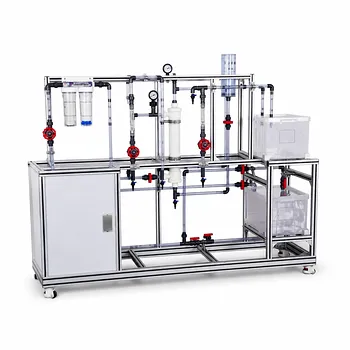
Ultrasound-Assisted Extraction (UAE) accelerates mass transfer in biotechnology primarily through a physical phenomenon known as acoustic cavitation. This process, driven by high-frequency sound waves, creates microscopic bubbles that violently collapse, generating powerful shear forces, micro-jets, and localized hotspots that physically disrupt cell walls and enhance solvent penetration. The key adjustable parameters for a laboratory UAE pilot plant are ultrasonic power (amplitude), wave frequency, duty cycle, extraction temperature, and the liquid-to-solid ratio—precise control of each is essential to maximize yield without degrading the target biomolecules.
While the mechanism of UAE is undeniably effective for process intensification, its success in a pilot plant hinges on balancing aggressive cell disruption with the preservation of delicate bioactives. The real challenge is not just understanding how cavitation improves mass transfer, but mastering the interdependent parameters that govern that improvement.
The Science Behind UAE’s Mass Transfer Enhancement
The core advantage of UAE in biotechnology is its ability to overcome the rate-limiting steps of conventional extraction. Instead of relying on slow diffusion across an intact cell wall, UAE physically transforms the solid matrix to make intracellular compounds instantly accessible.
How Acoustic Cavitation Works at the Microscopic Level
The applied ultrasound field creates compression and rarefaction cycles in the liquid medium. During the rarefaction phase, tiny gas nuclei grow into cavitation bubbles. When these bubbles can no longer absorb energy, they collapse implosively, releasing concentrated energy in a minuscule zone.
This collapse generates three primary mechanical effects:
- Micro-jets that erode the cell wall surface like a high-pressure water drill.
- Shear forces that tear apart the rigid polysaccharide and protein structures of plant, fungal, or microbial cells.
- Sonoporation, where the shockwaves create transient pores in the cell membrane, allowing the solvent to flood in and the target solutes to diffuse out rapidly.
Linking Cavitation to the Core Mass Transfer Equation
In any extraction, the mass transfer rate is proportional to the interfacial area for mass exchange ($a$) and the concentration driving force ($c_A^* - c_A$). UAE does not simply increase agitation; it fundamentally increases the effective interfacial area by converting a sealed intracellular compartment into an external, accessible surface.
By fragmenting cells and creating surface pores, UAE dramatically increases the specific surface area available for solvent-solute contact. This effect is especially critical in bioprocessing, where many valuable metabolites (polyphenols, alkaloids, therapeutic proteins) are stored inside tough vacuoles or organelles. The result is a faster achievement of equilibrium and, often, a higher final yield.
Key Adjustable Parameters in a Laboratory UAE Pilot Plant
A well-designed pilot plant must offer precise, independent control over five critical variables. Operators who treat these parameters as a single knob will never unlock the full potential of the technology.
Ultrasonic Power (Amplitude)
Power, expressed as the amplitude of vibration at the probe tip, directly governs the intensity of cavitation. Higher amplitude generates more violent bubble collapse, increasing the shear forces that tear apart cell walls. However, there is a sharp non-linear relationship: below a cavitation threshold, no extraction enhancement occurs, while excessive power can fragment the target molecule itself or create persistent cavitation clouds that shield the probe. Reproducible experimentation demands a probe capable of delivering 20–100% amplitude with a stable, feedback-controlled output.
Wave Frequency
Frequency determines the resonant size of the cavitation bubbles and the penetration depth of the acoustic field. Lower frequencies (20–40 kHz) produce larger, more energetic bubbles best suited for hard, lignocellulosic matrices. Higher frequencies (up to 120 kHz and beyond) create smaller bubbles that collapse with less mechanical force but greater chemical effect, favoring gentle extractions and enhanced radical generation. A pilot plant should allow switching between at least two distinct frequency ranges—or using a dual-frequency system—to match the mechanical sensitivity of the target biomolecule.
Duty Cycle (Pulse Mode)
Continuous sonication can raise the bulk liquid temperature uncontrollably and degrade thermolabile compounds. The duty cycle—the percentage of time the ultrasound is on versus off—solves this by introducing cooling intervals. For example, setting a 50% duty cycle with 10-second pulses means the probe is active for 5 seconds and resting for 5 seconds. This parameter decouples the beneficial mechanical effects of cavitation from the detrimental thermal effects, giving operators a critical lever to protect product integrity while still disrupting cells.
Extraction Temperature
Temperature plays a dual role: it increases the diffusion coefficient of solutes and softens cell walls, but it also reduces the cavitation threshold and increases the vapor pressure inside bubbles, making their collapse less violent. Optimal extraction temperature is always a compromise. A pilot plant must have a jacketed vessel with precise temperature control (±1°C) and an integrated cooling system, allowing users to map the yield-versus-temperature curve for each new feedstock.
Liquid-to-Solid Ratio
This parameter controls the concentration gradient that drives mass transfer. A higher solvent volume lowers the solute concentration in the bulk liquid, maintaining a larger driving force ($c_A^* - c_A$). However, excessive solvent dilutes the final extract, increasing downstream purification costs. A robust pilot plant design includes graduated vessels and variable-ratio dosing systems so students and researchers can systematically optimize the ratio for both yield and economic concentration.
Understanding the Trade-offs in UAE Process Design
A common pitfall is assuming that more ultrasound always means a better extraction. Achieving industrial relevance requires a clear-eyed view of the limitations.
Over-Cavitation and Product Degradation
While cavitation is the engine of extraction, it is also a source of hydroxyl radicals and localized hotspots that can oxidize or thermally denature delicate bioactives. Polyphenols, for instance, can undergo unwanted oxidative polymerization if sonication is too intense. The duty cycle and temperature must be tuned as a pair to suppress chemical degradation while maintaining mechanical disruption.
The Scale-Up Barrier
Laboratory UAE probes focus sonic energy into a small tip area. Scaling this to an industrial flow cell introduces challenges like acoustic shielding—where dense biomass slurries attenuate the sound waves before they reach the core of the material. A teaching pilot plant should therefore incorporate modular component designs (probes, horns, and flow cells) that let students directly measure the drop in cavitational activity with increasing scale, preparing them for real-world process engineering.
Energy Efficiency and Co-Solvent Systems
UAE is often marketed as energy-efficient, but the energy consumed per gram of extracted product can be high if parameters are not optimized. Simple maceration may still be more economical for very soft, easily permeabilized tissues. The pilot plant should also be compatible with co-solvent systems and pre-soaking stages, as these combinations occasionally outperform prolonged sonication in terms of both cost and final purity.
Making the Right Choice for Your Pilot Plant Operation
Your design and operational priorities will shift dramatically based on the primary goal of the extraction. Use the following guidelines to align the adjustable parameters with your specific objective.
- If your primary focus is maximizing yield: Start with a high amplitude at a low frequency (20 kHz) and a low liquid-to-solid ratio to maintain a steep concentration gradient, then systematically optimize temperature to improve solubility without killing cavitation.
- If your primary focus is preserving bioactivity: Prioritize a high duty cycle (e.g., 30–50% on-time) and active cooling to keep the bulk temperature below 25°C, even if it means sacrificing a few percentage points of absolute yield.
- If your primary focus is teaching scale-up principles: Choose a pilot plant that offers interchangeable probes and a flow-cell option. Task students with measuring the temperature and cavitation intensity profiles at different distances from the source to demonstrate the acoustic attenuation challenge.
- If your primary focus is method development for unknown samples: Use a wide-frequency, dual-mode system and run factorial experiments that map power and frequency against both extraction yield and antioxidant activity to find the “sweet spot” where cell disruption and molecule preservation balance perfectly.
Mastering UAE is about accepting that the perfect parameter set does not exist—it is a dynamic equilibrium you must find for each new biological system.
Summary Table:
| Parameter | Key Function | Optimization Goal |
|---|---|---|
| Ultrasonic Power | Controls cavitation intensity | Maximize disruption without degrading molecules |
| Wave Frequency | Determines bubble size & penetration | Match mechanical sensitivity of feedstocks |
| Duty Cycle | Introduces cooling intervals | Prevent thermal degradation of bioactives |
| Temperature | Affects diffusion & cavitation | Balance solubility and cavitation force |
| Liquid-Solid Ratio | Controls concentration gradient | Optimize yield vs. downstream processing cost |
Looking to equip your laboratory or training facility with advanced extraction systems? LABPARK provides state-of-the-art Educational and Vocational Unit Operations Pilot Plants in chemical engineering, bioprocess & biotech, and environmental & water treatment. Tailored for universities, research institutes, and enterprises, our pilot plants offer precise, independent control over critical process variables to ensure research accuracy and reliable scale-up data. Contact us today to find the perfect pilot plant solution for your needs!
Related Products
- Natural Product Extraction Unit Operations Training Pilot Plant
- Continuous Batch Extractive Distillation Educational Pilot Plant
- Multifunctional Membrane Separation Educational Pilot Plant with Ultrafiltration, Nanofiltration, Reverse Osmosis
- Multi-Functional Special Distillation Educational Pilot Plant
- Ultrafiltration Membrane Separation Educational Pilot Plant
People Also Ask
- How to Demo Solubility Sensitivity in SFE Pilot Plants? Practical Thermodynamics
- How do pilot plants differentiate physical vs chemical extraction? Enhance Chemical Engineering Training
- Why do emulsions form during extraction scale-up? Resolve pilot plant phase separation issues.
- What key factors contribute to emulsion formation during liquid-liquid extraction? Scale-up mitigation strategies.
- How are HTU and NTU applied to determine extraction column height? Guide to Pilot Plant Scaling