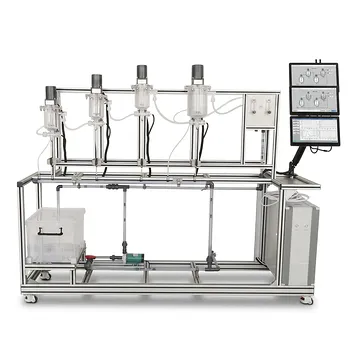
Accurate inventory monitoring in pilot plants often hinges on knowing the true mass of a chemical, not just its volume. The weighing method resolves density‑related inaccuracies by measuring mass directly (via load cells) or by converting hydrostatic pressure—both of which are inherently tied to the gravitational force of the liquid. Because the measurement principle is based on force (weight) rather than volume displacement, it becomes completely immune to density fluctuations caused by temperature changes or compositional variations.
When a storage vessel is equipped with load cells or a bottom‑mounted pressure transmitter, the reading reflects the actual product quantity by weight. This means an operator gets a reliable mass balance for reactions, custody transfer, or regulatory reporting, even as the liquid expands, contracts, or stratifies inside the tank.
Why Volume‑Based Measurements Mislead in a Pilot Plant
Pilot‑scale processes operate at small volumes where even minor errors can cascade into major product quality issues. Liquid density is rarely constant—it shifts with every batch, temperature spike, or solvent mix‑up.
The Hidden Instability of Density
In educational and R&D pilot plants, fluids are frequently heated, cooled, or blended. As temperature rises, liquid density decreases; the same mass occupies more volume. A sight glass or float‑type level sensor will show a higher level, even though no material has been added. Conversely, cooling makes the liquid contract, fooling the sensor into thinking the vessel has lost inventory.
The Consequence for Process Control
If a volume‑based level signal is used to pace dosing pumps or to track reaction progress, the operator sees a distorted picture. For a distillation column reboiler, a false low‑level reading during a cold start‑up might trigger an unnecessary feed addition. For a heat exchanger supply tank, a density‑induced volume swell could overfill the system. As the supplementary reference highlights, density directly impacts mass flow rate and pressure drop across piping and instrumentation—so a measurement that ignores density undermines every downstream calculation.
How the Weighing Method Eliminates Density Dependence
The core insight is simple: weigh the contents, don’t measure the depth. The weighing method bypasses density entirely by quantifying the gravitational force that the liquid exerts.
Direct Mass Measurement with Load Cells
Mount the storage vessel on three or four calibrated load cells. The total weight signal is:
Mass = (Load Cell Output – Tare Weight) / g
The reading is a pure mass value. Whether the liquid inside is hot hexane or cold water, the load cells register its actual weight. Temperature gradients, density gradients, or even partial phase changes (e.g., slurries) do not alter the force of gravity on the total mass. This makes load cells the gold standard for pilot‑plant inventory where stoichiometric precision is critical.
Hydrostatic Pressure: The Indirect Weighing Solution
A pressure transmitter installed at the very bottom of a vertical, constant‑cross‑section tank also delivers a mass‑based result. The hydrostatic pressure is:
P = (m × g) / A
where A is the known cross‑sectional area. Rearranged, m = (P × A) / g. Notice that density (ρ) does not appear in this equation—it is absorbed into the measured pressure. As long as the tank’s footprint is stable and the sensor is zeroed for the vapour space, the calculated mass remains accurate regardless of how the liquid’s density drifts. This approach combines the robustness of mass measurement with the simplicity of a single pressure tap, often using differential pressure cells that filter out vapour pressure effects.
Why It Matters for Pilot‑Plant Integrity
Both methods give a reading that is directly usable for material balances. You can confidently validate a pilot distillation’s separation efficiency, verify the solute concentration in an extraction column, or control a feed pump using the true mass flow. The measurement is no longer a fragile extrapolation from volume and assumed density—it is a direct process variable.
Understanding the Trade‑offs
No measurement technique is without limitations, and the weighing method is no exception. Being aware of these helps you deploy it wisely.
- Installation complexity and cost: Load cells require the entire vessel to be freely suspended, which can be challenging with hard‑piped connections. Flexible hose connections and mechanical isolation become necessary, adding upfront engineering effort. A bottom‑mounted pressure transmitter, while simpler, still demands a clean, non‑plugging process connection and compensation for the headspace pressure.
- Tare weight drift: If solids crystallize on the tank walls or a permanent coating builds up, the effective tare weight changes. The sensor reads the mass of the vessel plus contents, so you must periodically re‑zero or use corrosion‑resistant linings to keep the baseline stable.
- Sensitivity to vibration: In a pilot hall with fluid‑bed dryers, oscillating pumps, or nearby mixers, load cells can exhibit signal noise. Mechanical dampening and careful signal filtering are essential to prevent false mass fluctuations.
- Non‑vertical or irregular tank geometries: Hydrostatic mass calculation assumes a constant cross‑section. For conical bottoms, horizontal drums, or vessels with internal coils, the simple P×A relationship breaks down. In those cases, a multi‑point load frame or a geometric compensation algorithm becomes necessary.
Despite these caveats, the weighing method’s immunity to density changes makes it indispensable whenever the process demands true mass knowledge.
Making the Right Choice for Your Goal
Your decision between load cells and a bottom‑mounted pressure transmitter—or whether to adopt weighing at all—hinges on what you truly need to control.
- If your primary focus is absolute reaction stoichiometry: Invest in a high‑accuracy load cell system with robust tare‑zeroing routines. The direct mass reading eliminates all density guesswork and gives you the feed‑accurate numbers required for kinetic studies or regulatory batch records.
- If your primary focus is a simple, cost‑effective upgrade from a sight glass: Install a differential pressure transmitter at the tank base, provided the vessel has a uniform cross‑section. You will gain a density‑independent mass indication without the structural modifications load cells demand.
- If your tank experiences severe mechanical vibration or is in a classified area: Pair the load cell or pressure transmitter with an intrinsically safe barrier and apply digital filtering. For load cells, use vibration‑isolating mounts and a high‑sampling‑rate transmitter to smooth out mechanical noise.
- If your vessel geometry is complex or contains internal packing: Stick with load cells. The hydrostatic method alone cannot correct for varying area unless you build a detailed strapping table, which can be inaccurate when density changes alter the liquid’s centre of mass.
By selecting a mass‑based measurement path, you shift from wrestling with fluid property vagaries to managing a robust physical constant—the weight of the inventory. This is the simplest way to align your pilot plant’s instrumentation with the reality of what truly resides inside the tank.
Summary Table:
| Method | Measurement Principle | Key Advantage | Major Limitation |
|---|---|---|---|
| Load Cells | Direct mass via gravitational force | Immune to density, phase, & tank geometry | Complex installation; requires flexible piping |
| Hydrostatic Pressure | Pressure at tank base: P = (m * g) / A | Simple, cost-effective installation | Irregular geometries require calibration |
Optimize Your Pilot Plant Measurements with LABPARK
In precise R&D and educational environments, accurate mass balance is critical. LABPARK provides state-of-the-art Educational and Vocational Unit Operations Pilot Plants in chemical engineering, bioprocess & biotech, and environmental & water treatment. We tailor our systems for universities, research institutes, and enterprises to ensure maximum reliability, safety, and measurement precision.
Ready to eliminate density-related inaccuracies in your process? Contact our engineering experts today to discuss your custom pilot plant setup!
Related Products
- Water Electrolysis Hydrogen Production and Storage Educational Pilot Plant
- Multi Pump Fluid Transport Process Piping Unit Operations Training Pilot Plant
- Supercritical High-Gravity Flash Evaporation Educational Unit Operations Pilot Plant
- Rising and Falling Film Evaporation Educational Unit Operations Pilot Plant
- 100L Continuous Loop Hydrogenation Educational Unit Operations Pilot Plant
People Also Ask
- How do chemical engineering pilot plants demonstrate electrolysis? Bridge Theory & Industrial Scale
- Bipolar vs Monopolar Electrolysis: Key Configuration Details to Analyze in Pilot Plants
- Which Electrolysis Pilot Plant Parameters Ensure Safety & Efficiency? Key Controls Explained
- Why is the selection of electrode materials critical when configuring or operating educational electrolysis pilot plants?
- How to update chemometric calibration models in pilot plants? Best practices for process engineers.