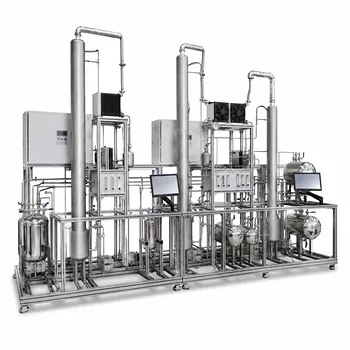
Standard ground glass joints are the universal language of modular pilot plants. Their standardization on precise taper dimensions—like 14/23 or 24/29—guarantees that any compatible reactor, column, or condenser will physically connect with a perfect, leak-tight seal, regardless of the manufacturer. This interchangeability is the bedrock of rapid reconfiguration and safe operation in any reaction or distillation setup.
The true benefit isn’t just a tight seal; standardization eliminates guesswork, slashes the inventory of specialized adapters, and creates an inherently safer learning environment by preventing hazardous vapor leaks. It shifts the user’s focus from fighting with the equipment to understanding the chemistry.
The Foundation of Modular Flexibility
The ability to reconfigure a pilot plant in minutes—not hours—stems entirely from the precision of these joints.
The Universal Connector: A Shared Language of Dimensions
Every standardized ground glass joint is defined by its ground-in taper ratio, typically 1:10, paired with a specific diameter and length (e.g., 14/23 means a 14 mm nominal core diameter and a 23 mm ground length). This precise specification functions as a universal interface protocol for glassware.
Because these dimensions are an industry standard, a round-bottom flask from one supplier and a reflux condenser from another will form a perfect, self-centering seal. There is no need for custom adapters or trial-and-error matching.
Seamless Configuration: From Distillation to Reflux in Minutes
This plug-and-play philosophy means a single collection of modules can serve countless experiments. A student team can dismantle a simple distillation apparatus and assemble a complex reflux setup with an addition funnel in less than five minutes.
The modularity directly supports pedagogical flexibility. Instructors can design a lab session around a core set of components, knowing that every piece will mate instantly, reducing downtime and frustration. For vocational training, this mirrors industrial modular systems where quick changeovers are essential.
Safety and Performance Under Extreme Conditions
Standardization does more than enable speed; it guarantees a consistent safety envelope for demanding chemical operations.
Vacuum and High-Temperature Integrity
The ground surfaces create a large contact area that, when lightly lubricated, traps a thin film of vacuum grease. This film fills microscopic surface irregularities to achieve a seal capable of holding a deep vacuum or containing pressurized vapors.
During a vacuum distillation, a non-standard joint would immediately leak, breaking the vacuum and potentially drawing in air to react with hot, sensitive compounds. The standardized 1:10 taper ensures that gravity and a gentle twist create a lock that gets tighter under vacuum.
Preventing Hazardous Vapor Leaks
For reactions involving toxic or volatile solvents at elevated temperatures, a leak is more than an inconvenience—it’s a health risk. The standardized fit creates a long, tortuous path for any escaping vapor, which condenses and refluxes back into the pot.
This sealing consistency is non-negotiable in an educational lab. Instructors must trust that a setup will not release a stream of ether into the fume hood just because a student failed to perfectly align a custom joint. The standard provides that predictable safety margin.
Recognizing the Limits and Pitfalls
For all their benefits, standardized joints are not immune to user error or physical limitation. Objectivity demands knowing where the system can fail.
The Imperative of Clean, Undamaged Joints
A precise taper is useless if it’s dirty or scored. Dried chemical residues or even a small chip in the ground surface will act as a shim, preventing a complete seal and causing the joint to freeze solid upon heating.
The biggest threat is base attack. Strong alkalis, like sodium hydroxide, can etch the glass microscopically, destroying the tight tolerance and creating a permanently leaky, unremovable joint. The standardization itself creates a large, vulnerable contact area that must be protected.
Compatibility Traps: Standard vs. Non-Standard Sizes
While the standards cover many sizes, a lab might inadvertently mix standard and non-standard parts. A Joint Size chart (e.g., 14/23, 19/26, 24/29, 29/32) must be consulted; a 24/29 joint will not physically fit a 29/32 port.
Attempting to force a mismatch will shatter the glass, risking severe injury. The system relies on the user correctly identifying the standard, meaning robust labeling and storage are essential to prevent a dangerous mix-up.
Making the Right Choice for Your Goal
The design of your modular pilot plant should be guided by how you will use these joints, not just by picking a random size.
After considering your primary operational need, follow these recommendations:
- If your primary focus is vocational training flexibility: Build your inventory around the workhorse 24/29 standard. It offers the best balance of volume capacity and vapor path for common 250 mL to 1000 mL setups, allowing students to reconfigure for distillation, reflux, and gas absorption without a sea of adapters.
- If your primary focus is vacuum distillation safety: Never rely on the joint alone. Always use a thin film of high-vacuum grease on clean 14/23 or 19/26 joints, and visually inspect for star cracks each time. The standard provides the potential for a seal, but the user’s technique activates it.
- If your primary focus is long-term equipment durability: Avoid exposing the assembled, ungreased joint to strong bases and never store glassware with mated joints tightly together. Slight thermal expansion can cause an unstoppable seizing that breaks the glass during disassembly, turning a $50 standard adapter into scrap.
The elegance of ground glass standardization is that it transforms a collection of almost-matching glass tubes into a truly integrated, safe, and creative scientific instrument.
Summary Table:
| Joint Standard Feature | Operational Benefit | Key Safety & Maintenance Tip |
|---|---|---|
| Precise 1:10 Taper | Self-centering, leak-tight seal; interchangeable parts across manufacturers. | Apply a thin film of vacuum grease to prevent seizing and leaks. |
| Modular Compatibility | Allows fast reconfiguration (distillation to reflux) in under 5 minutes. | Confirm joint dimensions (e.g., 24/29 vs. 29/32) to prevent breakage. |
| Vacuum Integrity | Holds deep vacuum and traps hazardous chemical vapors effectively. | Avoid exposure to strong alkalis (like NaOH) that etch and damage glass. |
Build Safer, More Flexible Labs with LABPARK
At LABPARK, we equip universities, research institutes, and enterprises with state-of-the-art Educational and Vocational Unit Operations Pilot Plants for chemical engineering, bioprocess & biotech, and environmental & water treatment. By integrating standardized, high-precision modular glassware, our pilot plants offer unmatched flexibility, allowing students and researchers to safely and rapidly reconfigure setups without compromising vacuum integrity.
Ready to elevate your training and research capabilities? Contact our team today to discuss your custom pilot plant requirements!
Related Products
- Multi-Modal Distillation Unit Operations Training Pilot Plant
- Green Anhydrous Ethanol Purification Extractive Distillation Unit Operations Training Pilot Plant
- Ethyl Acetate Synthesis Unit Operations Pilot Plant for Practical Training
- Dual-Mode Rectification Pilot Plant for Practical Training Unit Operations
- Multi-Functional Special Distillation Educational Pilot Plant
People Also Ask
- How can energy balance equations for condensers & reboilers be validated experimentally? Guide
- How can real-time carbon number prediction improve distillation pilot plants? Optimize control.
- Why is vacuum operation capability an essential feature for a distillation unit operations pilot plant? Unlock Efficiency
- How does catalyst water concentration affect distillation pilot plant design? Key separation train choices.
- What are the primary reflux ratio control strategies? Master Distillation Unit Operations