Knowledge Environmental and Water Treatment Education How does the seasonal variability of raw water chemistry impact the configuration of educational water treatment pilot plants?
Author avatar

Tech Team · LABPARK

Updated 3 weeks ago

How does the seasonal variability of raw water chemistry impact the configuration of educational water treatment pilot plants?


The single most defining design requirement for an educational water treatment pilot plant is not a specific piece of hardware, but the principle of operational flexibility. Because surface and groundwater sources undergo dramatic seasonal shifts in temperature, turbidity, and dissolved mineral content, the system must be a dynamic, reconfigurable teaching tool. It must allow students to diagnose the incoming water's chemistry and then actively manipulate the treatment process to achieve a stable, high-quality effluent, turning unpredictability into a core learning objective.

Educational pilot plants face a unique paradox: they must simulate a consistent industrial process while being fed an inherently inconsistent raw water source. The true pedagogical value is unlocked not when the water quality is stable, but when it changes. This demands a plant designed for students to easily alter chemical dosing, flow paths, and hydraulic retention times to actively shift chemical equilibria in response to seasonal variation.

The Pedagogical Need for Operational Flexibility

The primary reference correctly identifies that raw water is not a constant. For an educational setting, this variability is the curriculum's central challenge. A pilot plant designed for a single, static water quality fails to teach the core skill of process control.

Moving Beyond a Cookbook Approach

Training on an unchanging water source turns water treatment into a simple, rote recipe. Students merely learn to repeat fixed steps. This fails to build the diagnostic and decision-making skills required for real-world operations.

Seasonal changes shatter this static model. A sudden drop in river alkalinity or a spike in groundwater hardness forces students to think like operators. They must analyze the new conditions, predict the chemical required, and adjust the system to maintain treatment goals.

The Core Analytical Loop: Diagnose, Adjust, Verify

The configuration of the pilot plant must physically support a cyclical learning loop. The physical plant layout and instrumentation must make this sequence intuitive and accessible to students.

Step 1: Diagnosis Through Chemical Analysis

The system must include accessible sampling points at the raw water inlet. Students first perform direct analysis, measuring key parameters that shift with the seasons. Two critical parameters are hardness (primarily from calcium and magnesium) and alkalinity (the water's buffering capacity, often from bicarbonates).

These parameters change for predictable reasons. Spring snowmelt can dilute a river's mineral content, while summer drought can concentrate it. A well might show increased hardness after a rainy season recharges the aquifer through mineral-rich soil.

Step 2: Active Manipulation of Chemical Equilibria

The plant’s configuration must then facilitate a direct, observable response. The goal of water treatment is to shift chemical equilibria—for example, converting soluble calcium bicarbonate into insoluble calcium carbonate precipitate.

This is where the plant's flexibility becomes physical. It needs systems for students to easily adjust:

  • Chemical dosing systems: Peristaltic pumps for lime, coagulant, or acid must have simple-to-use speed or stroke controls that are clearly linked to a measurable flow rate.
  • Flow paths: Accessible valves should allow students to change the sequence of treatment stages or bypass certain unit processes depending on the raw water's condition.
  • Retention times: The ability to modulate the feed pump speed or alter water levels in flocculation and sedimentation tanks directly demonstrates the importance of contact time for chemical reactions to reach completion.

Understanding the Trade-offs of a Flexible Design

Building for maximum flexibility, while essential for learning, introduces inherent challenges that must be managed to ensure a functional and safe teaching environment. A flexible plant is more complex, and complexity creates risk.

The Complexity-Simplicity Paradox

A plant with dozens of adjustable valves, injection points, and variable-speed pumps is powerful but can be overwhelming for a novice. The initial learning curve is steeper. The physical design must mitigate this through excellent piping and instrumentation diagrams (P&IDs) permanently mounted on the skid itself, along with extremely clear labeling of every control point. Without this, flexibility becomes a source of confusion rather than enlightenment.

The Risk of Process Failure

Actively adjusting chemical dosing creates a real risk of process upset. An incorrect dose calculation based on a flawed hardness test can lead to clarifier failure, carryover of solids, and a completely off-specification effluent. While this is a powerful learning moment, the plant must be configured with the inherent containment and clean-out points to allow for a safe, quick, and educational recovery from an operational failure.

Making the Right Choice for Your Educational Goal

When configuring a pilot plant to handle seasonal variability, your specific learning objectives should dictate which systems are prioritized for flexibility.

  • If your primary focus is hands-on operator training: Prioritize flexibility in chemical feed systems and frequent, easy-to-use raw water sampling points. The core skill is the analytical loop of jar testing and adjusting chemical doses in response to changing water quality.
  • If your primary focus is demonstrating fundamental engineering principles: Focus on configuring adjustable flow paths and variable retention times. Design the plant so students can isolate the impact of a single variable, like contact time in a flocculator, on the overall process efficiency under different seasonal conditions.
  • If your primary focus is process control and automation: Integrate online instruments for pH, turbidity, and temperature directly into a SCADA system. The seasonal variability of the raw water becomes the disturbance variable students must automatically counteract through control logic, learning to tune PID loops for a dynamic system.

Embrace the raw water's seasonal variability not as a design problem, but as your most effective teaching instrument.

Summary Table:

Learning Focus Key Raw Water Variations Required Plant Flexibility
Operator Training Shifts in pH, turbidity, hardness, alkalinity Adjustable chemical dosing, multi-point sampling
Engineering Principles Variable organic loading, temperature changes Modulated flow paths, adjustable hydraulic retention times
Process & Automation Dynamic seasonal disturbances Online sensors (pH, turbidity), integrated SCADA & PID loops

Equip Your Lab for Real-World Water Treatment Training

Prepare your students and researchers for dynamic, real-world environmental challenges with LABPARK. We provide advanced Educational and Vocational Unit Operations Pilot Plants in chemical engineering, bioprocess & biotech, and environmental & water treatment for universities, research institutes, and enterprises.

Our highly flexible pilot plants allow students to actively manipulate process configurations, flow paths, and chemical dosing to master real-world water variability. Contact LABPARK today to configure the ideal educational system for your institution!

Related Products

People Also Ask

Related Products

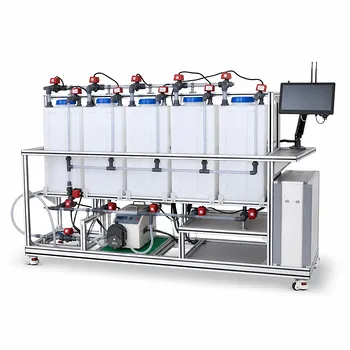
Electrochemical Water Treatment Educational Unit Operations Pilot Plant

Electrochemical Water Treatment Educational Unit Operations Pilot Plant

Enhance engineering education with this pilot-scale electrochemical water treatment plant. Designed for hands-on learning of efficient salt removal, electrolytic reactions, and real-time data acquisition. Features multi-mode control, corrosion-resistant PVC, low-voltage safety, and wireless connectivity for modern teaching labs.

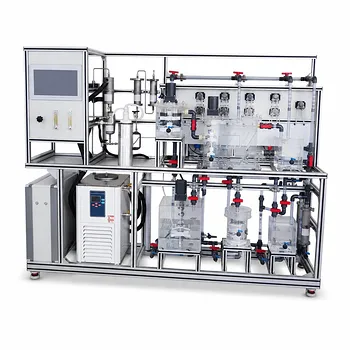
Thermal Desorption Exhaust Gas and Tail Water Treatment Educational Pilot Plant

Thermal Desorption Exhaust Gas and Tail Water Treatment Educational Pilot Plant

Bench-scale educational pilot plant for treating thermal desorption exhaust gas and tail water integrates condensation, Fenton oxidation, precipitation, filtration, and carbon adsorption. Ideal for chemical engineering and environmental labs, teaching unit operations, process control, and real-time data analysis.

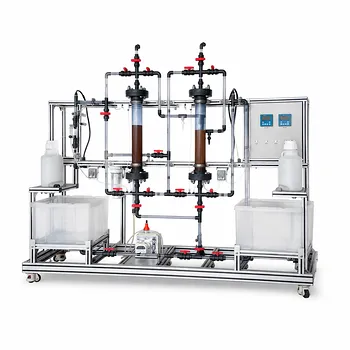
Ion Exchange Water Purification Educational Pilot Plant for Engineering Unit Operations

Ion Exchange Water Purification Educational Pilot Plant for Engineering Unit Operations

This bench-scale ion exchange pilot plant trains engineering students in water purification. Dual transparent columns simulate industrial softening and demineralization. Students observe fluid dynamics, perform resin regeneration, and analyze breakthrough curves. The corrosion-resistant frame ensures durability in unit operations experiments.

Alkaline Membrane Water Electrolysis Educational Pilot Plant Unit Operations Training System

Alkaline Membrane Water Electrolysis Educational Pilot Plant Unit Operations Training System

Hands-on educational pilot plant for alkaline membrane water electrolysis hydrogen production, integrating unit operations training with industrial PLC control, real-time data logging, customizable design, durable 316L stainless steel construction, explosion-proof safety, and modern 5G connectivity for university laboratories.

Water Electrolysis Hydrogen Production and Storage Educational Pilot Plant

Water Electrolysis Hydrogen Production and Storage Educational Pilot Plant

Integrated pilot-scale training system for higher education engineering labs. Features AWE/PEM electrolysis, adjustable DC power, PLC controls, gas-liquid separation, and pressurized hydrogen storage. Hands-on learning in green hydrogen, process control, and safety, ideal for chemical and energy departments.

Electrolytic Hydrogen Production Educational Unit Operations Pilot Plant

Electrolytic Hydrogen Production Educational Unit Operations Pilot Plant

Bench-scale electrolytic hydrogen production pilot plant designed for university engineering labs. Provides hands-on training in water electrolysis, gas-liquid separation, and process safety. Fully customizable system with digital PID control, corrosion-resistant components, and hydrogen gas detector. Ideal for chemical engineering curricula.

Continuous Batch Extractive Distillation Educational Pilot Plant

Continuous Batch Extractive Distillation Educational Pilot Plant

Versatile pilot plant for continuous, batch, and extractive distillation training. High-borosilicate glass column for visualizing hydraulics, 15.6-inch touchscreen with data logging, precise reflux ratio control 1-99, and durable corrosion-resistant frame. Ideal for chemical engineering education and process research.

Multi-Functional Special Distillation Educational Pilot Plant

Multi-Functional Special Distillation Educational Pilot Plant

Versatile multi-functional special distillation pilot plant for chemical engineering education. Supports continuous, vacuum, azeotropic, reactive, extractive distillation. Transparent glass columns enable real-time visual observation of hydrodynamics and separation processes.

100L Continuous Loop Hydrogenation Educational Unit Operations Pilot Plant

100L Continuous Loop Hydrogenation Educational Unit Operations Pilot Plant

This 100L continuous loop hydrogenation pilot plant is designed for chemical engineering education, featuring 316 stainless steel construction, advanced gas-liquid mass transfer components, explosion-proof safety systems, and a 15.6-inch touchscreen with 5G connectivity, cloud data logging, bridging theory and industry.

Constant Pressure Filtration Educational Unit Operations Pilot Plant

Constant Pressure Filtration Educational Unit Operations Pilot Plant

Hands-on educational pilot plant for constant pressure filtration. Classic plate and frame filter press allows students to study kinetics, determine specific cake resistance, perform cake washing and evaluate washing rates. Ideal for chemical engineering curriculum. Mobile, customizable, safety-compliant design.

Multifunctional Membrane Separation Educational Pilot Plant with Ultrafiltration, Nanofiltration, Reverse Osmosis

Multifunctional Membrane Separation Educational Pilot Plant with Ultrafiltration, Nanofiltration, Reverse Osmosis

An integrated laboratory bench-scale membrane separation system for higher education engineering labs combining Ultrafiltration, Nanofiltration, and Reverse Osmosis processes. Features industrial PLC control with touch-screen HMI, transparent piping, and academic assessment software. Ideal for chemical and environmental engineering curricula.

Electrolyte Distillation Purification and Formulation Educational Pilot Plant

Electrolyte Distillation Purification and Formulation Educational Pilot Plant

Integrated bench-to-pilot scale educational pilot plant for electrolyte distillation, purification, and formulation with borosilicate glass construction, PLC automation, touchscreen HMI, and advanced industrial safety features for hands-on chemical process training, ideal for chemical engineering and materials science curricula.

Ultrafiltration Membrane Separation Educational Pilot Plant

Ultrafiltration Membrane Separation Educational Pilot Plant

This ultrafiltration membrane separation educational pilot plant enables undergraduate students to process PVA solutions, study hollow fiber membrane dynamics, and perform quantitative analysis with spectrophotometry for hands-on learning of unit operations and industrial maintenance and membrane cleaning protocols.

Multi Functional Membrane Crystallization Educational Unit Operations Pilot Plant

Multi Functional Membrane Crystallization Educational Unit Operations Pilot Plant

Integrated bench-scale membrane crystallization pilot plant for engineering education. Provides hands-on training in advanced separation technologies, combining membrane distillation crystallization and process intensification. Features variable scaling vessels, industrial-grade flow control, and interactive digital data acquisition. Customizable for university labs.

Multi-Functional Membrane Separation Educational Pilot Plant for Unit Operations Lab

Multi-Functional Membrane Separation Educational Pilot Plant for Unit Operations Lab

The Multi-functional Membrane Separation Educational Unit Operations Pilot Plant is an integrated bench-scale laboratory system designed for teaching undergraduate engineering education. It features Ultrafiltration, Nanofiltration, and Reverse Osmosis modules in a compact, mobile unit for practical hands-on learning.

Natural Product Extraction Unit Operations Training Pilot Plant

Natural Product Extraction Unit Operations Training Pilot Plant

Integrated natural product extraction pilot plant for chemical engineering training bridges theory and industrial practice with modular extraction and evaporation/concentration units, hybrid touchscreen and manual control, realistic process simulation, and self-contained softened water and vacuum utilities.

Centrifugal Pump Performance and Orifice Flowmeter Calibration Educational Pilot Plant

Centrifugal Pump Performance and Orifice Flowmeter Calibration Educational Pilot Plant

This versatile educational pilot plant enables engineering students to conduct centrifugal pump performance tests, orifice flowmeter calibration, and fluid mechanics experiments using a transparent flow loop, industrial HMI, and 3D virtual simulation for a comprehensive hands-on learning experience.

Fixed-Bed Chemical Reaction and Gas Dust Tar Removal Unit Operations Pilot Plant

Fixed-Bed Chemical Reaction and Gas Dust Tar Removal Unit Operations Pilot Plant

Integrated educational pilot plant for studying catalytic gas-solid reactions and downstream gas purification. Features dual fixed-bed reactor, three-stage heating, and touchscreen control for hands-on engineering training. Ideal for chemical and environmental engineering curricula.

Comprehensive Fluid Mechanics Educational Unit Operations Pilot Plant

Comprehensive Fluid Mechanics Educational Unit Operations Pilot Plant

Hands-on fluid mechanics pilot plant for engineering education covering over 13 principles including pipe flow, minor losses, flowmeter calibration, and pump performance with industrial-grade components, smooth and rough piping, venturi and orifice flowmeters, and centrifugal pump testing and analysis.

Ethyl Acetate Synthesis Unit Operations Pilot Plant for Practical Training

Ethyl Acetate Synthesis Unit Operations Pilot Plant for Practical Training

Modular and customizable pilot plant for ethyl acetate synthesis practical training. Integrates esterification reaction, liquid-liquid extraction, neutralization, and sieve-plate distillation unit operations. Bridging theory and real-world industrial processes. Designed for university chemical engineering labs


Leave Your Message