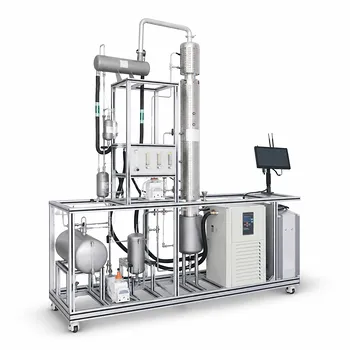
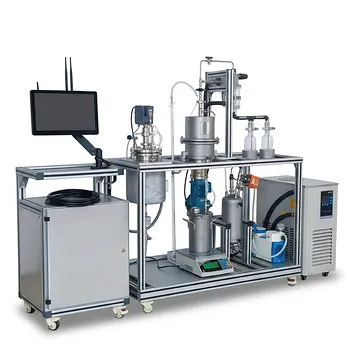
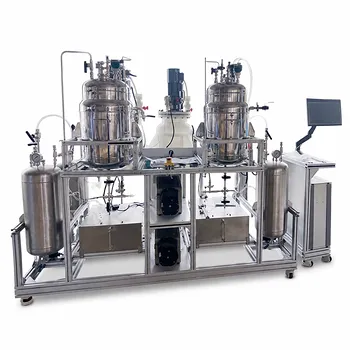
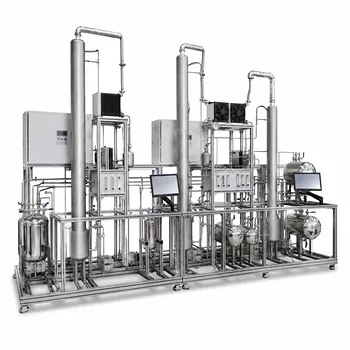
Adding a non-volatile solute fundamentally redefines the thermodynamic landscape of your pilot plant. In an educational setting, this principle of vapor pressure lowering dictates that the solution will always boil at a higher temperature than the pure solvent at the same pressure. This means your students must learn to compensate not just with more heat, but by actively manipulating pressure—most commonly through vacuum systems—to maintain boiling rates without thermally destroying the solute or wasting energy.
The core teaching moment is that boiling is not just about temperature, but about the dynamic interplay between solute concentration and system pressure. A pilot plant becomes a physical demonstration of how molecular-level vapor pressure depression directly translates to higher energy demands, slower evaporation, and the absolute necessity of vacuum control in industrial concentration processes.
The Thermodynamic Shift in Pilot Plant Operations
The primary reference correctly states that a non-volatile solute lowers vapor pressure, leading to boiling point elevation. In a pilot plant, this shifts operation from a simple thermal process to a pressure-dependent thermodynamic demonstration.
Why Vapor Pressure Lowering Demands a Vacuum Strategy
When you dissolve a non-volatile solute—like sugar or salt—into water for a pilot-scale evaporation exercise, the solute particles occupy surface area at the liquid-vapor interface. This physically blocks solvent molecules from escaping into the vapor phase. To achieve the same rate of boiling you would see with pure solvent at 100°C, you would now need to raise the temperature significantly.
This is often undesirable or impossible when dealing with heat-sensitive materials. The solution demonstrated by pilot plants is to lower the ambient pressure using a vacuum pump. By reducing the external pressure, you lower the boiling point, effectively allowing efficient vaporization without exceeding a critical thermal degradation threshold.
Demonstrating the Exponential Sensitivity of Vapor Pressure
The Clausius-Clapeyron relationship teaches students that vapor pressure is exponentially sensitive to temperature. A small 5°C increase in temperature can cause a dramatic spike in vapor pressure, potentially pushing a distillation column from stable operation into flooding. Conversely, a small vacuum adjustment can drastically reduce the required operating temperature.
Educational pilot plants must be outfitted with precise pressure transducers and modulated heating to visually log this exponential curve in real-time. This transforms a theoretical equation into a tangible safety and efficiency lesson.
Connecting Vapor Pressure to Column Hydrodynamics
The insights from the supplementary references on hydrodynamics are not separate topics—they are the direct physical consequences of managing vapor pressure depression.
How Boiling Point Elevation Triggers Flooding
To combat the natural boiling point elevation of a concentrated solution, an inexperienced student might simply increase heat input to push more vapor into the column. However, excessive heating generates a vapor velocity that exceeds the column's maximum capacity. The upward-moving vapor suspends the downward-flowing liquid, causing a condition known as flooding.
When a column floods, the system no longer obeys Raoult's Law in a steady state. The vapor-liquid equilibrium collapses because the phases cannot properly interface. The pilot plant’s data logging suite is therefore critical to teach the correlation between the vapor pressure curve and the physical limits of the packed column.
The Balancing Act of Column Hold-Up and Surface Area
The principles of vapor pressure and interfacial area are linked. While a higher operating temperature (to overcome boiling point elevation) generates more vapor, it can also reduce the necessary column hold-up by stripping the liquid phase too quickly. Some hold-up is vital; it provides the residence time and surface area for mass transfer.
Students must learn that the ideal operating point is a valley on a thermodynamic-hydrodynamic curve. The process involves finding the minimal temperature and pressure combo that overcomes the solution's reduced vapor pressure without exceeding the vapor velocity that destroys liquid retention.
Bridging Molecular Theory and Macro-Scale Operation
The leap from Raoult's Law to pilot plant control is best understood by examining deviations from ideality.
From Partial Pressure to Predictive Modeling
Raoult’s Law assumes an ideal solution, where the vapor pressure is simply the mole fraction of the solvent times its pure vapor pressure. In a real distillation pilot plant, molecular interactions like hydrogen bonding and van der Waals forces cause non-ideal behavior. The supplementary reference on thermodynamic modeling highlights that these interactions change the activity coefficient—a factor that corrects for non-ideality.
A well-instrumented pilot plant allows students to measure actual vapor pressures and compare them directly with ideal predictions. This comparison teaches them why an ethanol-water mixture forms an azeotrope, a phenomenon where vapor pressure lowering and molecular attraction prevent complete separation.
graph TD
    A[Non-Volatile Solute Added] --> B(Vapor Pressure Lowering);
    B --> C{Boiling Point Elevation};
    C --> D[Option 1: Increase Thermal Input];
    C --> E[Option 2: Reduce System Pressure via Vacuum];
    D --> F[Risk: Thermal Degradation & High Energy Cost];
    E --> G[Benefit: Low-Temp Vaporization];
    D --> H[Risk: Column Flooding from Excessive Vapor Velocity];
    E --> I[Risk: Droplet Entrainment or Insufficient Vapor Load];
    H --> J[Loss of Separation Efficiency];
    I --> J;
The operational paths stemming from vapor pressure lowering, illustrating the thermodynamic and hydrodynamic balancing act students must navigate.
Understanding the Trade-offs
Trust is built on acknowledging where a principle like Raoult's Law falls short as a sole operating guide.
The Limits of Ideal Assumptions
The primary reference is correct but simplified. An educational pilot plant must expose students to the pitfalls of taking Raoult’s Law at face value. In reality, the relatively small boiling point elevation observed in dilute textbook experiments becomes a massive energy barrier at high concentrations, where the ideal law no longer accurately predicts activity.
Energy Consumption vs. Time
Lowering pressure via vacuum is the elegant thermodynamic solution to vapor pressure lowering, but it introduces a new equipment cost and complexity. Furthermore, operating under deep vacuum can reduce the available temperature gradient for heat transfer in the reboiler, potentially slowing down the overall rate of distillation compared to atmospheric boiling, even if the boiling point is technically "lower."
Making the Right Choice for Your Educational Goal
Educating with a pilot plant means selecting an operating protocol that best illustrates these interconnected principles. Your strategy should depend on the specific learning objective you are targeting.
-
If your primary focus is pure thermodynamic fundamentals: Demonstrate the boiling point elevation directly at atmospheric pressure. Have students add a measured non-volatile solute and log the exact temperature jump needed to regain boiling—this proves Raoult's Law.
-
If your primary focus is heat-sensitive material processing: Shift immediately to vacuum operation. Show students how to use steam tables and the Clausius-Clapeyron relation to calculate a target absolute pressure that brings the solution’s boiling point safely below 60°C.
-
If your primary focus is column hydrodynamics and troubleshooting: Operate at steady atmospheric pressure with a constant boiler composition, but instruct students to deliberately increase reboiler heat to induce flooding. This connects the vapor load generated by overcoming vapor pressure lowering to the physical column limits, teaching them to recognize and recover from process upset.
Mastering the pilot plant requires treating Raoult’s Law not as a static equation, but as the starting gun that sets off a cascade of thermodynamic, hydrodynamic, and molecular events your students must learn to control.
Summary Table:
| Operational Challenge | Thermodynamic Impact | Pilot Plant Solution |
|---|---|---|
| Boiling Point Elevation | Requires higher heat inputs to vaporize solutions | Vacuum Systems: Lowers system pressure to enable low-temperature boiling. |
| Thermal Degradation | High temperatures can destroy heat-sensitive solutes | Precise Control: Use modulated heating and transducers to safely regulate heat. |
| Column Flooding | Excess vapor velocity disrupts liquid-vapor equilibrium | Data Logging: Helps students monitor vapor loads and adjust hold-up. |
Bring Thermodynamic Principles to Life with LABPARK
Bridging the gap between molecular theory and industrial practice requires robust, highly instrumented systems. LABPARK provides state-of-the-art Educational and Vocational Unit Operations Pilot Plants in chemical engineering, bioprocess & biotech, and environmental & water treatment for universities, research institutes, and enterprises.
Our pilot plants feature precise pressure control, real-time data logging, and vacuum modulation to help students master thermodynamics, column hydrodynamics, and process safety.
Contact our experts today to find the ideal pilot plant solution for your educational curriculum!
Related Products
- Multi-Functional Special Distillation Educational Pilot Plant
- Electrolyte Distillation Purification and Formulation Educational Pilot Plant
- Continuous Sieve-Plate Distillation Pilot Plant for Unit Operations Laboratory Education
- Continuous Batch Extractive Distillation Educational Pilot Plant
- Rising and Falling Film Evaporation Educational Unit Operations Pilot Plant
People Also Ask
- Why does simple distillation yield higher efficiency than flash distillation? Key thermodynamic differences.
- How to Verify Distillation Boundary Lines & Composition Regions with Pilot Plants
- How does double temperature difference control improve distillation pilot plants? Stabilize purity.
- How to Integrate Spectroscopy in Distillation Pilot Plants for Advanced Process Control
- How Batch vs Continuous Configuration Affects Distillation Pilot Plant Versatility & Footprint