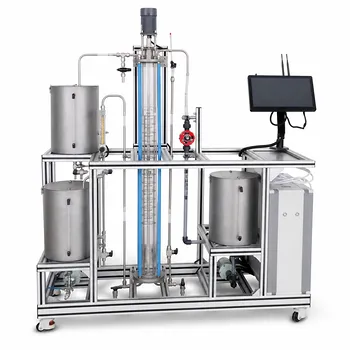
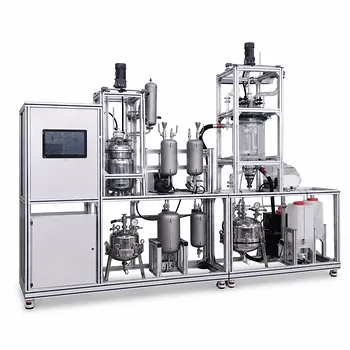
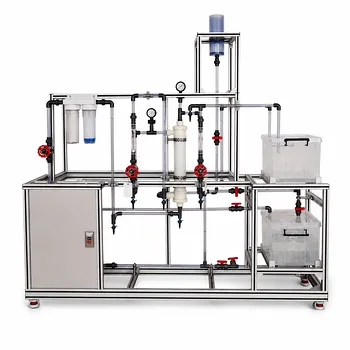
Supercritical fluid extraction (SFE) outperforms traditional liquid-liquid extraction (LLE) primarily through dramatically faster mass transfer. While LLE relies on slow molecular diffusion between two immiscible liquid phases, SFE exploits a supercritical fluid—most often carbon dioxide—that combines liquid-like density (400–900 kg/m³) with gas-like low viscosity (3–9 × 10⁻⁵ Pa·s) and high diffusivity (~0.2 × 10⁻³ m²/s). This unique state slashes extraction times, eliminates toxic solvent residues, and preserves heat-sensitive bioactives that would degrade under conventional processing. A supercritical extraction pilot plant brings these advantages into the lab, giving bioprocess researchers a hands-on platform to master green chemistry principles, optimize high-value separations, and scale processes with zero solvent contamination.
The core insight is that supercritical fluids act as tunable, self-removing solvents: they penetrate matrices faster than liquids, dissolve target compounds with precision, and leave behind a perfectly pure extract simply by releasing pressure. For bioprocess research, pilot plants transform this principle into a teachable, scalable, and solvent-free unit operation—ideal for developing next-generation pharmaceutical, food, and biofuel processes.
The Performance Advantage: Why SFE Outpaces LLE
Mass Transfer Kinetics Are Radically Faster
In liquid-liquid extraction, the solute must diffuse across a stagnant interfacial film where molecular movement is sluggish due to high liquid viscosity. Supercritical fluids collapse that barrier. Their gas-like diffusivity (two orders of magnitude higher than typical organic solvents) and extremely low viscosity mean the solvent can rapidly penetrate solid matrices and carry solutes away. The result is complete extraction in minutes rather than hours, even from dense plant or microbial biomass.
Solvent Recovery and Extract Purity Are Fundamentally Different
Traditional LLE uses organic solvents (e.g., dichloromethane, hexane) that must be thermally stripped from the extract. This step is energy-intensive, often leaves trace toxic residues, and can degrade heat-sensitive compounds. In SFE, the solvent is dense, pressurized CO₂. Reducing the system pressure to atmospheric level instantly converts the CO₂ to a gas, which vents away cleanly. The extract that remains is entirely solvent-free—a critical advantage for pharmaceutical, food, and cosmetic applications.
Extraction Speed and Selectivity Can Be Fine-Tuned
A supercritical fluid’s solvent power is a direct function of its density, which researchers can adjust in real time by varying pressure and temperature. At mild conditions just above the critical point (31 °C, 7.38 MPa for CO₂), you might extract volatile essential oils. Ramping up pressure increases density and dissolves heavier, less volatile compounds. This on-the-fly selectivity is impossible with conventional liquid solvents, where changing polarity often requires changing the entire solvent system. Paired with faster kinetics, SFE typically delivers higher yields in a single step compared to multi-stage LLE.
Heat-Sensitive Bioactives Stay Intact
Many bioprocess targets—unsaturated fatty acids like EPA/DHA, enzymes, antioxidants—are thermally labile. LLE’s post-extraction solvent evaporation often exposes them to damaging heat. SFE runs at near-ambient temperatures (CO₂’s critical temperature is just 31 °C) and the decompression cooling effect further protects the extract. The absence of oxygen in the pressurized CO₂ environment also minimizes oxidative degradation, preserving bioactivity and product quality.
The Pilot Plant as a Bioprocess Research Powerhouse
A Living Laboratory for Green Chemistry
A supercritical extraction pilot plant is not just a piece of equipment—it’s an integrated unit operation that teaches the full cycle of a sustainable separation. Researchers gain direct experience in high-pressure safety protocols, phase behavior observation, and solvent recycling without auxiliary purification steps. Every experiment demonstrates a core green chemistry principle: eliminate hazardous solvents at the source rather than cleaning them up later.
Optimizing High-Value Separations with Real Data
The ability to manipulate pressure, temperature, and CO₂ flow rate allows systematic exploration of extraction kinetics and thermodynamics. Research teams can map out how density shifts alter solubility parameters for specific bioactives—essential for isolating fragile compounds like omega-3 fatty acids from microalgae or decaffeinating coffee while preserving flavor. The pilot plant provides the quantitative mass transfer data needed to validate models and design scalable processes.
Bridging the Gap to Industrial Scale
Pilot-scale SFE units mirror the engineering challenges of production systems: managing pressure drops, recovering CO₂ for reuse, and designing efficient solid-fluid contactors. By working at a relevant scale, researchers can troubleshoot fractionation strategies, test different packing materials, and optimize energy consumption during depressurization-precipitation cycles. This hands-on experience transforms theoretical thermodynamics into practical process intensification skills.
Understanding the Trade-offs
SFE Is Not a Universal Solvent Substitute
Supercritical CO₂ is inherently non-polar and works best for lipophilic compounds—essential oils, lipids, and alkaloids. Polar molecules often require the addition of small amounts of co-solvents (like ethanol), which partially reintroduces solvent handling complexity. By contrast, liquid-liquid extraction can easily switch between polar and non-polar solvents by choosing a different organic phase.
Capital and Energy Costs Are Higher
High-pressure equipment is expensive to build and maintain. Compressing CO₂ to supercritical conditions demands energy, and while solvent recovery is simple, the overall process may have a higher capital footprint than a stirred tank LLE setup. For low-value commodity products, this cost can be hard to justify unless the premium for “solvent-free” or “green” label is substantial.
Solid-Feed Handling Remains a Challenge
Most SFE processes require solid or semi-solid feed material to be packed into a high-pressure vessel, often in batch mode. Continuous operation is possible but more complex than the well-established continuous counter-current columns of liquid-liquid extraction. This can limit throughput for certain bioprocess applications.
How to Apply This to Your Bioprocess Research Goals
The choice between SFE and LLE—and the decision to invest in a pilot plant—hinges on what you need to achieve.
- If your primary focus is producing a completely solvent-free, high-purity extract: An SFE pilot plant is the definitive tool. The inherent residue-free nature of CO₂ makes it irreplaceable for pharmaceuticals, nutraceuticals, and premium food ingredients.
- If your primary focus is speed and single-step yield for lipophilic bioactives: SFE’s faster mass transfer kinetics and tunable selectivity will consistently outperform traditional LLE, justifying the equipment investment.
- If your primary focus is hands-on education in green process engineering: A supercritical pilot plant offers an unmatched platform to teach high-pressure unit operations, phase thermodynamics, and sustainable process design across multiple disciplines.
- If your primary focus is processing highly polar or very low-cost bulk products: Traditional LLE—or a hybrid approach with SFE and co-solvents—may provide a more practical economic balance without the high capital outlay.
- If your primary focus is scaling a new bioprocess technology: A pilot plant provides the critical scale-up data and operational experience that cannot be obtained from bench-top analytical extractions alone.
Ultimately, a supercritical extraction pilot plant is the gateway to mastering a separation technology that is as gentle on the product as it is aggressive in efficiency, giving bioprocess researchers the power to innovate without compromise.
Summary Table:
| Parameter | Supercritical Fluid Extraction (SFE) | Liquid-Liquid Extraction (LLE) |
|---|---|---|
| Mass Transfer | Fast (gas-like diffusivity) | Slow (molecular diffusion) |
| Solvent Residue | Zero (CO2 vents cleanly as gas) | Trace organic residues remain |
| Selectivity | Tunable (adjust pressure & temp) | Fixed (requires solvent change) |
| Thermal Risk | Low (runs at near-ambient temp) | High (heat required for evaporation) |
| Capital Cost | High (high-pressure design) | Lower (standard stirred tanks) |
Elevate Your Bioprocess Research with LABPARK Pilot Plants
Are you looking to transition from traditional extraction methods to advanced, sustainable green chemistry?
LABPARK provides premium Educational and Vocational Unit Operations Pilot Plants in chemical engineering, bioprocess & biotech, and environmental & water treatment. Engineered specifically for universities, research institutes, and enterprises, our pilot plants enable researchers and students to gain critical, hands-on experience in high-pressure operations and generate precise scale-up data.
Ready to bring advanced separation technology to your institution? Contact LABPARK today to find the perfect pilot plant solution.
Related Products
- Supercritical High-Gravity Flash Evaporation Educational Unit Operations Pilot Plant
- Educational Rotary Disc Liquid-Liquid Extraction Pilot Plant
- Comprehensive Liquid-Liquid Extraction Pilot Plant for Engineering Education
- Gallium and Indium Selective Extraction Educational Pilot Plant
- Multi-Functional Special Distillation Educational Pilot Plant
People Also Ask
- How is the heat transfer area calculated for an evaporation unit operations pilot plant during experimental design? Guide
- How to select educational evaporator pilot plants for thermal & scaling solutions? Complete Guide
- What is the practical significance of Kb in pilot plant evaporation? Master process design.
- How to Connect Benchtop Evaporation to Pilot Plants in Chemical Engineering Education
- How are Dühring plots applied in evaporation pilot plants? Practical guide to boiling point prediction