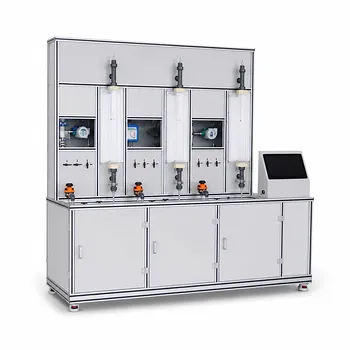
In educational distillation columns, the downcomer liquid backup height is the single most critical hydraulic limit that separates stable operation from complete column failure.
This backup height directly caps the vapor and liquid rates a column can handle before flooding. In pilot‑scale units used for training, the clear‑liquid level in the downcomer is typically held to no more than 60 % of the physical tray spacing; exceeding that threshold backs aerated liquid into the tray above, destroying mass‑transfer efficiency and risking equipment damage. Students and researchers use this ceiling to calculate maximum allowable throughputs, diagnose pressure‑drop anomalies, and map the safe operating envelope.
While many variables influence distillation performance, the downcomer backup height acts as the ultimate hydraulic fuse. In vocational‑training columns, maintaining it below roughly 60 % of tray spacing – and matching the active‑area flood percentage with the downcomer flood percentage – ensures that the column teaches real‑world hydrodynamics without tipping into destructive flooding.
How Downcomer Backup Height Governs Operational Limits
The Direct Link to Column Flooding
When vapor flows up the column and liquid flows down, the tray must balance pressure drop with gravity‑driven downcomer drainage.
If the backup height climbs too high, the aerated froth in the downcomer reaches the outlet weir of the tray above.
That condition – downcomer flooding – chokes liquid flow, sends slugs of liquid up the column, and causes tray‑to‑tray entrainment that renders separation impossible.
In educational plants, this failure point is often approached deliberately.
By tracking how backup height rises with increasing boil‑up, students learn to identify the incipient flood point and validate the column’s design limits.
Calculating the Clear Liquid Backup Height
The backup height is not a single measured value but a calculated head.
The clear liquid height in the downcomer, (h_b), is the sum of three main contributions:
- Weir head on the tray – the height of liquid over the outlet weir ((h_w + h_{ow})).
- Total tray pressure drop ((h_t)) – dry‑tray resistance, liquid head on the tray, and residual surface‑tension loss.
- Head loss at the downcomer exit ((h_{dc})) – friction as the liquid accelerates under the downcomer apron.
Mathematically, (h_b = (h_w + h_{ow}) + h_t + h_{dc}).
In pilot‑plant control systems, (h_b) is inferred from differential pressure measurements and used to set alarms long before froth appears in the sight glasses.
Operational Safety Margins: From Rule of Thumb to Design Equation
The primary 60 %-of‑tray‑spacing rule gives a quick, intuitive limit.
More refined design criteria ensure the equivalent clear liquid height ((H_d)), expanded by foaming, stays below the tray spacing plus the weir height.
A widely used inequality is:
(H_d \le \phi , (H_T + h_w))
- (H_T) = tray spacing
- (h_w) = outlet weir height
- (\phi) = foaming safety factor
For non‑foaming systems, (\phi) ranges from 0.6 to 0.7. For foam‑prone mixtures, (\phi) drops to 0.3–0.4, slashing allowable backup.
In educational columns where foaminess is low, a conservative internal guideline keeps the froth height below 50 % of tray spacing under the most cautious training protocols, and no more than 80 % in optimized designs.
Regardless of the exact number, the message is the same: backup height is the hard ceiling that must never be exceeded.
Design Implications for Educational Distillation Columns
Tray Spacing and Weir Height Trade‑offs
Backup height limits directly influence how closely trays can be spaced.
Wider tray spacing allows a larger downcomer volume and permits a higher backup height, raising throughput before flooding occurs.
Weir height pulls in two directions.
A taller weir increases contact time and tray efficiency, but it also contributes to higher backup height and pressure drop.
For atmospheric educational units, weir heights of 40–100 mm are common. In contrast, vacuum pilot plants may use weirs as low as 6 mm to keep pressure drop and backup height minimal – sacrificing some efficiency for hydraulic stability.
By varying weir height in a teaching lab, students instantly see the trade‑off: a deeper liquid layer improves separation but shrinks the safe operating window.
Flow Path and Downcomer Configuration
Most educational columns under 2.2 m diameter use a single‑pass crossflow layout with segmental downcomers.
This simple design keeps the liquid path short, the number of downcomers low, and the backup height easy to model.
For a given tray design, the backup head must be evaluated at maximum liquid loading.
If the downcomer area is too small, the backup height will rise sharply even at moderate rates.
Educational exercises often involve changing downcomer clearance or weir length to illustrate how these modulations directly alter the flood point.
Matching Active Area and Downcomer Flood Percentages
The primary reference emphasizes a key insight often overlooked in teaching: stable operation demands that the active‑area flood percentage and the downcomer flood percentage are comparable.
If the tray’s active area reaches jet‑flood before the downcomer backs up, the column will entrain heavily; if the downcomer floods first, liquid handling becomes the bottleneck.
In an educational column, operators learn to balance vapor and liquid loading so that neither limit is reached prematurely.
This balanced design is the foundation of robust pilot‑plant operation and gives students a systems‑level understanding of hydraulic constraints.
Understanding the Trade‑offs in Backup Height Management
Increasing Weir Height: Better Contact, Higher Risk
A frequently explored trade‑off is weir height.
Taller weirs extend gas–liquid contact, boosting tray efficiency – a desirable outcome for demonstrating separation fundamentals.
However, the same increase adds directly to the backup height and total pressure drop, shrinking the safe operating range and potentially triggering jet‑flood at lower vapor rates.
Lowering Backup Limits: Safety vs. Throughput
Setting a more stringent backup limit (e.g., 50 % of tray spacing) makes the column nearly flood‑proof, ideal for unsupervised student labs.
The cost is a lower maximum throughput, which can limit the range of experiments – for instance, studying high‑boil‑up rate effects or handling unexpected feed surges becomes impossible.
Educational programs must decide whether safety margins or experimental flexibility take priority.
Foaming Systems and the Phi Factor
When the pilot column processes a foaming liquid, the “safe” backup height collapses dramatically.
A (\phi) factor of 0.3 means the allowable clear‑liquid height might be only 30 % of what a non‑foaming system would tolerate.
This teaches an invaluable lesson: a seemingly identical column operated with a different chemical system can have a drastically reduced capacity, purely because of foam stability in the downcomer.
Making the Right Choice for Your Educational Pilot Plant
Apply these design and operational priorities based on your specific teaching objectives.
- If your primary focus is maximizing safe throughput for high‑rate demonstrations: Size downcomers generously and adopt the 60 %-of‑tray‑spacing criterion. Use moderate weir heights and non‑foaming test mixtures to push the hydraulic envelope without risking frequent floods.
- If your primary focus is teaching conservative hydraulic constraints and flooding phenomena: Use a narrower safety margin (e.g., 50 % of tray spacing), incorporate sight glasses at downcomer inlets, and deliberately approach the flood point in supervised sessions to let students trace the rising backup height.
- If your primary focus is demonstrating the efficiency‑capacity trade‑off: Design experiments that vary weir height and liquid load while recording pressure drop, backup height, and tray efficiency. Let the data show that every efficiency gain carries a hidden capacity penalty.
- If your primary focus is handling a specific, possibly foaming, chemical system: Run the column with a reduced (\phi) factor (0.3–0.4) and design the downcomer volume accordingly. Emphasize that industrial separations often derate columns by 30–40 % precisely because of foam‑related backup limitations.
Understanding and controlling the downcomer backup height turns a simple glass column into a powerful teaching tool, where every liquid and vapor limit is not a mystery but a measurable, design‑governed reality.
Summary Table:
| Parameter | Effect on Backup Height | Operational Impact |
|---|---|---|
| Weir Height | Taller weirs increase backup height | Boosts tray efficiency but reduces safe operating range |
| Tray Spacing | Wider spacing allows higher backup | Increases column throughput capacity and safety margins |
| Foaming Factor ($\phi$) | Foam reduces allowable backup height limit | Lowers column capacity to prevent premature downcomer flooding |
| Vapor/Liquid Load | Higher flow rates increase backup height | Pushes column toward downcomer flood limit |
Enhance Your Engineering Lab with LABPARK Pilot Plants
To help your students and researchers safely master complex column hydrodynamics, you need equipment designed for real-world simulation. LABPARK provides high-quality Educational and Vocational Unit Operations Pilot Plants in chemical engineering, bioprocess & biotech, and environmental & water treatment for universities, research institutes, and enterprises.
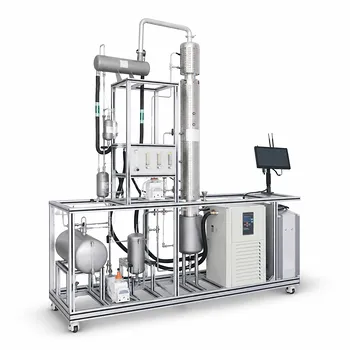
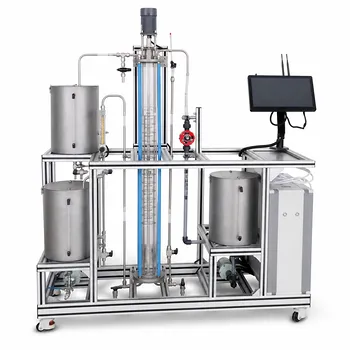
Our advanced distillation columns feature industrial-grade instrumentation and clear sight glasses, allowing users to safely analyze downcomer backup height, pressure drops, and flooding limits.
Ready to upgrade your laboratory? Contact us today to explore our custom pilot plant solutions and request a quotation!
Related Products
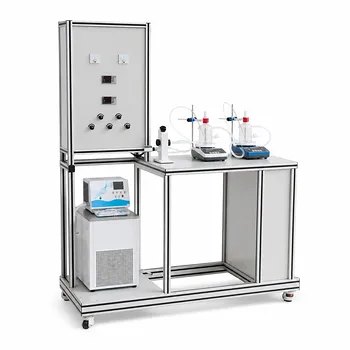
- Multi-Functional Special Distillation Educational Pilot Plant
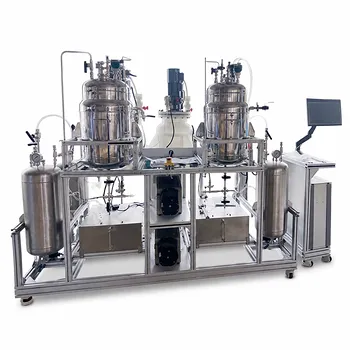
- Continuous Batch Extractive Distillation Educational Pilot Plant
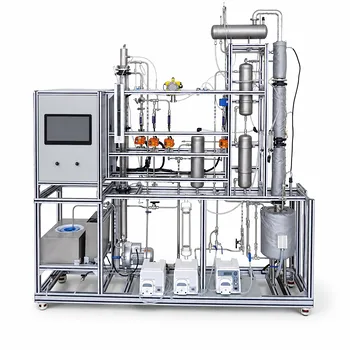
- Continuous Sieve-Plate Distillation Pilot Plant for Unit Operations Laboratory Education
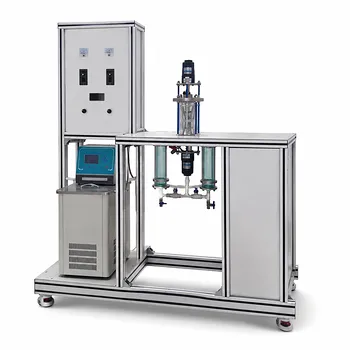
- Educational Rotary Disc Liquid-Liquid Extraction Pilot Plant
- Multi-Modal Distillation Unit Operations Training Pilot Plant
People Also Ask
- Why does simple distillation yield higher efficiency than flash distillation? Key thermodynamic differences.
- Why is the acentric factor important in pilot plants? Fluid property prediction.
- How Batch vs Continuous Configuration Affects Distillation Pilot Plant Versatility & Footprint
- How to Integrate Spectroscopy in Distillation Pilot Plants for Advanced Process Control
- How to Estimate Distillation Pilot Plant Tray Efficiency? O'Connell's Correlation Guide