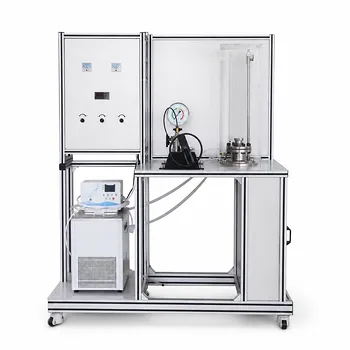
The lab-scale distillation setup for nitrogen determination is a simple analytical tool; an educational pilot plant is a complex process simulator. The first is a glassware assembly—often a Kjeldahl distillation unit—designed solely to isolate ammonia from a digested coordination compound so its nitrogen content can be titrated and quantified. The second is a scaled‑down industrial column, packed with trays or structured packing, that deliberately manipulates reflux, thermodynamic stages, and mass transfer to teach chemical engineering principles. In essence, the benchtop glassware answers “how much nitrogen is present?”; the pilot plant answers “how do we design a separation process that is efficient, safe, and scalable?”
The fundamental divide is one of purpose and complexity. A laboratory ammonia distillation performs a single, quantitative separation for chemical analysis. An educational pilot plant simulates an entire industrial unit operation—complete with reflux control, pressure drop measurement, and dynamic composition profiles—to train engineers in process design, troubleshooting, and the physical underpinnings of distillation.
The Scale Chasm: From Analytical Chemistry to Process Engineering
The two setups occupy opposite ends of the distillation landscape. Understanding their differences starts with what they are built to do.
The Analytical Workhorse: A Single-Stage Phase Transition
The glassware used for nitrogen determination (e.g., in cobalt complexes) is a simple distillation apparatus. Its goal is not purification but quantitative transfer.
The ammoniacal digest is heated, the vapor is swept through a condenser, and the ammonium ions are captured in a receiving solution of known acid. This is a single equilibrium stage, operated only long enough to ensure complete recovery. There is no intent to enrich a fraction—just to move a volatile species from one liquid matrix to another. Separation efficiency is judged by recovery percentage, not by product purity in an engineering sense.
The Industrial Simulator: Multi-Stage Rectification Under Control
Educational pilot plants, by contrast, are built around a rectification column. They may use sieve trays, random packing, or structured packing to provide multiple theoretical stages. Vapor rises from a reboiler; liquid is returned as reflux from an overhead condenser.
Unlike the analytical setup, the pilot plant intentionally creates a counter‑current flow of vapor and liquid. Temperature sensors at multiple heights, differential pressure transmitters, and programmable reflux dividers allow students to observe how altering the reflux ratio changes the composition profile in real time. The system is designed to teach the engineering art of balancing capacity, efficiency, and energy consumption.
Equipment Complexity: Glassware vs. Modular Process Skids
The gulf in hardware reflects the gulf in educational ambition.
The Benchtop Reality: Heating Mantle, Round Bottom Flask, Liebig Condenser
For nitrogen determination, the setup is minimal: a distillation flask connected to a splash head and a condenser, with a receiving flask at the outlet. The “control system” is often a Variac and a watchful eye. There are no trays, no reflux splitter, and no permanent instrumentation beyond a thermometer.
This simplicity is its strength: it focuses the student entirely on the chemistry—the digestion, the steam distillation of ammonia, and the subsequent back-titration. It is a tool for teaching stoichiometry and sample preparation, not distillation theory.
The Pilot Plant Reality: Columns, Reboilers, and Data Acquisition
Educational pilot plants feature vertical columns that may be several meters tall, fabricated from glass or stainless steel. They include:
- Reboilers with controlled heating jackets or electrical elements.
- Overhead condensers with precise cooling water flow control.
- Reflux controllers (automatic or manual) that split the condensate into distillate product and returning reflux.
- Instrumentation for temperature, pressure drop, and often flow rates, all logged via computer.
The student’s worksheet moves from calculating percent nitrogen to calculating the Fenske‑Underwood‑Gilliland equations, determining HETP (Height Equivalent to a Theoretical Plate), and mapping the flooding point of the column. The hardware teaches that distillation is a rate‑based, mass‑and‑energy‑balance‑driven operation.
Operational Principles: Single Equilibrium vs. Dynamic Mass Transfer
The core physics lessons differ dramatically.
The Analytical Separation: A Transient Recovery Process
In the Kjeldahl-like ammonia distillation, the overhead vapor composition changes continuously as ammonia is depleted from the boiling liquid. The process is unsteady-state and ends when the distillate stops turning litmus paper blue—no equilibrium is maintained. The separation is driven purely by the volatility difference between ammonia and the aqueous matrix, and it is never intended to reach a steady state.
The Pilot Plant Separation: Steady‑State Rectification
An educational pilot plant is often operated to reach a steady state (or it is deliberately run in a dynamic batch mode to study transients). In either mode, the fundamental mechanism is rectification: multiple vapor‑liquid equilibrium contacts achieved by reflux.
The column’s internal liquid downflow and vapor upflow create a composition gradient. The student sees that the top product’s purity depends on the reflux ratio, the number of stages, and the energy input to the reboiler. This turns a simple boiling process into a thermodynamic separation process with design variables. For mixtures with a boiling point difference less than 25 °C, a fractional column with many stages is essential—something the simple glassware cannot achieve.
Bridging the Gap: From Lab Chemistry to Unit Operations Training
The pilot plant is deliberately engineered to make the invisible visible.
Making Thermodynamics Tangible
In the analytical setup, the student sees bubbles and a condensate drip. In the pilot plant, they see a differential pressure gauge: a direct indicator of column loading. They can increase the reboiler duty and watch the pressure drop spike as the column approaches flooding, then reduce it to restore stable operation.
This visual, immediate cause-and-effect transforms abstract equations (like the Ergun equation for packed beds or tray hydraulics) into tactile experience. The pilot plant teaches that every stage is a miniature heat and mass exchanger.
Demonstrating Unsteady‑State Behavior
Batch distillation pilot plants are particularly favored in vocational training because they are inherently unsteady-state processes. Under constant reflux ratio, the overhead composition drifts continuously as the more volatile component is depleted. This forces students to grapple with process dynamics, sampling timing, and the concept of cut‑point control—concepts completely absent from the fixed‑endpoint ammonia distillation.
Understanding the Trade‑offs
The choice between a simple analytical distillation and a full pilot plant is not about which is “better,” but about what you need to teach.
When Analytical Simplicity Is a Drawback for Engineering Training
A student who has only performed the nitrogen‑determination distillation will have no intuition for:
- Column pressure drop and flooding: There is no packed height to generate it.
- Reflux policy and product purity: The simple setup has no reflux loop.
- Mass and energy balances around a multi‑stage column: The entire apparatus is a single hypothetical stage.
Relying solely on such a setup for distillation education leaves a huge gap in understanding industrial separations. It teaches phase change, but not process design.
When a Pilot Plant Is Overkill for Analytical Work
For a coordination chemist, the pilot plant’s complexity is a hindrance. The chemist needs a fast, quantitative ammonia recovery—not a study of HETP. The pilot plant’s hold‑up volume could lose product, its many joints could leak, and its cleaning demands between samples would be immense. The analytical distillation’s strength is its minimal dead volume and rapid turnaround.
Making the Right Choice for Your Educational Goal
The two systems serve different masters. Align your equipment choice with the learning outcome you want to achieve.
- If your goal is to teach quantitative chemical analysis and method validation: A simple Kjeldahl‑style or ammonia distillation setup is ideal. It trains precise lab technique, recovery checks, and the chemical logic of digestion‑distillation‑titration sequences.
- If your goal is to train chemical engineering undergraduates in unit operations: Select a modular pilot plant capable of running both simple batch and fractional rectification modes. It must include instruments for temperature, pressure, and flow, and allow students to adjust reflux ratio and feed position.
- If your goal is vocational training for plant operators: A batch distillation pilot plant that can handle multi‑component mixtures with frequent recipe changes is your best bet. It mimics real‑world flexibility and forces students to manage unsteady‑state conditions, cut points, and product fractionation logistics.
- If your goal is to compare pilot plant distillation with other mass transfer processes: Complement the distillation column with a gas absorption column on the same skid. This side‑by‑side comparison teaches the fundamental difference between creating vapor‑liquid contact via boiling (distillation) versus introducing an external liquid solvent (absorption).
Ultimately, the analytical glassware turns a chemist’s sample into a number; the pilot plant turns engineering theory into an industrial reality—each irreplaceable in its own sphere.
Summary Table:
| Feature | Lab-Scale Distillation (Analytical) | Educational Pilot Plant (Unit Operations) |
|---|---|---|
| Primary Purpose | Quantitative chemical analysis (e.g., Nitrogen determination) | Process engineering training & scale-up simulation |
| Apparatus | Simple glassware (flask, condenser, receiver) | Modular column (sieve trays/packing, reboiler, sensors) |
| Stages | Single equilibrium stage | Multi-stage rectification (counter-current flow) |
| Process State | Transient/Unsteady-state | Steady-state or dynamic batch mode |
| Key Metrics | Recovery percentage | HETP, reflux ratio, pressure drop, flooding point |
Ready to elevate your engineering curriculum or research capabilities? LABPARK provides premium Educational and Vocational Unit Operations Pilot Plants in chemical engineering, bioprocess & biotech, and environmental & water treatment. Designed specifically for universities, research institutes, and enterprises, our systems bridge the gap between benchtop chemistry and industrial reality. Contact us today to find the perfect pilot plant setup for your lab!
Related Products
- Multi-Modal Distillation Unit Operations Training Pilot Plant
- Continuous Sieve-Plate Distillation Pilot Plant for Unit Operations Laboratory Education
- Multi-Functional Special Distillation Educational Pilot Plant
- Electrolyte Distillation Purification and Formulation Educational Pilot Plant
- Dual-Mode Rectification Pilot Plant for Practical Training Unit Operations
People Also Ask
- How can energy balance equations for condensers & reboilers be validated experimentally? Guide
- How do distillation pilot plants validate VLE data? Achieve reliable solvent separation scale-up.
- Why is vacuum operation capability an essential feature for a distillation unit operations pilot plant? Unlock Efficiency
- How can real-time carbon number prediction improve distillation pilot plants? Optimize control.
- How does catalyst water concentration affect distillation pilot plant design? Key separation train choices.