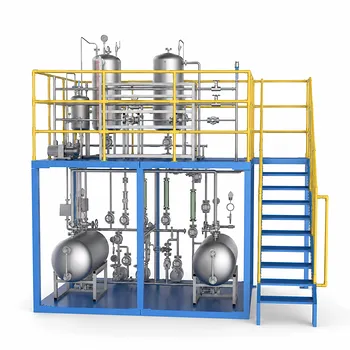
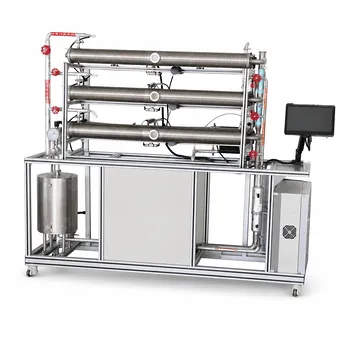
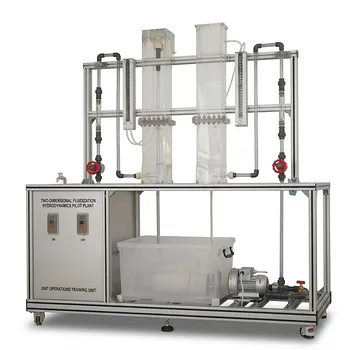
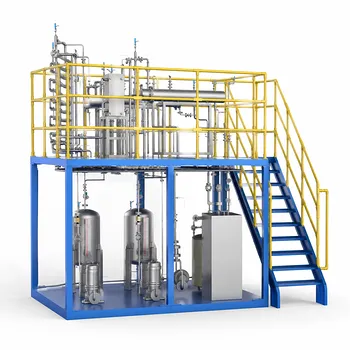
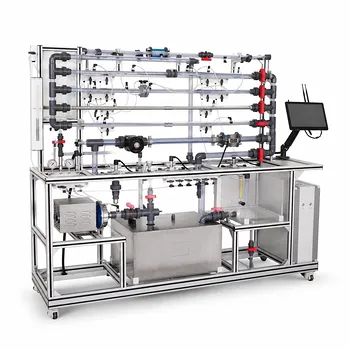
The integration of miniplant techniques with mathematical simulation delivers a clear, powerful benefit: it lets you leapfrog traditional piloting stages, dramatically shrinking development timelines while preserving—and often enhancing—the reliability of scale-up data. In unit operations pilot plants, this combined approach saves significant time and capital by enabling researchers to analyze process conditions, optimize operations, and model real industrial behavior with minimal raw material consumption, moving directly from laboratory findings to commercial design.
In short, pairing a scaled-down miniplant with rigorous process modeling yields industrial-grade scale-up data at a fraction of the cost and time. This synergy eliminates the need for a costly, bulky pilot plant while still revealing the hidden, long-term behaviors—like impurity accumulation and catalyst deactivation—that can derail large-scale production.
How the Synergy Works: Miniplant + Simulation
The power lies in the interplay between a physical miniature plant and a virtual process model. Each fills a gap the other cannot address alone, creating a feedback loop that builds confidence rapidly.
The Miniplant as a Physical Truth Machine
A miniplant is a fully recycled, scaled-down version of the projected commercial plant, typically running at just 0.01 to 1 kg/h. It uses standard, reusable laboratory components, which keeps initial investment low and operational flexibility high.
Because it includes all recycle loops, the miniplant can run continuously for days or weeks. This is what reveals the process’s real character.
The Simulation as a Predictive Accelerator
Mathematical process simulations model the chemistry and physics—reaction kinetics, mass and energy balances, transport phenomena—across different scales. They let you test “what-if” scenarios instantly and map the design space before any metal is cut.
When fed with empirical data from the miniplant, the simulation becomes a highly reliable predictive engine, vastly reducing the trial-and-error typically required at the pilot stage.
Closing the Validation Loop
The real magic happens when the two work together. Researchers run the miniplant, collect data on material balances, cycle times, and by-product formation, then feed that data into the simulation to calibrate the model. The refined model, in turn, predicts the impact of scale, points to hidden bottlenecks, and guides the next miniplant experiment. This iterative loop validates assumptions quickly and allows scale-up factors to jump directly from lab to commercial, bypassing the intermediate pilot plant.
The Scientific Edge: Reliability Without the Bulk
Why does this approach produce data you can actually trust for scale-up? Because it solves the root cause of most scale-up failures: the gulf between idealized lab conditions and messy industrial reality.
Uncovering the Long-Term Truths
Lab-scale experiments usually run with pure starting materials for short durations and focus primarily on initial activity. They miss the insidious problems that only appear over time.
A closed-loop miniplant run continuously exposes:
- Accumulation of impurities in recycle streams that can poison catalysts or shift equilibria.
- Long-term catalyst deactivation (e.g., coking) that short tests hide.
- Unforeseen thermal or kinetic limitations under realistic, sustained conditions.
Mathematical models calibrated with this long-duration data become capable of predicting these effects at the commercial scale, something a model built from flask data never could.
Validating Physical and Chemical Shifts
Reactions that proceed smoothly on a gram scale often behave differently—sometimes catastrophically—when volumes increase due to changes in heat and mass transfer. The miniplant serves as a semiworks to study reaction behavior under controlled, yet scaled-down conditions.
Researchers can verify whether mixing, heat removal, or mass transfer truly remains adequate, and they can optimize parameters like temperature and concentration empirically. The validated simulation then extrapolates these findings, quantifying how much worse or better things will get at the 10,000-liter reactor.
Stress-Testing the Process Safely
Unit operations pilot plants configured as miniplants allow researchers to safely introduce deliberate process upsets, test multivariate designs, and push the system to its limits.
By collecting crash data under controlled conditions, teams can perform realistic risk assessments, identify failure modes, and refine operating envelopes—all before a single commercial batch is made. This empirical substantiation turns the simulation from a theoretical guess into a reliable engineering tool.
Bridging Academia and Industry
This integrated methodology isn’t just an R&D shortcut—it’s a training imperative that aligns educational outcomes with the industry’s shift toward predictive engineering.
Engineering Judgment at Scale
When students and future engineers operate a unit operations pilot plant with both a physical miniplant and its digital twin, they gain hands-on experience in analyzing process scalability and modeling transport phenomena.
They witness firsthand how physical dynamics change at different scales, and they learn to interpret the gap between simulation and reality. This cultivates the critical judgment needed to assess vendor scale-up claims or to lead a scale-up project confidently.
Reducing R&D Costs Through Competence
The same skills that accelerate commercial scale-up also lower development costs. Practicing on a miniplant teaches researchers to extract maximum information from minimal material, run efficient experiment campaigns, and avoid expensive dead ends.
For universities and research institutes, this means graduates and researchers leave with the ability to design experiments that directly validate mathematical models, shrinking the timeline from discovery to clinical supply or commercial production for drug substances and fine chemicals.
Understanding the Trade-offs
No methodology is without limitations. While the miniplant-simulation combination is extraordinarily powerful, objective assessment reveals where it falls short.
Miniplants do not perfectly replicate all scale-up physics. Macro-scale phenomena like large-feed-nozzle injection patterns, full-scale heat exchanger fouling, or industrial-grade pump cavitation cannot be fully captured in a kg/h setup. The simulation must fill these gaps, but the model is only as good as the assumptions coded into it.
Model validation demands high experimental rigor. If the miniplant is not operated accurately—if recycle loops don’t close, if sensors drift—the calibrated model will be faulty, and its scale-up predictions will be dangerously optimistic or pessimistic. Success requires skilled operators and meticulous data hygiene.
Not all chemistry tolerates extreme scale-down. Highly exothermic reactions, certain crystallizations, or processes with ultra-low by-product thresholds can be unrealistic to run in a miniplant without distorting the physics. In such cases, an intermediate pilot stage might still be necessary.
The technique replaces the conventional pilot, but not the need for experienced engineering judgment. The integrated approach generates massive amounts of data; interpreting it still requires someone who understands the difference between a meaningful trend and a modeling artifact.
Making the Right Choice for Your Goal
The decision to adopt a miniplant-plus-simulation strategy should be guided by what you are trying to achieve. The benefits are undeniable, but alignment with your primary focus is what turns a good technique into a breakthrough.
- If your primary focus is slashing development time: Leverage this integration to skip the large-scale pilot. The iterative miniplant-simulation loop will deliver reliable scale-up data in weeks rather than months, letting you make commercial design decisions faster.
- If your primary focus is uncovering hidden process risks: Use the miniplant’s continuous recycle operation to expose long-term deactivation and impurity accumulation. This data, fed into your simulation, will reveal failure modes that flask studies could never predict.
- If your primary focus is training future engineers: Embed this methodology in your unit operations plant curriculum. It teaches students to validate models with real data and to think critically about scale-up, exactly as modern industry demands.
- If your primary focus is controlling R&D costs: Start with a miniplant built from standard components and a well-structured simulation. The combined capital and operating expense is a fraction of a traditional pilot program, yet the data quality for process synthesis and equipment sizing is comparable.
When you marry the physical truth of a miniplant to the predictive speed of mathematical simulation, you don't just speed up scale-up—you transform it from a costly gamble into a systematic engineering practice.
Summary Table:
| Aspect | Miniplant | Simulation | Integrated Approach |
|---|---|---|---|
| Primary Role | Physical validation (recycle loops, impurities) | Virtual prediction (kinetics, mass/energy balance) | Fast-track scale-up with calibrated models |
| Key Benefit | Realistic long-term data at 0.01–1 kg/h | Rapid "what-if" testing and design space mapping | Bypasses traditional pilot stage, cutting R&D costs |
| Limitation | Doesn't capture macro-scale physics | Accuracy depends on assumptions/empirical input | Requires high experimental rigor and skilled operators |
Accelerate Your Process Scale-Up with LABPARK
Ready to bridge the gap between laboratory research and commercial production? LABPARK provides state-of-the-art Educational and Vocational Unit Operations Pilot Plants in chemical engineering, bioprocess & biotech, and environmental & water treatment.
Whether you are a university training the next generation of engineers, or a research institute/enterprise aiming to optimize processes and minimize R&D costs, our customizable systems deliver the reliable data you need.
Contact LABPARK today to discuss your project requirements!
Related Products
- General Purpose Cosmetics Production Unit Operations Training Pilot Plant
- Multi Pump Fluid Transport Process Piping Unit Operations Training Pilot Plant
- Multi-Functional Drying Educational Unit Operations Pilot Plant
- Fixed-Bed Chemical Reaction and Gas Dust Tar Removal Unit Operations Pilot Plant
- 100L Continuous Loop Hydrogenation Educational Unit Operations Pilot Plant
People Also Ask
- How do deviations in estimating latent heat impact pilot plant thermal systems? Avoid hardware mis-sizing.
- Why is the chemical plant startup schedule crucial? De-risk scale-up with pilot plants.
- When to transition from PID to adaptive control in pilot plants? Key process indicators.
- Why Compare Predicted and Experimental Excess Enthalpy? Key to Accurate Pilot Plant Scale-up
- Why Use PTFE & Hastelloy in Chemical Pilot Plants? Prevent Corrosion & Ensure Safety