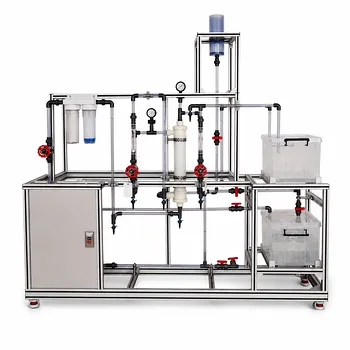
Donnan exclusion is the gatekeeper of ion-exchange membrane selectivity, dictating which ions can cross and which are rejected. In chemical engineering unit operations like electrodialysis or diffusion dialysis, this principle allows membranes to preferentially transport counterions while blocking co-ions. However, as the external salt concentration rises, co-ion leakage increases, degrading both selectivity and process efficiency.
While Donnan exclusion provides the fundamental mechanism for ion separation, its effectiveness erodes at high feed concentrations. The key to robust performance is maintaining a membrane’s fixed ion-exchange capacity significantly above the solution concentration, ensuring low co-ion sorption and preserving permselectivity.
The Underpinning Physics of Ion Rejection
Ion-exchange membranes carry fixed functional groups that are either negatively (for cation-exchange) or positively charged (for anion-exchange). This fixed charge creates a microscopic electrical environment that governs ion partitioning.
The Charge-Based Barrier
When a membrane is immersed in a salt solution, the fixed charges repel ions of the same sign—the co-ions—while attracting oppositely charged counterions. This is the Donnan exclusion effect at its core. It’s not a physical sieve but an electrostatic gate.
The Inevitable Co-ion Leakage
Even a perfectly manufactured membrane cannot exclude all co-ions. Water absorption into the polymer matrix creates a pathway. Driven by a chemical potential gradient, some co-ions inevitably enter the membrane phase from the bulk solution.
To maintain electroneutrality inside the membrane, every co-ion that enters must be accompanied by an equivalent charge of counterions. This salt absorption is what ultimately limits permselectivity.
Quantifying the Selectivity Erosion
Permselectivity, often expressed as the apparent transport number of counterions, is the practical measure of selectivity. When co-ions leak into the membrane, they carry current in the opposite direction during electrodialysis, reducing the net transport of the desired ion. The higher the bulk solution concentration, the smaller the Donnan potential difference, and the more salt enters—directly lowering the separation factor achievable.
How Feed Concentration Compromises Operations
The Donnan equation quantifies this relationship. It shows that the co-ion concentration inside the membrane scales with the square of the external salt activity for a 1:1 electrolyte, making the effect nonlinear and concentration-dependent.
The Efficiency Penalty: From Purity to Energy Costs
In practice, co-ion leakage causes two major problems. First, product purity drops because counterions of the co-ion also cross, contaminating the receiving stream. In electrodialysis, for example, this means salt bypasses the membrane stack and ends up in the diluate, reducing desalination efficiency.
Second, current efficiency plummets. Every co-ion that traverses the membrane wastes electrical energy without contributing to separation. The result is higher energy consumption per unit of product and often larger, more expensive equipment to compensate.
A Design Balancing Act
The primary reference highlights that for lab- and pilot-scale units, the membrane ion-exchange capacity must be substantially higher than the feed solution concentration. This ensures that the fixed charge density dominates the internal ionic environment, swamping out the absorbed electrolyte. In high-capacity membranes, even at moderate salinity, the co-ion concentration remains a small fraction, preserving selectivity.
Understanding the Trade-offs
No membrane is a universal solution. The Donnan-based selectivity ceiling forces engineers to navigate a complex trade-off landscape.
The Concentration Ceiling
Membranes with a given fixed charge density will fail to deliver adequate selectivity once the external salt concentration approaches and exceeds that capacity. For processes treating brine streams or concentrated chemical solutions, standard ion-exchange membranes become virtually non-selective. Specialized, high-capacity films or alternative separation techniques may be required.
The Pitfall of Overlooking Feed Variability
Pilot plants often validate performance under idealized, low-concentration conditions. However, real chemical engineering unit operations face fluctuating feeds. A dip in membrane capacity from fouling or a spike in salinity can suddenly push the system past its Donnan exclusion limit, causing a rapid and unexpected loss of yield or purity. Continuous monitoring of water quality and membrane health is therefore mandatory.
Membrane Swelling and Mechanical Integrity
Higher fixed charge densities improve Donnan exclusion but increase water uptake and swelling. Excessive swelling reduces mechanical strength and can alter the membrane’s morphology, potentially creating new leakage pathways. The ideal membrane must balance high ion-exchange capacity with dimensional stability, a compromise that often defines the success of a design.
Making the Right Choice for Your Goal
Whether you are designing a new membrane system or troubleshooting an existing unit, aligning your strategy with the Donnan reality is essential.
- If your primary focus is maximum product purity: Select a membrane with the highest practical ion-exchange capacity relative to your average feed concentration, and operate well below the concentration threshold where co-ion leakage accelerates.
- If your primary focus is energy efficiency: Avoid running the process at concentrations where current efficiency drops sharply. Pre-dilute the feed or stage the operation to keep the salinity in the region where permselectivity remains above 95%.
- If your primary focus is treating variable or high‑salinity feeds: Consider alternative membrane architectures, such as bipolar or mosaic membranes, or adopt a hybrid process that couples ion exchange with thermal or pressure-driven separation to manage the load beyond Donnan’s limits.
- If your primary focus is long‑term operational stability: Prioritize membranes with crosslinked polymer matrices that offer high capacity with low swelling, and implement a rigorous CIP (clean-in-place) schedule to prevent fouling from falsely mimicking Donnan failure.
Harnessing Donnan exclusion effectively means respecting its physical limits—when you design around these principles, the membrane transforms from a simple barrier into a precise, energy‑efficient separation tool.
Summary Table:
| Factor | Impact on Membrane | Operational Result |
|---|---|---|
| High Feed Concentration | Lowers Donnan potential; increases co-ion leakage | Decreased product purity & current efficiency |
| High Membrane Capacity | Strengthens electro-repulsion; blocks co-ions | Preserves permselectivity & process efficiency |
| High Polymer Swelling | Creates bypass water pathways in matrix | Compromised selectivity & mechanical integrity |
Optimize Your Unit Operations Training with LABPARK
Mastering complex membrane transport phenomena requires robust, hands-on training systems. LABPARK provides high-quality Educational and Vocational Unit Operations Pilot Plants in chemical engineering, bioprocess & biotech, and environmental & water treatment. Designed to meet the precise needs of universities, research institutes, and enterprises, our pilot units help students and researchers bridge the gap between membrane theory and real-world industrial performance.
Ready to elevate your engineering lab or training center? Contact LABPARK today to discuss your pilot plant requirements!
Related Products
- Ion Exchange Water Purification Educational Pilot Plant for Engineering Unit Operations
- Photocatalytic Membrane Separation and Degradation Unit Operations Pilot Plant
- Ultrafiltration Membrane Separation Educational Pilot Plant
- Alkaline Membrane Water Electrolysis Educational Pilot Plant Unit Operations Training System
- Multifunctional Membrane Separation Educational Pilot Plant with Ultrafiltration, Nanofiltration, Reverse Osmosis
People Also Ask
- How to Prevent Ion Exchange Channeling? Expert Solutions for Pilot Plants
- How does ion exchange work in water treatment pilot plants? Cost & process guide.
- What operational precautions should lab operators take for resin volume changes and air pockets? Key Guide
- How to use ion exchange pilot plants to verify alkalinity? A hands-on guide for engineering students.
- How can students use ion exchange pilot plants for column sizing? Master Wastewater Design