The choice of packing material is the single most decisive factor governing liquid wetting and effective interfacial area in your absorption column. Packing materials with a high critical surface tension (σc), such as steel (75 mN/m) or glass (73 mN/m), inherently attract and spread aqueous liquids into a continuous film. Conversely, low-energy plastics like polyethylene (33 mN/m) resist wetting, causing the liquid to bead up and channel, which drastically reduces the gas-liquid contact area and sabotages your mass transfer measurements.
The core insight is that mass transfer efficiency is not just about surface area in a catalog; it's about hydraulic reality. A packing material's inherent surface energy relative to your liquid's surface tension dictates whether that theoretical surface area ever actually becomes a wetted, functional interface. This single variable explains why geometrically identical packings made of steel versus plastic will yield wildly different experimental results.
The Fundamental Driver: Critical Surface Tension
Your absorption experiment's success hinges on a microscopic battle between cohesive and adhesive forces at the packing surface. This battle is fought and won based on the material's critical surface tension.
Wettability is a Material Property, Not a Geometric One
The critical surface tension (σc) is a thermodynamic property of the solid packing material. For complete wetting to occur, the packing's σc must be greater than the liquid's surface tension (σL). For water (σL ≈ 72 mN/m), this immediately disqualifies many bare polymers.
- High-Energy Surfaces (σc > 72 mN/m): Materials like stainless steel and glass possess surface energies above water's surface tension. This promotes spontaneous spreading, creating a stable, thin liquid film that maximizes contact.
- Low-Energy Surfaces (σc < 72 mN/m): Polymeric materials like polyethylene (33 mN/m) or paraffin (20 mN/m) create a non-wetting condition. The liquid resists spreading, forming rivulets and droplets, leaving vast amounts of dry, ineffective packing surface.
The Onda Correlation Quantifies the Effect
The relationship isn't just qualitative. The Onda correlation provides a theoretical framework to predict the ratio of the effective wetted area (a_w) to the total packing surface area. It reveals this ratio is a direct function of (σc / σL). When this ratio falls below a critical value, the wetted area collapses, demonstrating how surface chemistry trumps geometry as the primary control knob for interfacial area.
The Direct Consequence: Interfacial Area and Mass Transfer
A poorly wetted packing doesn't just look different; it fundamentally cripples the entire purpose of the pilot plant experiment. The effective interfacial area (a_e) plummets, directly sabotaging the mass transfer rate.
From Wetted Area to Mass Transfer Coefficient
The overall mass transfer coefficient (K_Ya) is the product of the overall coefficient (K_Y) and the effective interfacial area per unit volume (a). If poor wetting cuts your effective area by half, you've just halved your column's capacity for absorption, regardless of how favorable the gas-liquid kinetics are. This manifests experimentally as a dramatic increase in the height of a transfer unit (H_OG), the most direct indicator of lost column efficiency.
The Minimum Wetting Rate Hurdle
Surface chemistry also dictates operational stability through the minimum wetting rate (Q_min). This is the lowest liquid flow rate required to maintain a continuous film. Because materials like PTFE or polypropylene resist film formation, they have much higher Q_min values than rough ceramics or surface-treated metals. Operating a plastic-packed column below its Q_min leads to film breakup, channeling, and a catastrophic loss of effective area, setting a hard operational limit that metal/ceramic packings may not face.
Understanding the Trade-offs
While high critical surface tension materials are hydrodynamically superior, a purely material-science-driven decision is insufficient. You must navigate a matrix of practical constraints that often force a compromise.
The Corrosion and Chemical Compatibility Trade-off
Steel's high surface energy is irrelevant if your absorption system involves acids. Glass provides excellent wettability but is fragile and heavy. This is where the strategy of hydrophilizing polymeric packings becomes critical. Chemical treatments can raise the critical surface tension of a chemically inert, lightweight plastic to 54 mN/m, partially closing the performance gap while retaining corrosion resistance. The trade-off is cost and treatment longevity.
The Geometry vs. Material False Choice
Do not fall into the trap of believing you fix wetting problems with smaller packing. While smaller packings offer higher specific surface area, if the material's surface energy is too low, that additional area remains dry and is simply added pressure drop with no performance benefit. Geometry provides potential area; surface chemistry determines usable area. They must be solved in sequence, not traded off against each other.
Making the Right Choice for Your Experiment
Your experimental goal should dictate your material selection strategy. The "best" material is the one that aligns with your true objective.
- If your primary focus is maximizing separation efficiency and obtaining textbook mass transfer data: Select an untreated high-energy material like glass or stainless steel for aqueous systems. This guarantees maximum wetting, minimizes the effective interfacial area as a confounding variable, and provides a clean baseline with the lowest H_OG.
- If your primary focus is mimicking industrial reality for an acidic or corrosive gas stream: Choose a corrosion-resistant polymer but aggressively investigate hydrophilized grades (σc near 54 mN/m). Accept a performance penalty over metal, but document the difference as a key learning outcome of your pilot study.
- If your primary focus is an educational comparison of transport phenomena: Build a matrixed experiment. Run identical geometric packings in steel, ceramic, and untreated polypropylene at the same flow rates. The measured differences in K_Ya and pressure drop will be a stark, unforgettable lesson that separation is an interfacial phenomenon controlled first by surface chemistry.
A successful absorption experiment begins not at the gas cylinder or the liquid pump, but in the deliberate selection of a packing material whose surface energy fully serves your experimental objectives.
Summary Table:
| Material | Critical Surface Tension (σc) | Wetting Behavior | Best For |
|---|---|---|---|
| Stainless Steel | ~75 mN/m | High spreading, stable film | High-efficiency aqueous absorption |
| Glass | ~73 mN/m | Excellent wetting, no bead-up | Visual studies, corrosive systems |
| Polyethylene | ~33 mN/m | Low wetting, forms droplets | Acidic streams (requires treatment) |
| PTFE / Paraffin | ~20 mN/m | Extremely poor, high channeling | Severe chemical corrosion resistance |
Elevate Your Chemical Engineering Experiments with LABPARK
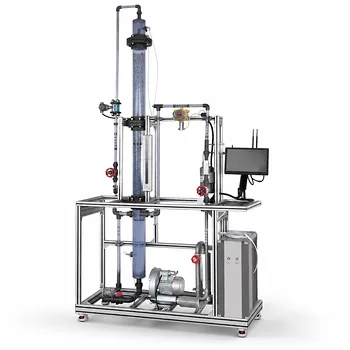
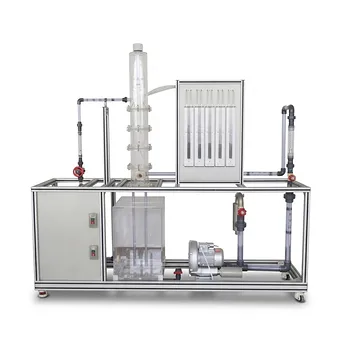
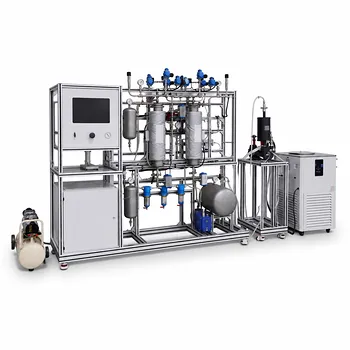
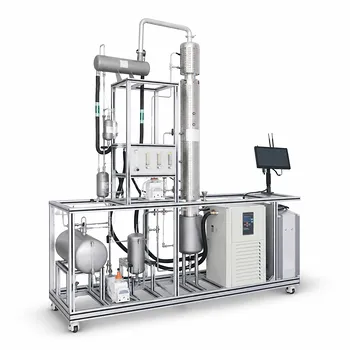
Choosing the right column configuration is critical for accurate research and educational outcomes. LABPARK provides state-of-the-art Educational and Vocational Unit Operations Pilot Plants in chemical engineering, bioprocess & biotech, and environmental & water treatment. Designed specifically for universities, research institutes, and enterprises, our systems ensure precise process control and reliable data.
Ready to upgrade your lab's capabilities? Contact us today to discuss your project needs!
Related Products
- Packed Bed Absorption Educational Unit Operations Pilot Plant
- Multimodal Absorption and Desorption Pilot Plant for Unit Operations Training
- Absorption and Desorption Educational Unit Operations Pilot Plant
- High-Gravity Emulsification and Mass Transfer Educational Pilot Plant
- Plate Column Hydrodynamics Tray Demonstration Educational Pilot Plant
People Also Ask
- How Do Flow Regimes Transition in Packed Bed Pilot Plants? Key Scale-up Insights
- How does reactant concentration determine absorption column control? Gas-film vs. dual-film.
- How is the packing height of an absorption column calculated? Master HTU & NTU Concepts
- How does static vs. operating holdup affect pilot plant calibration? Avoid Critical Scale-Up Errors
- Why is counter-current flow selected for gas absorption? Maximize Pilot Plant Efficiency