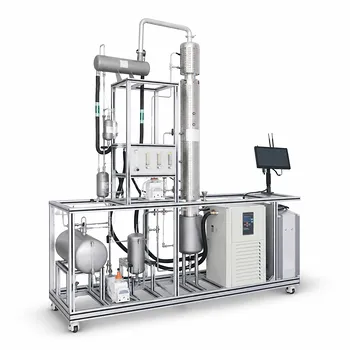
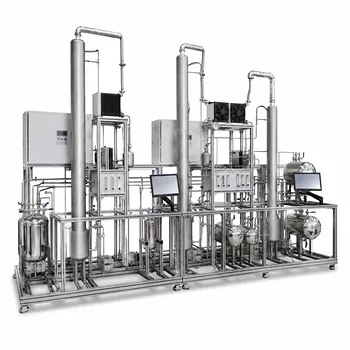
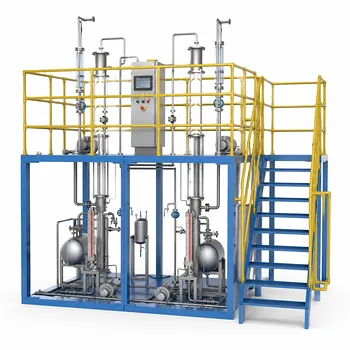
The Antoine equation isn't just a formula—it's the fundamental blueprint for thermal control in your distillation pilot plant. It directly converts temperature data into the predicted vapor pressures of your chemical components. This relationship allows you to pinpoint the precise thermodynamic boundaries—the bubble and dew points—where separation occurs, guiding the design of your heating strategy, condenser operation, and column pressure controls to keep the system stable and efficient.
Pilot plants using fractional distillation succeed or fail on the prediction of vapor-liquid equilibrium. The Antoine equation translates a temperature reading into a vapor pressure value, which defines the exact operating window for your column. Managing this window is what prevents thermal degradation, controls boiling rates, and ensures the target purity is physically achievable.
Defining the Operating Window for Temperature
A fractional distillation pilot plant doesn't just "boil" a mixture; it must initiate boiling at a precise, predictable thermodynamic state. The Antoine equation is the tool that lets you calculate that state.
Calculating the Startup Point with the Bubble Point
To begin distillation, you must heat the liquid in the reboiler until it boils. The Antoine equation calculates the bubble point temperature at your column's operating pressure. By inputting your feed composition and desired pressure, you can use the equation to find the exact temperature where the first vapor bubble forms. This prevents a trial-and-error approach to setting your initial reboiler duty, ensuring you achieve vaporization efficiently without immediately overheating and potentially degrading heat-sensitive materials.
Preventing Damage with a Controlled Thermal Differential
The exponential relationship described by the Antoine equation highlights the danger of excessive heat. During scale-up in a batch distillation pilot plant, controlling the jacket delta T is critical. The equation clarifies why a maximum temperature differential of 30°C across the vessel jacket is a common rule of thumb. Exceeding this doesn't just increase the boil-up rate linearly; it can cause a dangerous spike in local vapor pressure at the vessel wall, leading to product degradation before the bulk liquid even reaches a higher average temperature.
Mapping the Separation Landscape
Distillation requires a thermal gradient. The top of the column must be cold enough for condensation, while the bottom is hot enough for vaporization. The Antoine equation predicts the vapor pressure for each component at every tray temperature. This allows you to map the desired temperature profile along the column's height, setting the stage for effective mass transfer. Your control system uses this profile as a target, adjusting heating and cooling to maintain the precise thermal gradient that favors the separation of your key components.
The Stability Mandate: Controlling Operating Pressure
Temperature cannot be controlled in isolation. The operating pressure is the co-pilot that dictates the entire thermal landscape, and the Antoine equation provides the logic for choosing it.
Setting the Condenser and Reboiler Boundaries
The practically achievable temperatures for your condenser (usually cooling water at ~40°C) and reboiler (often limiting steam below 180°C) define the absolute pressure limits for your pilot plant.
You use the Antoine equation to calculate the bubble point pressure of your top product at the cooling water temperature. This gives you the p_min—operate below this, and you won't achieve condensation with standard utilities. Similarly, you calculate the bubble point pressure of your bottom product at the maximum safe heating steam temperature to find p_max, preventing thermal decomposition in the reboiler.
Selecting the Right Pressure Regime for Heat-Sensitive Materials
For biological or pharmaceutical compounds, thermal degradation is a primary concern. The Antoine equation is the first tool you turn to for designing a vacuum distillation process. By applying the equation, you can determine exactly how much to reduce the operating pressure to lower the boiling points of your mixture below a safe threshold. Operating at a pressure significantly less than atmospheric (p < 0.1 MPa) is a direct, calculated response to an equation that quantifies the exponential drop in boiling point with reduced pressure.
Balancing Economics and Column Efficiency
The chosen pressure doesn't just affect temperature; it changes the vapor density and, therefore, the column's hydrodynamics. The Antoine equation helps you find the sweet spot. While you might be tempted to use vacuum to simplify thermal control, the reduced vapor density increases the required column diameter for the same throughput. Using the equation to model separation under moderate pressures (0.1–1 MPa) helps you design the most economical column—one that balances a manageable boiling point with a compact, efficient column size that doesn't require ultra-thick walls for high-pressure containment.
Preventing Catastrophe: The Role in Hydrodynamics
Beyond thermodynamics, the principles derived from the Antoine equation are essential for teaching operators to avoid flooding, a common and destructive failure mode in pilot plants.
From Vapor Pressure to Vapor Velocity
The Antoine equation predicts the quantity of vapor generated for a given heat input. This directly dictates the vapor velocity rising through the column. A small, uncalculated increase in reboiler temperature will cause an unexpectedly large increase in vapor volume and velocity due to the exponential relationship. This surge is the primary trigger for column flooding, where high-speed vapor physically prevents liquid from flowing downward through the packing.
Using Instrumentation as a Teaching Tool
A pilot plant is an educational instrument. The pressure drop readings across the column are a direct, real-time reflection of the vapor velocity predicted by the Antoine equation. By monitoring pressure sensors, an operator learns to correlate a climbing pressure drop with an excessive vapor load. The adjustable heating controls are not just for setting a temperature; they are the primary tool for regulating vapor velocity. The understanding that a slight reduction in heat can dramatically reduce vapor pressure and resolve an incipient flood is a core lesson enabled by the Antoine equation's logic.
Why Following the Blueprint is Non-Negotiable
Ignoring the guidance of the Antoine equation leads to specific, predictable failures. Understanding these pitfalls is as important as understanding the ideal operation.
- Thermal Degradation: Operating at a higher temperature than necessary, even by a few degrees, can exponentially increase the degradation rate of a sensitive molecule. The Antoine equation predicts the minimum viable temperature, and your process should not stray from it without cause.
- Energy Inefficiency: An unnecessarily high reboiler temperature consumes more thermal energy (proportional to the molar heat of vaporization) than required. The equation guides you to the precise thermodynamic work point, minimizing utility consumption.
- Column Instability: Failing to link temperature to vapor pressure leads to unstable operation. You risk oscillating between a state of insufficient vaporization (causing a dry column and zero separation) and a flooded column where separation collapses entirely.
Making the Right Choice for Your Pilot Plant
Your operational strategy must be directly linked to your chemical mixture's properties as revealed by the Antoine equation.
- If your primary focus is a thermally sensitive, high-value product: Use the equation to calculate the precise vacuum level needed to keep the reboiler temperature safely below the degradation threshold, even if it requires a larger column diameter.
- If your primary focus is rapid process demonstration and operator training: Prioritize moderate pressure operation (0.1-1 MPa) and use the exponential vapor pressure relationship to teach the critical link between heat input, vapor velocity, and flooding prevention.
- If your primary focus is a multicomponent mixture with unknown thermal limits: Start by modeling the lightest and heaviest key components with the Antoine equation to find a safe, wide operating window before running a slow thermal ramp to verify the predicted bubble point curve.
The Antoine equation translates a fundamental physical property into an actionable control philosophy, empowering you to design a pilot plant that is not just operational, but truly instructive.
Summary Table:
| Control Area | Role of the Antoine Equation | Practical Process Benefit |
|---|---|---|
| Startup & Boiling | Calculates bubble point temperature | Prevents trial-and-error reboiler heating & thermal degradation |
| Pressure Design | Sets condenser/reboiler pressure limits | Safeguards heat-sensitive materials via vacuum operation |
| Hydrodynamics | Predicts vapor velocity from heat input | Prevents column flooding and maintains column stability |
Bridge Theory and Practice with LABPARK Pilot Plants
Ready to enhance your engineering curriculum or research capabilities? LABPARK provides state-of-the-art Educational and Vocational Unit Operations Pilot Plants in chemical engineering, bioprocess & biotech, and environmental & water treatment.
Specially designed for universities, research institutes, and enterprises, our pilot plants allow students and researchers to visualize thermodynamic equations and master process control hands-on.
Contact our engineering team today to find the perfect pilot plant solution for your facility!
Related Products
- Multi-Modal Distillation Unit Operations Training Pilot Plant
- Continuous Sieve-Plate Distillation Pilot Plant for Unit Operations Laboratory Education
- Dual-Mode Rectification Pilot Plant for Practical Training Unit Operations
- Green Anhydrous Ethanol Purification Extractive Distillation Unit Operations Training Pilot Plant
- Ethyl Acetate Synthesis Unit Operations Pilot Plant for Practical Training
People Also Ask
- How can energy balance equations for condensers & reboilers be validated experimentally? Guide
- What are the primary reflux ratio control strategies? Master Distillation Unit Operations
- How can real-time carbon number prediction improve distillation pilot plants? Optimize control.
- Why is vacuum operation capability an essential feature for a distillation unit operations pilot plant? Unlock Efficiency
- How does catalyst water concentration affect distillation pilot plant design? Key separation train choices.