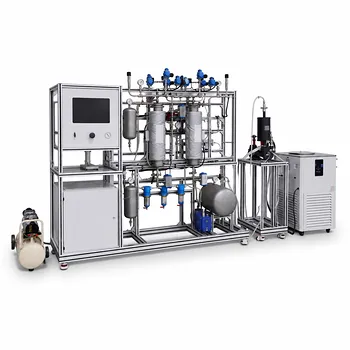
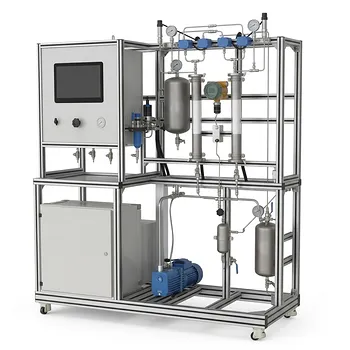
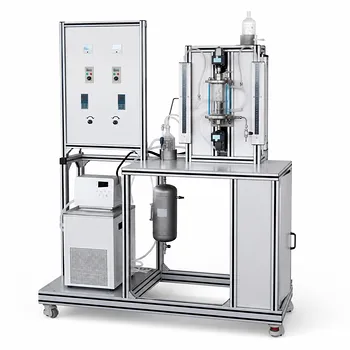
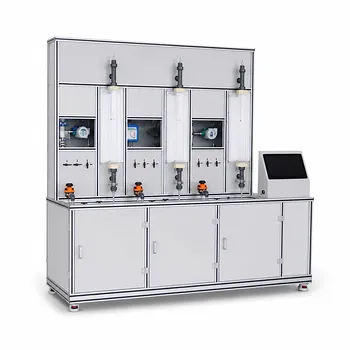
Adding column packings transforms an empty bubble column from a high-backmixing, large-bubble system into a low-backmixing, high-interfacial-area contactor with dramatically improved mass transfer efficiency. In a gas‑liquid unit operations pilot plant, the introduction of high‑porosity screen packings (void fraction ≈0.90) immediately limits bubble coalescence. This yields smaller bubbles that rise at a lower velocity, slashing backmixing in both phases while simultaneously boosting gas holdup and the specific gas‑liquid interfacial area. The result is a markedly more efficient column ideal for demonstrating enhanced absorption or stripping, and the accompanying pressure drop increase is typically negligible.
The core advantage of packed columns over empty bubble columns lies in their ability to suppress bubble coalescence and sustain rapid surface renewal. This delivers a higher gas‑liquid interfacial area, lower backmixing, and a steeper concentration gradient—all of which dramatically elevate mass transfer efficiency, at the cost of a minor pressure drop and a deliberate choice to sacrifice bulk liquid holdup.
How Packings Reshape Hydrodynamics
An empty gas‑liquid column behaves like a simple bubble column: large bubbles rise through a continuous liquid pool, triggering strong back‑mixing and limited interfacial area. Adding packings fundamentally changes that fluid‑dynamic signature.
Bubble Size and Rise Velocity
Packings impose a physical barrier that continuously breaks large bubbles. High‑porosity screens (porosity ~0.90) are especially effective because they split the gas path without choking the flow. The resulting smaller bubbles experience greater drag, so their rise velocity drops significantly. Lower rise velocity prolongs gas‑liquid contact time at a microscopic level.
Backmixing and Phase Dispersion
In an empty column, buoyancy‑driven circulation loops create intense axial mixing—backmixing—that smears out concentration profiles. Packings interrupt these loops by creating tortuous, compartmentalized pathways. Backmixing decreases in both the gas and liquid phases, bringing the system closer to plug‑flow behavior and preserving the concentration driving force along the entire column height.
Gas Holdup and Interfacial Area
Smaller, slower bubbles and the obstruction of free‑rising paths cause gas to accumulate more densely inside the column. Gas holdup increases substantially. Crucially, the same physical effect that yields smaller bubbles also multiplies the total gas‑liquid surface area available for mass transfer. This interfacial area can be an order of magnitude higher than in an empty bubble column.
The Inevitable but Minor Pressure Drop
Any internal structure imposes a flow resistance. Packed columns do experience a pressure drop, but when high‑porosity packings are used, the penalty is small—often low enough to be practically irrelevant in demonstration‑scale pilot plants. The hydraulic benefit of improved contact far outweighs this modest loss.
The Efficiency Leap: Mass Transfer Enhancement
Hydrodynamic changes directly feed into the column’s ability to transfer a component from one phase to the other. The efficiency gain is not incremental; it is transformative.
The Role of Surface Renewal and Penetration Theory
Liquid flowing over packing elements continuously breaks and reforms thin films. Penetration theory tells us that the mass transfer coefficient is inversely proportional to the square root of the fluid element’s exposure time. Frequent surface renewal sharply reduces that exposure time, maintaining a steep concentration gradient at the interface and dramatically accelerating absorption. In an empty column, liquid surface renewal is haphazard and slow; packings engineer it into a persistent, productive cycle.
Height of a Transfer Unit (HTU) and Packing Characteristics
The height of a transfer unit ($H_G$ or $H_L$) captures how much column length is needed to achieve a given change in concentration. These values depend on packing type, size, and gas/liquid velocities through relations like
$H_G = \alpha G^\beta W^\gamma (Sc_G)^{0.5}$.
Smaller packing elements offer a larger specific surface area, yielding lower HTU and greater efficiency per meter of column. Students operating pilot plants can test different packing sizes (e.g., 9.5 mm vs. 25 mm Raschig rings) and directly observe how a shorter mass transfer zone emerges with finer packings.
Film Theory and Fast Reactions
For a fast gas‑liquid reaction, the chemical transformation is completed entirely within the liquid film; the bulk liquid concentration of the dissolved gas is essentially zero. Here, interfacial area is the controlling variable, not liquid holdup. Packed columns excel because they deliver a far larger specific interfacial area than empty bubble columns, making them the superior choice for fast‑reaction regimes in educational and research pilot plants.
Understanding the Trade‑offs
No contactor design is universally perfect. Engineers and educators must weigh packing’s efficiency boost against specific operational limitations, especially when the column serves as a teaching tool.
When Liquid Holdup Matters: Packed vs. Empty Columns
The dimensionless ratio $\alpha_1$ (bulk liquid volume to liquid film volume) reveals stark differences. Packed columns distribute liquid as a thin film; their $\alpha_1$ values are low, typically $10$–$100$. Empty bubble columns immerse gas in a large continuous liquid volume, yielding $\alpha_1$ values of $100$–$10^4$. For slow or moderate reactions that need extended residence time in the bulk liquid, an empty bubble column’s high holdup is essential. Packed columns, despite their interfacial area advantage, would under‑perform because the reaction cannot complete in the film alone.
The Risk of Maldistribution and Channeling
Packing only works when the flow is uniformly distributed. Uneven packing, trapped air pockets, or poor initial liquid distribution can create preferential flow paths—channeling—that bypass the packing entirely. This drastically reduces effective interfacial area and can lead to results that are worse than those of an empty column. Teaching students proper wet packing (slurrying) and dry packing techniques at the pilot scale is critical for building reliable laboratory habits.
Pressure Drop vs. Performance
While the pressure drop increase with high‑porosity packings is small, it does rise if very small packing sizes or high gas flow rates are tested. Pilot plant experiments can demonstrate this trade‑off by plotting pressure drop against mass transfer coefficient for different packing types. The educational value lies in learning to select packings that balance acceptable pressure drop with target separation, a genuine industrial decision.
Making the Right Choice for Your Goal
The decision to add packings—and which type—should be driven by your pilot plant’s primary learning objective or reaction regime. Let the following priorities guide you.
- If your primary focus is maximizing mass transfer efficiency for fast gas‑liquid reactions: Choose a packed column with fine, high‑porosity packings. You will see a dramatic jump in interfacial area and surface renewal, far beyond what an empty column can provide.
- If your pilot plant objective is to observe and quantify the effects of backmixing on separation: Run side‑by‑side experiments with an empty bubble column and a packed column. The stark reduction in axial dispersion will make backmixing visible and measurable.
- If the reaction kinetics are slow and demand extended liquid residence time: Stick with the empty bubble column or a plate column. The large liquid holdup inherent to these designs gives the reaction the necessary time to approach equilibrium.
- If students are learning about column hydrodynamics and the impact of internals: Use the packed column to demonstrate bubble‑size control, pressure drop measurement, and the HTU concept. The hands‑on lessons in packing uniformity and surface renewal will build foundational process engineering intuition.
In every case, the addition of packings is not a one‑dimensional upgrade; it is a deliberate, physically elegant way to re‑engineer the column’s internal environment—giving you the power to trade backmixing for interfacial area and to tune efficiency to match the chemistry at hand.
Summary Table:
| Parameter / Feature | Packed Column | Empty Column (Bubble Column) |
|---|---|---|
| Bubble Size & Velocity | Small bubbles, low rise velocity | Large bubbles, high rise velocity |
| Backmixing (Dispersion) | Low (approaches plug-flow) | High (strong circulation loops) |
| Interfacial Area | Very High (thin films) | Low |
| Gas Holdup | High | Low |
| Pressure Drop | Minor increase | Negligible / None |
| Liquid Holdup ($\alpha_1$) | Low ($10\text{--}100$) | High ($100\text{--}10^4$) |
| Ideal Application | Fast reactions & mass transfer | Slow reactions needing residence time |
Enhance Your Engineering Curriculum with LABPARK
Looking to demonstrate advanced mass transfer, hydrodynamics, and column efficiency in your labs? LABPARK provides state-of-the-art Educational and Vocational Unit Operations Pilot Plants in chemical engineering, bioprocess & biotech, and environmental & water treatment.
Designed specifically for universities, research institutes, and enterprises, our modular pilot plants help students and researchers transition from theory to practice with hands-on, industry-grade equipment.
Ready to upgrade your laboratory capabilities? Contact LABPARK today to find the perfect pilot plant solution for your institution!
Related Products
- Packed Bed Absorption Educational Unit Operations Pilot Plant
- Educational Rotary Disc Liquid-Liquid Extraction Pilot Plant
- Absorption and Desorption Educational Unit Operations Pilot Plant
- Comprehensive Liquid-Liquid Extraction Pilot Plant for Engineering Education
- Multimodal Absorption and Desorption Pilot Plant for Unit Operations Training
People Also Ask
- How Do Flow Regimes Transition in Packed Bed Pilot Plants? Key Scale-up Insights
- How does reactant concentration determine absorption column control? Gas-film vs. dual-film.
- How is the packing height of an absorption column calculated? Master HTU & NTU Concepts
- How does static vs. operating holdup affect pilot plant calibration? Avoid Critical Scale-Up Errors
- Why is counter-current flow selected for gas absorption? Maximize Pilot Plant Efficiency