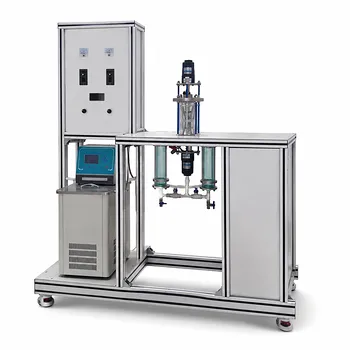
If you raise the temperature, the mutual solubility of your two liquid phases increases. This shrinks the two-phase region on the ternary diagram, alters the slope of the tie lines, and makes phase separation harder. In a pilot plant experiment, this directly reduces the working window where extraction can occur—and in extreme cases, it can erase the phase boundary entirely, turning your extraction system into a single homogeneous liquid.
Temperature is the master dial that sets the size of your operating envelope. While higher temperatures almost always shrink the two-phase region and threaten phase stability, setting the temperature too low cripples mass transfer through high viscosity and slow diffusion. The practical art in any liquid-liquid extraction pilot plant is finding the optimal temperature that keeps your system deep inside the two-phase zone while maintaining fluid properties that allow droplets to form, mass to transfer, and phases to disengage quickly.
How Temperature Alters Phase Equilibrium
The Solubility Curve Shrinks
On a ternary phase diagram, the binodal curve defines the boundary between the single-phase and two-phase regions. As temperature rises, the mutual solubility of the components increases. This forces the binodal curve to move inward, and the two-phase splitting region visibly shrinks. The maximum extract concentration ($y'_{max}$) drops, and your process loses its thermodynamic driving force.
Tie-Line Slopes Change
The tie-lines connecting extract and raffinate compositions also shift their slope with temperature. Because the selectivity and solute distribution coefficient are derived from these tie-lines, a temperature change alters the separation efficiency you can achieve. This makes it impossible to predict extraction performance without temperature-specific equilibrium data.
How the Molecular Picture Changes
Higher temperatures give molecules more kinetic energy, which helps them overcome intermolecular interactions that keep phases separate. This increased molecular mixing is why more solute and solvent can dissolve in each other, and why the two-phase window narrows. In short, the system moves closer to complete miscibility.
When the System Type Flips
For some systems, the effect is not gradual but qualitative. A temperature increase can transform a Type II system (two partially miscible pairs) into a Type I system (only one partially miscible pair). When that happens, one entire liquid-liquid interface disappears. An extraction that worked perfectly at 25 °C can become physically impossible at 40 °C. This is a silent, irreversible failure if you are not tracking temperature precisely.
The Kinetic Counterpoint: Why "Too Cold" Also Fails
Viscosity, Interfacial Tension, and Diffusion
Lowering the temperature may protect your two-phase region, but it penalizes you in three ways:
- Viscosity rises – droplets coalesce slowly, and pumping becomes harder.
- Interfacial tension increases – it takes more energy to generate the dispersion you need for mass transfer.
- Diffusion coefficients drop – solute molecules move sluggishly across the boundary layer, slowing down extraction rates.
These physical changes extend residence time and can reduce throughput even though the thermodynamic equilibrium looks favorable.
The "Goldilocks" Principle for Pilot Plants
The operator must choose a temperature that avoids both extremes. Too hot and your two-phase region collapses. Too cold and your mass transfer becomes so slow that you cannot achieve equilibrium in any reasonable column height or residence time. The optimal temperature sits where thermodynamics and kinetics just balance.
Critical Solution Temperatures: The Hidden Tripwire
UCST, LCST, and the Closed-Loop System
Not all binary liquid pairs behave monotonically. Some exhibit a critical solution temperature (CST) beyond which the two-phase region disappears completely.
- Systems with an upper critical solution temperature (UCST), like phenol–water, are miscible at higher temperatures and split only at lower temperatures.
- Systems with a lower critical solution temperature (LCST), such as water–trimethylamine, do the opposite: they are miscible at low temperatures and split into two phases as you heat them up.
- A few systems, like water–nicotine, exhibit both an LCST and a UCST, meaning two phases exist only in a narrow temperature window; outside that range, the system becomes a single phase.
For a pilot plant running an educational or research demonstration, this means that a seemingly minor temperature swing can cause your carefully chosen test mixture to disappear into a single phase in the middle of an experiment.
Practical Lessons for Lab and Pilot Plant Experiments
Precise Temperature Control Is Not Optional
Every extraction column, mixer-settler, or LLE vessel must be actively thermostatted. Use a jacketed vessel with a circulating water bath or integrated heating/cooling coils. A temperature fluctuation of just 2–3 °C can be enough to push a sensitive system inside the binodal curve, eroding the separation entirely.
Selecting the Operating Temperature Systematically
Start with equilibrium data or cloud-point measurements to map the two-phase envelope at different temperatures. Then check the physical properties (viscosity, density difference) at the candidate temperature. If the two-phase region is too tight at 40 °C, step down to 30 °C—but verify that viscosity and settling rates are still acceptable for your equipment. Never choose a temperature based on thermodynamic data alone.
Verifying Two-Phase Stability During Your Run
Incorporate visual checks or sampling ports into the column. If the liquid phases become cloudy or a sharp interface disappears, stop immediately and adjust the temperature. Documenting the temperature history alongside your yield and purity data turns every run into a learning opportunity rather than a failed batch.
Understanding the Trade-offs
The Equilibrium vs. Rate Dilemma
- Higher temperature: accelerates mass transfer (higher diffusion, lower viscosity) but reduces the attainable purity because the maximum extract concentration decreases and the two-phase region shrinks.
- Lower temperature: widens the operating window and can improve thermodynamic selectivity, but demands longer contact times and can cause flooding or poor dispersion if viscosities become too high.
There is no universal "better" temperature. You optimize for your specific goal.
Common Mistakes That Destroy Pilot Plant Results
- Assuming that because a mixture splits at room temperature, it will also work at an elevated process temperature.
- Ignoring the influence of temperature on tie-line slopes, leading to miscalculated distribution ratios.
- Relying on literature data measured at 20 °C while operating a column at 35 °C without correction.
- Failing to track the column temperature profile, which can lead to local hot spots that collapse the two-phase zone midway through the extractor.
Making the Right Choice for Your Goal
Start from what matters most in your experiment, and then pick a temperature that supports that priority.
- If your primary focus is high-purity separation: choose a temperature that keeps the two-phase region as large as possible, even if this means accepting a slightly longer residence time. Validate that the viscosity at that low temperature still allows good contact and clean phase separation.
- If your primary focus is fast throughput or short contact time: raise the temperature just enough to reduce viscosity and increase diffusion coefficients, but stay at least 5–10 °C inside the two-phase envelope to avoid crossing the binodal curve.
- If your primary focus is demonstrating thermodynamic principles in an educational pilot plant: select a system with a clear UCST (like phenol–water) and run two experiments, one below CST and one above, to directly visualize the loss of phase separation. This dramatically teaches the concept of critical solution temperature.
- If your primary focus is scaling up a proven lab extraction: measure the cloud-point curve for your actual feed, identify the thermal limits, and use that data to set interlocks on your pilot plant heating system so that you never inadvertently leave the two-phase region.
Your pilot plant will only be as reliable as your understanding of temperature’s double-edged sword: it can activate both better mixing and worse phase stability. Control it with precision, and the extraction column becomes a tool of clarity—not confusion.
Summary Table:
| Parameter | Higher Temperature | Lower Temperature |
|---|---|---|
| Two-Phase Region | Shrinks (risk of miscibility) | Expands (safer operating window) |
| Mass Transfer | Faster (low viscosity, high diffusion) | Slower (high viscosity, low diffusion) |
| Separation Purity | Lower maximum concentration | Higher thermodynamic selectivity |
| Phase Separation | Harder (risk of single phase) | Slower (high resistance to settling) |
Optimize Your Liquid-Liquid Extraction Process with LABPARK
Are you looking to enhance your research precision or upgrade your chemical engineering curriculum? LABPARK provides state-of-the-art Educational and Vocational Unit Operations Pilot Plants in chemical engineering, bioprocess & biotech, and environmental & water treatment. Designed specifically for universities, research institutes, and enterprises, our advanced pilot systems feature precise temperature controls and robust designs to help you maintain stable phase equilibrium and generate accurate, repeatable experimental data.
How LABPARK adds value to your facility:
- Precision Control: Easily maintain optimal operating envelopes using integrated heating and cooling jackets.
- Interactive Education: Visualize phase transitions (like UCST/LCST) clearly for teaching and demonstration.
- Scalable Performance: Seamlessly bridge the gap between bench-top chemistry and industrial scale-up.
Ready to elevate your laboratory capabilities? Contact LABPARK today to discuss your custom pilot plant configuration with our specialists!
Related Products
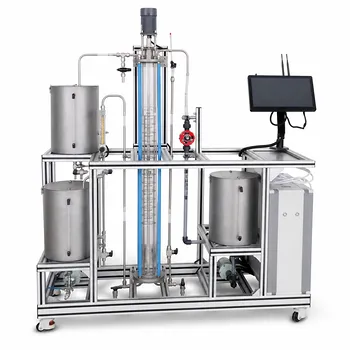
- Educational Rotary Disc Liquid-Liquid Extraction Pilot Plant
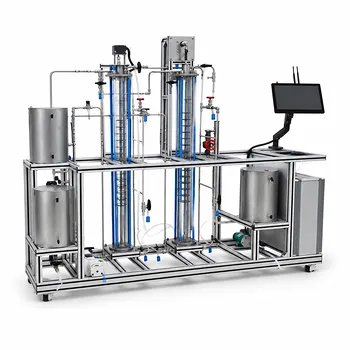
- Comprehensive Liquid-Liquid Extraction Pilot Plant for Engineering Education
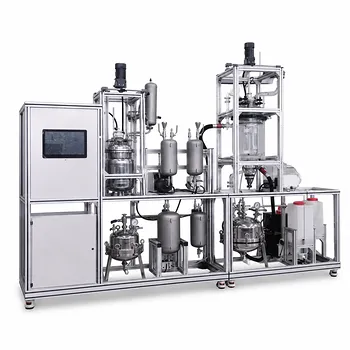
- Gallium and Indium Selective Extraction Educational Pilot Plant
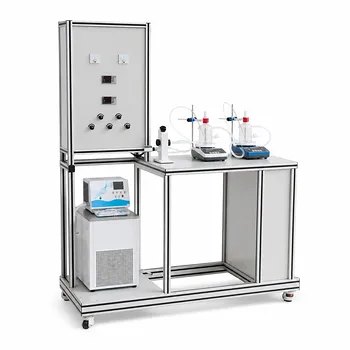
- Ternary Liquid-Liquid Equilibrium Educational Pilot Plant
- Liquid-Liquid Mass Transfer Coefficient Determination Educational Pilot Plant
People Also Ask
- How do density and IFT affect liquid-liquid extraction pilot plants? Optimize Column Performance
- In a liquid-liquid extraction pilot plant, how is a ternary-phase diagram utilized to determine solvent feed requirements?
- How are ternary phase diagrams and LLE data applied in extraction experiments? Optimize Pilot Plant Scale-up
- How Do Selectivity & Distribution Coefficients Influence LLE Pilot Plant Solvent Choice?
- How to Validate BIPs for LLE Pilot Plants? Steps to Align Simulations with Reality