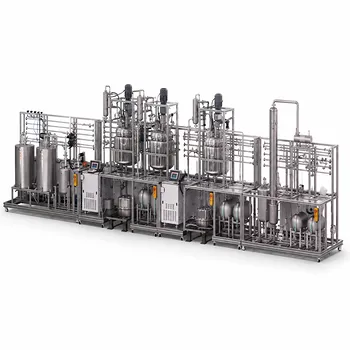
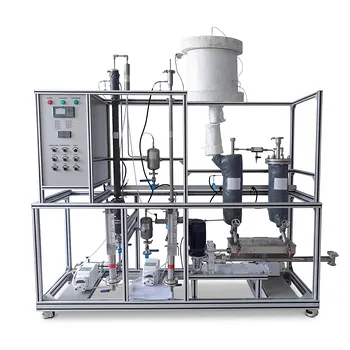
A prototype isn't just a smaller version of a factory—it's a physical lie detector for your process design. For universities and research institutes, chemical engineering and bioprocess pilot plants serve as these essential prototypes. They allow researchers to validate a new formulation's scalability, perform safe hands-on testing of integrated unit operations, and generate the real-world data needed to bridge the gap between a theoretical model and a commercially viable product.
A unit operations pilot plant acts as the critical, physical bridge between a laboratory-scale concept and a high-capital industrial process. Its primary value is to de-risk innovation by empirically validating design assumptions, identifying hidden scale-up bottlenecks, and confirming economic feasibility before any commitment to full-scale construction.
The Pilot Plant as a Physical Prototype for Feasibility Testing
A laboratory beaker provides proof of chemistry, but it reveals almost nothing about production viability. A pilot plant prototype answers the fundamental question: "Can we actually make this?"
Validating System Integration and Production Feasibility
The primary reference highlights that a core function of prototype testing is verifying system integration. A new process isn't just a single reaction; it's a connected chain of separation, purification, and solids handling.
A pilot plant forces these disparate unit operations to work together under realistic flow conditions. This integrated run reveals how upstream variability impacts downstream equipment—a dynamic completely absent in a standalone benchtop reactor. This physical verification ensures all components function as a cohesive, stable system.
Parallel-Testing and Optimizing Formulations
These pilot-scale systems also enable parallel-testing of different formulations, a powerful de-risking strategy. Researchers can systematically substitute a cheaper raw material or adjust a catalyst loading and immediately observe the effects on the entire downstream process.
This is a direct, empirical test for supply-chain flexibility and cost optimization. You can validate whether a substitute raw material causes unforeseen fouling in a heat exchanger or reduces the efficiency of a crystallization step, enabling data-driven formulation decisions.
Bridging the Critical Gap Between Theory and Reality
The most dangerous phrase in process development is "the simulation said it would work." Pilot plants provide the irreplaceable physical data that validates or refutes mathematical models.
Testing Recycle Streams and Real-World Yields
Computer simulations often fail to accurately predict the accumulation of by-products or impurities in recycle streams. A pilot plant equipped with physical recycle loops exposes this harsh reality.
By operating a continuous reaction-separation-recycle process, researchers gather empirical mass balance data. They can then identify an accumulating impurity that would poison a catalyst over time, a critical finding that allows them to adjust the simulation model and redesign the process layout before it becomes an economic failure.
Correcting for Real-World Physical Constraints
Theoretical models struggle to account for complex, often messy, physical phenomena. A pilot plant quantifies these real-world constraints. Fouling, heat loss, and non-ideal fluid dynamics directly impact heat transfer coefficients and reaction kinetics. By collecting physical performance data, researchers can identify discrepancies between the model and reality. This physical verification transforms a theoretical design into a reliable, validated process flow diagram (PFD).
A Safe Playground for Process Understanding and Risk Assessment
Beyond simple validation, a pilot plant is a controlled environment for developing deep, intuitive process knowledge and intentionally testing the limits of a design.
Handling Complex Formulation Challenges
Many modern drug formulations involve highly potent compounds or face physical challenges like low solubility and tissue permeability. Teaching these handling techniques cannot be done hypothetically. Pilot-scale filtration, crystallization, and mixing equipment provide hands-on experience in managing mass transfer constraints and maintaining precise control. This training builds the critical process-understanding skills needed to troubleshoot delivery systems for these challenging formulations on a commercial scale.
Introducing Controlled Process Upsets
A safe scale-down environment allows researchers to become failure analysts. They can deliberately introduce controlled process upsets—like a pump failure or a temperature excursion—that would be far too dangerous or costly to test in a production plant.
This generates critical data for a proactive risk assessment. The data validates multivariate models under stress, identifies potential failure modes, and establishes a safe operating window, ensuring the final plant design is inherently safer and more resilient.
Understanding the Limitations: When is Pilot Testing Essential?
True technical advisorship requires objectivity. Pilot plants are a powerful but resource-intensive tool, and their necessity is not universal. The decision to use one is a calculated evaluation of technical risk versus cost and time.
Matching the Equipment to Process Predictability
According to chemical engineering principles, the complexity of scale-up behavior determines the need for piloting. A significant trade-off is that building a pilot plant for a predictable process is a waste of valuable research funding. Reactors, extraction units, and dryers/solids handling systems almost always require pilot-plant testing due to the high risk of non-linear scale-up behavior. Conversely, processes involving simple single-phase fluid flow or standard distillation typically do not warrant a pilot plant unless there are specific, known complications like foaming. The key is to apply the pilot plant resource surgically, only where the technical uncertainty is highest.
How to Apply This to Your Research Program
Successfully leveraging a pilot plant requires a goal-oriented strategy, not a one-size-fits-all approach. Here is how to align your testing with your primary objective.
- If your primary focus is maximizing the probability of successful scale-up: Use the pilot plant to specifically test critical parameters like heat transfer coefficients and to run integrated, long-duration trials with full-fidelity recycle loops to uncover hidden accumulation issues.
- If your primary focus is developing student and researcher competency: Design experiments that contrast simulation predictions with raw pilot-plant data, focusing on the hands-on troubleshooting of real-world physical constraints like fouling and non-ideal flow.
- If your primary focus is de-risking a high-value invention or patent: Focus your pilot plant work on generating robust, empirical mass and energy balances under real operating conditions to build an unshakeable technical and economic feasibility study for potential investors or industrial partners.
By treating the pilot plant not just as equipment, but as the ultimate arbiter of process viability, you transform a concept into a safe, profitable, and scale-ready reality.
Summary Table:
| Validation Focus | Key Pilot Plant Advantage | Essential Equipment |
|---|---|---|
| System Integration | Verifies continuous flow and multi-step unit operations | Integrated reactors & separators |
| Recycle Loops | Detects impurity accumulation and validates actual yield | Distillation & extraction systems |
| Risk Assessment | Tests controlled process upsets safely | Crystallization & drying units |
Scale Up Your Research with LABPARK Pilot Plants
Transform your laboratory concepts into commercially viable processes. LABPARK delivers state-of-the-art Educational and Vocational Unit Operations Pilot Plants in:
- Chemical Engineering
- Bioprocess & Biotech
- Environmental & Water Treatment
Designed specifically for universities, research institutes, and enterprises, our pilot plants de-risk innovation by providing hands-on training, reliable mass/energy balance validation, and safe process upset testing.
Ready to enhance your lab's capabilities? Contact us today to request a quote!
Related Products
- Natural Product Extraction Unit Operations Training Pilot Plant
- Ethyl Acetate Synthesis Unit Operations Pilot Plant for Practical Training
- Residence Time Distribution and Reactor Flow Characteristics Determination Educational Pilot Plant
- Fixed Bed Gas Solid Catalytic Reaction Educational Pilot Plant
- Bio-fermentation Ethanol Production Practical Training Unit Operations Pilot Plant
People Also Ask
- How to Demo Solubility Sensitivity in SFE Pilot Plants? Practical Thermodynamics
- How do pilot plants differentiate physical vs chemical extraction? Enhance Chemical Engineering Training
- How are HTU and NTU applied to determine extraction column height? Guide to Pilot Plant Scaling
- How do fluid transport principles apply to pilot plant configuration? Optimize your unit operations.
- What are the limitations of acentric factor models? Avoid pilot plant errors with polar fluids.