Temperature is the master key that unlocks—or locks—different structural architectures in copper coordination chemistry. It directly dictates whether you form a kinetically trapped orange complex or a thermodynamically stable reddish-brown one, simply by controlling the reaction coordinate through precise heating and rapid quenching. In an educational setting, this transformation is the perfect vehicle for teaching the real-world interplay between thermodynamics, kinetics, and industrial process control.
While the vivid color change is the hook, the deep educational value lies in mastering the balance between thermodynamic stability and kinetic control. Precise temperature regulation is the tool that allows students to deliberately select one coordination geometry over another, transforming a simple beaker experiment into a rigorous exercise in chemical engineering unit operations.
Why a Few Degrees Changes Everything
The synthesis of copper coordination complexes is not a single-path reaction. It is a landscape of competing energy profiles where temperature acts as the traffic controller.
The Kinetic vs. Thermodynamic Tug-of-War
Think of the formation of these complexes as two competing pathways. Kinetic products form fast because they have a lower activation energy barrier. Thermodynamic products take longer to form but sit in a deeper energy well, making them more stable overall.
Precise heating to 70°C or 80°C supplies the necessary energy to overcome the barrier for the thermodynamically stable, reddish-brown complex. If the temperature is off by even a few degrees, you may not provide enough activation energy, and the reaction gets stuck producing the kinetically favored orange complex. The structure you get is entirely dependent on this thermal input.
Beyond the Color: The Jahn-Teller Sculpting
The visual marker of this structural shift is driven by the Jahn-Teller effect. Copper(II) ions in an octahedral field inherently suffer from electronic degeneracy.
To relieve this, the complex distorts, most often by elongating bonds along the z-axis. Temperature control dictates the degree and type of this distortion and which ligands occupy the elongated axial sites. This directly changes the d-orbital energy gaps, which in turn sculpts the visible color from orange to reddish-brown. You are not just heating a solution; you are physically manipulating molecular geometry.
The Hidden Trap of Metastability
The most critical conceptual leap for students is understanding that crystallization is not an instantaneous event at a fixed melting point. It requires a departure from equilibrium.
The Metastable Zone is Your Target
A solution must be supercooled to crystallize. The region between the saturation line and the spontaneous nucleation boundary is the metastable zone. This is where controlled, high-quality crystal growth lives.
For educational experiments, the goal is to operate inside this narrow window. By maintaining a precise, low level of supercooling (ΔT), you promote ordered growth on existing crystal surfaces. The result is large, well-defined, and structurally pure crystals that clearly demonstrate their intended coordination geometry.
Escaping the Zone of Chaos
If your temperature control is poor and you overshoot into a high ΔT state, the system enters a chaotic regime of spontaneous, massive nucleation. The energy barrier for forming new crystal nuclei is violently overcome.
The outcome is a mass of microscopic, needle-like, or dendritic crystals. These fragile formations trap impurities, produce poor X-ray diffraction data, and fail to isolate the structurally transformed complex you intended to create. Your structural proof literally crumbles.
Essential Equipment: From Glass Beaker to Pilot Plant
To bridge the gap between textbook chemistry and chemical engineering, educational equipment must replicate industrial-level control. A simple hotplate is fundamentally inadequate.
The Reflux and Quench Loop
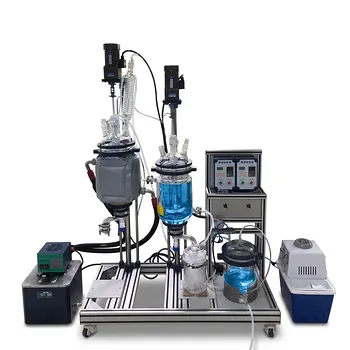
The primary reference's protocol of heating to 70°C reflux followed by an ice bath is a study in thermal shock management. A jacketed reactor connected to a circulating bath is essential.
This setup allows for a controlled heating ramp to the target temperature, followed by a precisely executed quenching step. Rapid cooling locks the high-temperature structural configuration in place, preventing the system from relaxing back to the low-temperature kinetic product. The equipment must handle this thermal swing instantly and uniformly.
Engineering with PID Control
At the heart of this precision is a PID (Proportional-Integral-Derivative) temperature controller. It doesn't just turn a heater on and off; it uses a predictive algorithm to minimize oscillations around the setpoint.
This is non-negotiable for meaningful data. To calculate a reaction rate constant ($k$) from the Arrhenius equation, you need a stable and known T value. A PID-controlled system suppresses fluctuations that would otherwise introduce significant errors into kinetic and thermodynamic calculations, such as determining activation energy ($E_a$) or Gibbs free energy change ($ΔG°$).
Understanding the Trade-offs
No single piece of equipment is universally perfect. The choice always involves balancing competing needs.
Purity vs. Yield in Crystallization
A perfectly controlled system operating in the metastable zone will produce exceptional, high-purity crystals, but often at the cost of total yield. The growth is slow and deliberate. An aggressive cooling strategy will give you a high yield of solids, but those solids will be impure and structurally ill-defined.
For a structural proof experiment, purity and crystal quality are paramount. For a bulk synthesis exercise, yield might be the primary metric. The equipment must allow users to deliberately choose between these two strategies and observe the consequences on crystal structure.
Thermodynamic Truth vs. Engineering Reality
Educational pilot plants often feature high-precision thermal sensors in a thermostatic bath. However, the temperature on a controller's display is not necessarily the temperature inside the reacting mixture, especially in exothermic or endothermic reactions.
Students must learn that a temperature gradient can exist within a jacketed reactor. The key equipment requirement is therefore not just heating power, but effective stirring and baffle design that ensures rapid heat transfer and thermal uniformity, bringing immediate engineering reality onto the lab bench.
Making the Right Choice for Your Educational Goal
The structural investigation of a copper coordination complex via temperature control is a multi-faceted teaching module. Your equipment selection must align with your primary objective.
- If your primary focus is structural chemistry and geometric proof: Prioritize a small-scale, high-precision jacketed reactor with a rapid heating/quenching loop and superior thermal uniformity to isolate single, large, high-quality crystals for XRD analysis.
- If your primary focus is chemical engineering unit operations and process safety: Choose a pilot-scale reactor with a full PID control system, data logging, and integrated probes to study thermal runaway, heat transfer kinetics, and reaction scale-up principles.
- If your primary focus is reproducible crystallization and product quality: Select a system that allows you to meticulously map the metastable zone width and maintain a stable supercooling setpoint, ensuring students can visually distinguish between controlled growth and catastrophic nucleation.
Ultimately, precise temperature control transforms a copper salt solution from a passive mixture into a responsive architectural medium, allowing students to build, clarify, and finally understand the energy landscape of a molecule.
Summary Table:
| Aspect | Kinetic Control (Orange Complex) | Thermodynamic Control (Reddish-Brown) |
|---|---|---|
| Temperature Target | Lower activation energy / rapid quench | Heated to 70°C–80°C reflux |
| Crystal Structure | Metastable, rapid/dendritic growth | Stable, ordered Jahn-Teller geometry |
| Key Equipment Need | High-rate thermal quench loop | Jacketed reactor with PID control |
Elevate Your Chemical Engineering Lab with LABPARK
Achieving precise thermal control is critical for teaching complex thermodynamic and kinetic crystallization concepts. LABPARK provides premium Educational and Vocational Unit Operations Pilot Plants in chemical engineering, bioprocess & biotech, and environmental & water treatment for universities, research institutes, and enterprises.
Ready to equip your students with PID-controlled jacketed reactors and high-precision pilot systems?
👉 Contact LABPARK today to request a custom equipment consultation!
Related Products
- Multi Functional Membrane Crystallization Educational Unit Operations Pilot Plant
- Potassium Salt Thermal Dissolution and Crystallization Separation Educational Unit Operations Pilot Plant
- Multi-Stage Stirred Tanks in Series Residence Time Distribution and Mixing Performance Determination Educational Pilot Plant
- Residence Time Distribution and Reactor Flow Characteristics Determination Educational Pilot Plant
- Multi-Reactor Educational Pilot Plant for Reaction Engineering Unit Operations
People Also Ask
- Control Crystallization Pilot Plant Secondary Nucleation: 4 Key Adjustments
- Why is precise temperature control critical in crystallization pilot plants? Key to Scale-Up Success
- How Crystal vs Amorphous Solids Guide Crystallization Pilot Plant Objectives
- What key factors should be considered when configuring a crystallization unit operations pilot plant?
- What are the benefits of integrating online PAT tools like ATR-FTIR into crystallization unit operations pilot plants?