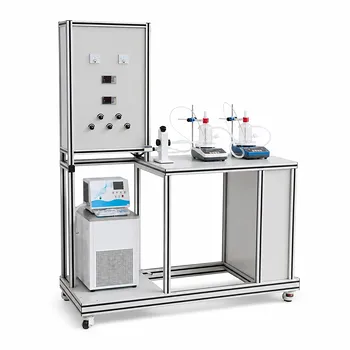
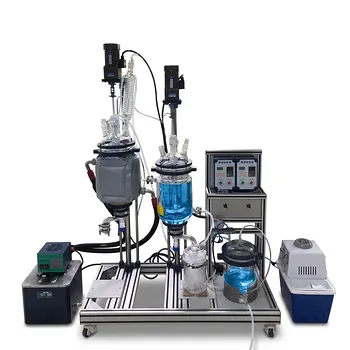
Preventing unwanted precipitation is a core pH-control challenge in any pilot plant handling high-valence metal ions like Al³⁺, Fe³⁺, or Zn²⁺. These ions behave as polyprotic acids in water, releasing hydrogen ions through stepwise hydrolysis. If the solution’s pH rises, the hydrolysis equilibrium shifts, ultimately forming insoluble hydroxide solids that can clog lines, foul sensors, and alter reaction stoichiometry. To keep the metals dissolved, operators must deliberately lower the pH—usually by injecting a strong acid—to suppress the hydrolysis and maintain a stable, particle‑free feed stream.
The central insight: pH control prevents precipitation by keeping the hydrolysis equilibrium of high-valence metal cations so far to the left that hydroxide products never exceed their solubility limit. Without this deliberate acidity, even a slight pH increase can trigger rapid solids formation, compromising pilot‑plant reliability and data quality.
The Chemistry Behind the Clogging Hazard
Why High‑Valence Metals Act as “Acid Generators”
Hydrated cations like Al³⁺ and Fe³⁺ are strongly polarizing. They pull electron density from surrounding water molecules, weakening O–H bonds and making it easy for those water molecules to shed a proton.
Each hydrolysis step releases a hydrogen ion, for example:
[M(H₂O)₆]³⁺ ⇌ [M(H₂O)₅(OH)]²⁺ + H⁺
As pH rises, the equilibrium shifts forward, stripping more protons and generating species with multiple hydroxide groups. Eventually, these polynuclear hydrolysis products grow into a network that precipitates as an amorphous hydroxide—Al(OH)₃ or Fe(OH)₃—even in solutions that appeared clear moments before.
The pH Window That Keeps Ions Dissolved
Every metal hydroxide has a critical pH at which its solubility product (Ksp) is exceeded. For Fe(OH)₃ (Ksp ≈ 4.0 × 10⁻³⁸), precipitation begins near pH 2‑3; for Cu(OH)₂ (Ksp ≈ 2.2 × 10⁻²⁰), it’s around pH 5‑6. By holding the pH well below this threshold, you suppress the hydroxide ion concentration so that the ion product [Mⁿ⁺][OH⁻]ⁿ stays safely below Ksp.
This is why pilot‑plant feed tanks for acidic metal salt solutions are typically maintained at pH 1‑2. In that range, hydrolysis is minimal, and the metal ions remain fully dissolved—even after hours of recirculation.
Ionic Potential Governs the Need for Acidity
The tendency to hydrolyze and precipitate scales with the ion’s ionic potential – the ratio of charge (z) to ionic radius (r). Trivalent ions like Al³⁺ and Fe³⁺ have much higher ionic potential than divalent Ca²⁺ or Mg²⁺. They demand stricter, lower‑pH control to stay in solution. A pilot plant running a mixed‑metal stream must therefore tailor the acid dose to the most hydrolysis‑prone species to avoid “surprise” solids.
Practical pH Control in a Pilot‑Plant Environment
Acid Dosing and the Suppression of Hydrolysis
The direct method is to add a strong, non‑complexing acid (often H₂SO₄ or HNO₃) to the feed tank. The added protons drive the hydrolysis equilibrium backward, converting any hydroxo‑species back to the fully hydrated cation.
A small excess is usually needed to provide a pH buffer against ambient CO₂ uptake or alkali carry‑over from upstream units. However, chemical engineers must calculate the dose stoichiometrically, not just add acid until the pH meter looks “good,” because over‑acidification brings its own problems.
Automated pH Control Loops and Sensor Calibration
Modern pilot plants rely on closed‑loop pH control: a pH probe in the feed line sends a signal to a dosing pump that adds acid on demand. This dynamic control is particularly important when the metal solutions are being pumped from a tank that is slowly evolving CO₂ or reacting with air.
Pilot plants serve as the training ground for tuning these loops. Students and operators learn to:
- Calibrate pH probes in high‑ionic‑strength, aggressive solutions.
- Avoid “dead bands” that allow the pH to drift above the precipitation threshold.
- Set alarm triggers on oxidation‑reduction potential (ORP) when combined with oxidizers like H₂O₂ to convert Fe²⁺ to Fe³⁺ before pH adjustment.
Buffer Systems for Longer‑Term Stability
For processes that must run for hours at a fixed, moderate pH (e.g., pH 4 for selective Fe³⁺ removal), a simple acid squirt is insufficient. The solution needs a buffer. Ammonia‑ammonium chloride or acetate buffers are often used in educational pilot plants to demonstrate how equilibrium can be locked even as the system evolves. These buffers absorb the small pH swings caused by hydrolysis or CO₂ ingress, keeping the hydroxide ion concentration exactly where it needs to be to prevent precipitation of the target metal while allowing others to drop out.
Understanding the Trade‑offs
The Corrosion and Material Compatibility Cost
Keeping a solution at pH 1‑2 prevents hydroxide scale, but it introduces a different problem: aggressive corrosion of stainless steel, glass, and seals. Pilot‑plant designers must choose materials like PVDF, PTFE, or Hastelloy. The cost of these materials and the safety protocols for handling concentrated acid are real project constraints.
Acid Carry‑over and Downstream Disruption
Over‑acidifying a stream prevents precipitation now but may interfere later. If the treated water is sent to a subsequent precipitation stage, the excess acid will consume the base meant to raise the pH for, say, sulfide precipitation. The result is wasted chemicals and sluggish process dynamics. In continuous pilot plants, a cascaded pH control strategy—where the acid is partially neutralized before the next unit—is often necessary.
The Danger of Toxic Gas Evolution
When the metal solution contains sulfide sources (e.g., H₂S for sulfide precipitation), lowering the pH too much can shift the S²⁻/HS⁻/H₂S equilibrium toward volatile H₂S gas. So while pH control prevents metal hydroxide solids, it must be executed with a clear understanding of all equilibrium species present. A pilot plant that focuses only on the hydroxide problem may inadvertently create a toxic gas hazard.
Making the Right Choice for Your Pilot‑Plant Goal
The “best” pH control strategy depends entirely on what you need the dissolved metals to do next.
-
If your primary focus is clog‑free, long‑term storage of high‑valence metal feed solutions: Maintain the pH at a value at least one unit below the onset of hydrolysis, using a continuous acid dosing loop. Validate the setpoint with a small‑scale jar test because ionic strength shifts can alter the true precipitation pH.
-
If your primary focus is selective precipitation for separation or purification: Use pH as a fine‑tuning tool. Calculate the target [OH⁻] from Ksp, then implement a buffer to hold that exact pH. In pilot plants, this is where you train on the interplay between equilibrium theory and real‑time sensor feedback.
-
If your primary focus is educational – demonstrating chemical engineering principles: Design experiments where students intentionally drift the pH and observe the rapid onset of turbidity. Let them measure the pH delay in their control loop and learn why a few seconds of lag can mean a plugged line.
Mastering pH control transforms it from a nuisance variable into a reliable lever for maintaining solution stability, enabling precise separations, and building operator intuition about aqueous equilibrium chemistry.
Summary Table:
| Metal Ion | Solubility Product (Ksp) | Precipitation pH | Recommended Feed pH |
|---|---|---|---|
| Iron (Fe3+) | ~ 4.0 x 10^-38 | pH 2 - 3 | pH 1 - 2 |
| Copper (Cu2+) | ~ 2.2 x 10^-20 | pH 5 - 6 | pH < 4 |
| Aluminum (Al3+) | High Ionic Potential | pH 3 - 4 | pH 1 - 2 |
Optimize Your Process Control with LABPARK
Preventing line clogging and ensuring precise chemical control is critical for reliable data and effective training. LABPARK provides state-of-the-art Educational and Vocational Unit Operations Pilot Plants in chemical engineering, bioprocess & biotech, and environmental & water treatment.
Specifically designed for universities, research institutes, and enterprises, our pilot plants are equipped with robust, corrosion-resistant materials and advanced automated pH control loops to ensure seamless, trouble-free operation.
Ready to upgrade your laboratory capabilities? Contact us today to discuss your custom pilot plant requirements!
Related Products
- Electrochemical Water Treatment Educational Unit Operations Pilot Plant
- Water Electrolysis Hydrogen Production and Storage Educational Pilot Plant
- Thermal Desorption Exhaust Gas and Tail Water Treatment Educational Pilot Plant
- Ion Exchange Water Purification Educational Pilot Plant for Engineering Unit Operations
- Alkaline Membrane Water Electrolysis Educational Pilot Plant Unit Operations Training System
People Also Ask
- What design features do educational electrochemical pilot plants utilize to manage gas liberation and water loss?
- How can unit operations pilot plants show lead-acid concentration vs state of charge? Real-time monitoring guide.
- How do educational electrochemical pilot plants scale up electrolysis? Master industrial engineering.
- How to Estimate Sulfate in Water Treatment Pilot Plant Deposits: Gravimetric Guide
- How can foaming be managed during steam generation experiments in water treatment unit operations pilot plants? Tips