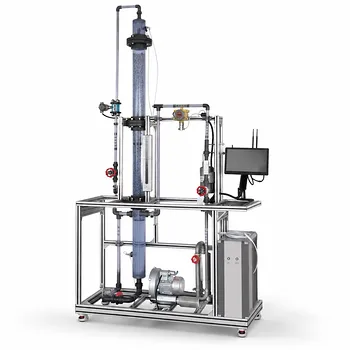
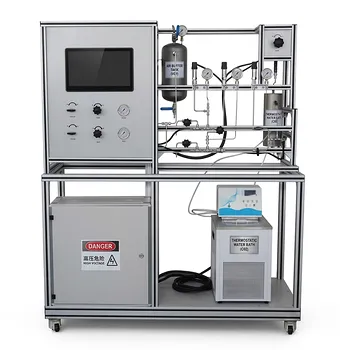
Inter-stage cold shot cooling operates by injecting a cooler stream between sequential adiabatic packed-bed reactor stages. As an exothermic reaction proceeds through the first catalyst bed, the reacting mixture releases heat and its temperature rises. A controlled flow of cold reactant, solvent, or another compatible quench stream then mixes with the hot bed effluent, reducing its temperature before it enters the next bed. This allows the pilot plant to maintain catalyst and product temperature limits while achieving higher overall conversion.
In a staged adiabatic reactor, each catalyst bed generates heat, while the inter-stage cold shot resets the stream temperature between beds. The result is a controlled temperature trajectory that can improve conversion and protect the catalyst, especially when high temperature reduces equilibrium conversion or selectivity.
Why Temperature Rises Through an Adiabatic Bed
Reaction Heat Accumulates in the Flow
An adiabatic packed bed is designed to exchange little or no heat with its surroundings. For an exothermic reaction, the heat released by reaction therefore remains in the process stream.
As the stream moves through the catalyst, conversion increases and the temperature typically rises along the bed. The magnitude of this rise depends on reaction heat, feed composition, conversion, flow rate, and heat capacity.
High Temperature Can Limit Performance
For a reversible exothermic reaction, increasing temperature can reduce the equilibrium conversion even though it generally accelerates reaction kinetics.
This creates a competing requirement: the reaction must be hot enough to proceed at a practical rate, but not so hot that equilibrium conversion, selectivity, or catalyst stability deteriorates.
One Long Bed May Follow an Unfavorable Trajectory
In a single adiabatic bed, the reaction path continuously moves toward higher temperature as conversion develops. The resulting high-temperature region can restrict the final achievable conversion.
Dividing the catalyst into multiple beds creates opportunities to control the temperature between reaction zones.
How the Cold Shot Works
Hot Effluent Leaves the First Bed
The effluent from the first packed bed contains partially converted reactants, products, and the heat generated during reaction.
Temperature and composition measurements at the bed outlet provide the basis for determining whether cooling is required before the next stage.
A Cooler Stream Is Injected
A cold-shot stream is introduced into the process line between beds. Depending on the process, it may be a cooler reactant, recycle stream, solvent, or another compatible fluid.
The injected stream must be chemically compatible with the reaction mixture and sufficiently cool to provide the required temperature reduction.
Mixing Produces a New Inlet Condition
The cold stream mixes with the hot first-stage effluent. The mixed stream has a lower temperature than the unquenched effluent, although its composition and flow rate also change.
The downstream reactor therefore receives a new feed condition rather than simply the original first-stage feed at a lower temperature.
The Second Bed Continues the Reaction
After mixing, the cooled stream enters the second catalyst bed. Reaction resumes under a lower inlet temperature, and the bed again generates heat as conversion proceeds.
Each subsequent stage repeats this pattern: reaction heat is generated inside the bed, then temperature is adjusted before the next bed.
How Cooling Improves Overall Conversion
The Temperature Path Is Reset
Inter-stage cooling moves the process stream back toward a lower temperature between reaction stages. For exothermic reversible reactions, this can restore a more favorable equilibrium conversion limit.
The next bed can then drive the reaction further toward products than would be possible if the hot first-stage effluent entered one continuous bed without cooling.
Conversion Accumulates Across the Beds
Each bed makes an additional contribution to conversion. The overall conversion is determined by the combined effects of stage inlet conditions, catalyst volume, residence time, reaction kinetics, equilibrium, and the amount of cooling.
The beds do not operate independently: the outlet of one stage, after quench mixing, becomes the inlet to the next.
Cooling Balances Kinetics and Equilibrium
Lowering the temperature may improve equilibrium conversion for an exothermic reversible reaction, but excessive cooling can slow the reaction rate.
The operating objective is therefore not simply to minimize temperature. It is to establish a temperature profile that provides adequate reaction rate while maintaining a favorable equilibrium and protecting the catalyst.
How Pilot Plants Control the System
Cold-Shot Flow Is a Key Operating Variable
Operators adjust the cold-shot flow rate, or bypass ratio, to control the temperature entering the next bed.
A larger cold-shot flow generally provides greater cooling but also changes reactant concentration, residence time, and total volumetric flow through the downstream bed.
Temperature Sensors Reveal the Thermal Profile
Pilot plants commonly use temperature measurements at bed inlets and outlets, as well as at selected points along the reactor system.
These measurements show the temperature rise within each bed and the cooling effect achieved by the inter-stage injection.
Flow and Pressure Must Be Monitored Together
The quench stream adds material to the process, so its flow must be included in the stage material balance. The resulting change in total flow can affect pressure drop, residence time, and downstream reactor performance.
Stable operation therefore requires coordinated monitoring of cold-shot flow, process flow, pressure, and temperature.
Mixing Quality Matters
The cold shot must mix sufficiently with the hot effluent before the mixture reaches the next catalyst bed. Poor mixing can create local hot or cold zones at the bed inlet.
Those maldistributed temperatures can cause uneven reaction rates, reduced catalyst utilization, selectivity loss, or localized catalyst damage.
Cold Shot Versus Inter-Stage Heat Exchange
Cold Shot Adds a Process Stream
Cold-shot cooling reduces temperature by mixing the hot process stream with a cooler stream. It is mechanically direct and can respond rapidly to operating changes.
However, it changes the composition and flow rate of the material entering every downstream stage.
A Heat Exchanger Removes Heat Externally
An inter-stage heat exchanger cools the process stream without intentionally adding another process stream to it.
This preserves the process composition more closely, but it requires additional heat-transfer equipment, utilities, control systems, and attention to fouling and pressure drop.
The Choice Depends on the Process
Cold shot is attractive when a suitable cold stream is available and dilution or composition changes are acceptable. Heat exchange is preferable when maintaining a defined composition is more important or when adding quench material would impair downstream performance.
Some pilot plants can demonstrate both approaches to compare their thermal and material-balance effects.
Understanding the Trade-offs
More Cooling Is Not Always Better
Increasing cold-shot flow can reduce the next-bed inlet temperature, but excessive cooling may reduce reaction rate and require more catalyst volume or residence time.
The correct quench rate is the one that achieves the required temperature profile and conversion, not necessarily the lowest possible temperature.
Quench Changes Composition
A cold reactant stream may increase the concentration of one reactant, while a solvent or inert stream may dilute the reacting species.
These changes affect reaction kinetics, equilibrium, volumetric flow, pressure drop, and the design basis of downstream beds.
Additional Stages Add Complexity
Splitting one reactor into several beds requires more piping, injection points, sensors, valves, and control logic.
Additional stages can improve temperature management, but the benefit generally diminishes as mechanical and operational complexity increases.
Thermal Runaway Risk Still Requires Protection
Cold-shot cooling is a control measure, not a substitute for process safety design. A loss of quench flow, excessive reaction rate, blocked outlet, or faulty temperature measurement can still produce dangerous temperature excursions.
Pilot plants require appropriate alarms, interlocks, relief protection, controlled startup and shutdown procedures, and clearly defined maximum temperature limits.
The Reaction May Be Sensitive to Dilution
For reactions requiring a particular reactant ratio, adding a cold stream can move the mixture away from its desired composition.
The quench design must therefore consider both the energy balance and the material balance. Temperature control that ignores composition can reduce overall reactor performance.
Making the Right Choice for Your Goal
The operating strategy should be selected from the combined thermal, kinetic, equilibrium, and material-balance requirements.
- If your primary focus is maximizing conversion: Use multiple beds with carefully controlled inter-stage cooling to restore favorable equilibrium conditions between reaction zones.
- If your primary focus is protecting the catalyst: Set cold-shot flow and temperature limits to prevent downstream bed inlets and internal hot spots from exceeding allowable temperatures.
- If your primary focus is maintaining product selectivity: Control the temperature trajectory closely and avoid hot spots that can accelerate side reactions or product degradation.
- If your primary focus is preserving feed composition: Prefer inter-stage heat exchange when adding a quench stream would cause unacceptable dilution or reactant-ratio changes.
- If your primary focus is pilot-plant instruction or process development: Measure bed inlet and outlet temperatures, cold-shot flow, pressure drop, and conversion to connect the energy and material balances with reactor performance.
Inter-stage cold shot cooling turns a continuously heating adiabatic reaction path into a sequence of controlled reaction and temperature-adjustment steps.
Summary Table:
| Key aspect | How it works | Main benefit |
|---|---|---|
| Heat generation | Each adiabatic catalyst bed releases reaction heat into the process stream. | Enables efficient reaction without external heat exchange inside the bed. |
| Cold-shot injection | A cooler reactant, solvent, recycle, or compatible fluid is added between beds. | Lowers the temperature before the next reaction stage. |
| Temperature control | Cold-shot flow is adjusted using bed inlet and outlet temperature measurements. | Maintains catalyst, selectivity, and product temperature limits. |
| Conversion improvement | Cooling resets the temperature path and can improve equilibrium conversion for reversible exothermic reactions. | Supports higher overall conversion across multiple beds. |
| Material-balance impact | The injected stream changes composition, dilution, residence time, and total flow. | Requires coordinated flow, pressure, and composition control. |
| Mixing requirement | The cold stream must mix uniformly with the hot effluent before entering the next bed. | Prevents hot spots, cold zones, and uneven catalyst utilization. |
| Cold shot vs. heat exchange | Cold shot adds material; a heat exchanger removes heat externally without intentional dilution. | Helps engineers select the best thermal-control strategy. |
| Safety requirements | Alarms, interlocks, relief systems, and maximum-temperature limits remain necessary. | Reduces the risk of thermal excursions and catalyst damage. |
Need to evaluate temperature control, conversion, or catalyst protection in an exothermic process? Contact LABPARK to discuss an Educational or Vocational Unit Operations Pilot Plant tailored to your application. LABPARK provides multi-stage adiabatic packed-bed reactor systems for chemical engineering, bioprocess and biotechnology, and environmental and water-treatment research. Our pilot plants help universities, research institutes, and enterprises study inter-stage cooling, reaction kinetics, equilibrium, heat and material balances, pressure drop, mixing quality, process safety, and scale-up with practical measurement and control capabilities.
Related Products
- Multi-Reactor Educational Pilot Plant for Reaction Engineering Unit Operations
- Packed Bed Absorption Educational Unit Operations Pilot Plant
- Micro-Scale Gas-Solid Catalytic Reaction Educational Pilot Plant
- High-Gravity Emulsification and Mass Transfer Educational Pilot Plant
- Multi Functional Catalytic Reaction and Reactor Evaluation Educational Unit Operations Pilot Plant
People Also Ask
- How do reactor pilot plants define QbD design space? Master chemical process scale-up.
- When configuring a reactor unit operations pilot plant for highly exothermic reactions, how to prevent thermal runaway?
- How do metal ion-catalyzed reaction mechanisms inform chemical engineering pilot plant design? From kinetics to scale-up
- What are the barriers to process intensification & how do pilot plants help?
- What role do educational pilot plants play in scaling green chemistry? Bridging the Lab-to-Industry Gap