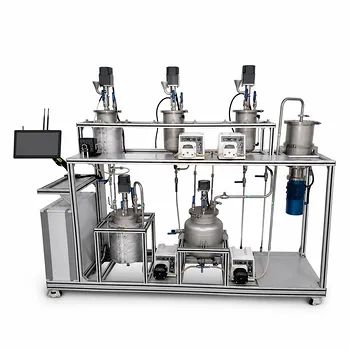
Elevated pressure is a double-edged sword for gas transfer in a bioprocess pilot plant. Increasing the operating pressure inside a fermentor enhances the absorption rate of oxygen (O₂) into the liquid broth – boosting the driving force for this critical mass transfer step. However, the very same pressure increase simultaneously makes it harder for carbon dioxide (CO₂) to escape the liquid, raising the risk of its accumulation to inhibitory levels.
The central challenge is not maximizing one transfer rate, but balancing the opposing effects of pressure on O₂ and CO₂ mass transfer. Raising pressure drives more oxygen into the culture, but traps more CO₂. Your pilot plant's success hinges on finding the sweet spot where aerobic respiration is supported without allowing dissolved CO₂ to stall microbial growth.
How Pressure Dictates the Dual Mass-Transfer Dynamic
The dissolved gas concentrations that a fermentor can achieve are ruled by phase equilibrium – specifically, Henry's Law. Changing the head pressure directly shifts the equilibrium target for both O₂ and CO₂. This mechanism creates the opposing consequences every pilot plant operator must manage.
Oxygen Transfer: A Pressure-Driven Boost
For oxygen, raising the total pressure increases its partial pressure in the gas phase. According to Henry's Law, this elevates the saturation concentration (C*ₒ) of dissolved oxygen in the broth.
The rate of oxygen mass transfer is proportional to the difference between this saturation concentration and the actual dissolved oxygen concentration (Cₒ). A higher C*ₒ, brought about by increased pressure, widens the driving force (C*ₒ - Cₒ).
Consequently, the volumetric oxygen transfer rate (OTR) climbs, directly supporting higher aerobic cell densities and more vigorous respiration. In viscous cultures or those with large microorganisms – where mass transfer resistance is high – this pressure-driven boost can become the decisive factor for maintaining a non-limiting oxygen supply.
Carbon Dioxide Stripping: The Hidden Constraint
The same equilibrium physics works against CO₂ removal. As pressure increases, the equilibrium liquid concentration of CO₂ (c*CO₂) also rises.
Microbial metabolism continuously produces CO₂, pushing the actual liquid concentration (cCO₂) upward. For CO₂ to desorb from the broth, cCO₂ must be higher than this new, elevated equilibrium value. Increased pressure therefore shrinks the driving force (cCO₂ - c*CO₂) that strips CO₂ out of the liquid.
This means that the gas phase becomes a less effective sink for the CO₂ the culture generates. The result is a tendency for dissolved CO₂ to build up, which can readily reach levels that inhibit cell growth, alter metabolic pathways, or change the broth's pH in unintended ways.
The Crucial Balance in a Pilot Plant
In pilot plant operation, these two effects are inseparably linked. Push pressure up to meet a demanding oxygen uptake rate, and you simultaneously raise the equilibrium floor for CO₂. Let pressure fall to ease CO₂ venting, and you may starve the culture of oxygen.
The pilot plant's job is to experimentally uncover the best pressure window. You do this while manipulating other independent variables – agitation speed, gas flow rate, vessel height-to-diameter ratio – that also influence the volumetric mass transfer coefficient (kLₐ) for both gases.
For airlift designs, this often involves an iterative simulation and measurement loop: set a pressure, model the dissolved oxygen profile through the draft tube and downcomer regions, and adjust until the target dissolved oxygen is hit – all while monitoring CO₂ venting.
Understanding the Trade-offs and Pitfalls
Pilot plant pressure optimization is never about maximizing a single metric. It requires accepting and managing clear trade-offs.
- The CO₂ Inhibition Ceiling: Rapidly growing aerobic organisms generate large amounts of CO₂. If pressure is set primarily to satisfy oxygen demand, dissolved CO₂ can spike to 5–15% of saturation or more, triggering morphological changes, reduced growth rates, and even product titre losses. This ceiling often dictates the maximum allowable pressure, not the oxygen transfer capacity.
- Viscosity Amplifies the Problem: In filamentous fungal or polysaccharide-producing cultures, high broth viscosity further slows bubble rise and reduces kLₐ for both gases. Here, the negative effect of pressure on CO₂ removal is magnified because the gas-liquid interfacial area for desorption is already poor.
- No Simple Calculated Sweet Spot: While models and correlations (like Hughmark's for power draw) help you estimate the initial conditions, the precise pressure balance emerges only from real pilot runs. The optimal pressure for O₂ transfer rarely coincides with the optimal pressure for CO₂ venting.
Applying This Knowledge to Your Pilot Plant
Use pressure as a deliberate, tunable lever for trade-off management—not just as a brute-force method to increase oxygen supply.
- If your primary focus is maximizing oxygen-limited productivity: Start with elevated pressure to fully relieve oxygen constraints, but immediately implement a rigorous dissolved CO₂ monitoring protocol. Back pressure down incrementally if CO₂ surpasses your strain's known inhibition threshold.
- If your primary focus is avoiding CO₂ toxicity in a sensitive strain: Operate at the lowest pressure that maintains dissolved oxygen above the critical level (usually 20–30% saturation). Use high air flow rates and optimized impeller configurations to keep kLₐ high without relying on pressure.
- If you are scaling down a commercial process to pilot scale: Remember that hydrostatic pressure profiles differ. Ensure that the pilot fermentor's head-space pressure mimics the average partial pressure experienced by cells in the full-scale vessel, so that your scale-down correctly models both O₂ and CO₂ mass transfer.
Your pilot plant is the proving ground for this balance. Treat pressure not as a fixed setpoint, but as a dynamic variable that must be harmonized with your culture's complete respiratory needs.
Summary Table:
| Parameter | Oxygen (O₂) Transfer | Carbon Dioxide (CO₂) Removal |
|---|---|---|
| Effect of Higher Pressure | Increases driving force (OTR ↑) | Decreases driving force (stripping ↓) |
| Impact on Culture | Supports high-density growth | Risks growth inhibition & pH shifts |
| Operational Goal | Maximize dissolved O₂ supply | Avoid accumulation above toxic limits |
Optimize your bioprocess scale-up with precision. LABPARK provides advanced Educational and Vocational Unit Operations Pilot Plants in chemical engineering, bioprocess & biotech, and environmental & water treatment. Designed for universities, research institutes, and enterprises, our systems empower you to master gas mass transfer dynamics and scale your processes successfully. Contact our experts today to find the perfect pilot plant solution for your lab!
Related Products
- Bio-fermentation Ethanol Production Practical Training Unit Operations Pilot Plant
- Continuous Batch Extractive Distillation Educational Pilot Plant
- Natural Product Extraction Unit Operations Training Pilot Plant
- Multi-Functional Special Distillation Educational Pilot Plant
- Electrolyte Distillation Purification and Formulation Educational Pilot Plant
People Also Ask
- Why Use PTFE & Hastelloy in Chemical Pilot Plants? Prevent Corrosion & Ensure Safety
- Why Compare Predicted and Experimental Excess Enthalpy? Key to Accurate Pilot Plant Scale-up
- Why is the chemical plant startup schedule crucial? De-risk scale-up with pilot plants.
- When to transition from PID to adaptive control in pilot plants? Key process indicators.
- Why must batch and fed-batch fermentation pilot plants be designed to accommodate changing rheological conditions?