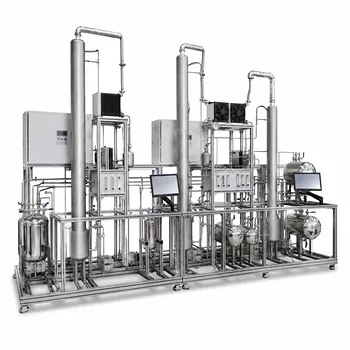
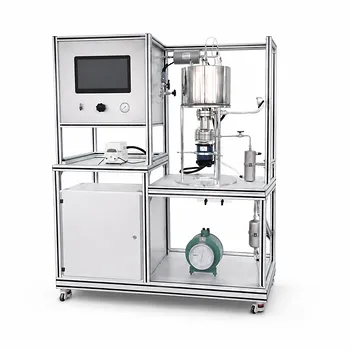
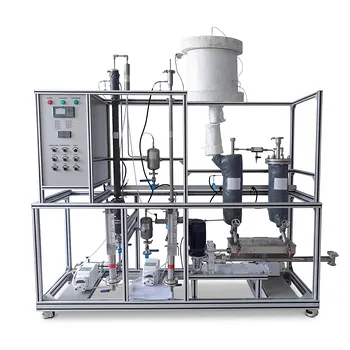
Here’s the core answer in a single, bolded sentence: Coupling distillation with a chemical reaction in a unit operations pilot plant lets you continuously remove one or more products from the reaction zone, driving equilibrium-limited reactions like esterification and transesterification far beyond their normal conversion ceiling—while simultaneously cutting energy use and capital footprint.
A reactive distillation pilot plant is a powerful process-intensification tool: it exploits Le Chatelier’s principle in real time to boost yield, integrates reaction heat into the separation, and gives you a physical platform to test the exact parameters (reflux ratio, temperature profile, feed location, catalyst holdup) that will define a successful industrial-scale operation.
Why Coupling Reaction and Distillation Is a Game Changer
The Fundamental Bottleneck: Equilibrium-Limited Reactions
Esterification and transesterification are classic reversible reactions. Left alone in a simple batch reactor, they stall at an equilibrium conversion that often falls well below economical targets. The traditional fix—using a separate reactor followed by a distillation train—still requires you to push the equilibrium by stripping products offline, which wastes energy and time.
In-Situ Separation Drives Conversion
The pilot-scale reactive distillation column solves this by merging the reactor and the fractionator into a single vessel. As volatile products (water, light esters, or alcohol azeotropes) form, they are immediately vaporized and separated upward in the rectifying section. According to Le Chatelier’s principle, this continuous removal pulls the reaction forward, driving conversion to near completion. In an esterification run, for example, removing the ester-water azeotrope overhead compels the reaction to keep producing more ester, achieving yields that a standalone reactor can never reach.
Energy Integration Makes It Economical
Running an endothermic or mildly exothermic reaction inside a distillation column lets you directly use the heat of reaction to help vaporize components. You’re not paying for a separate reboiler to generate vapor flow plus heating a reactor; the two functions coexist on the same trays. Pilot plant data consistently show that reactive distillation can cut overall energy consumption by 20–40% compared to the conventional reaction-plus-distillation sequence.
How the Pilot Plant Unlocks These Benefits
The Bridge Between Benchtop Chemistry and Full-Scale Production
A benchtop flask gives you kinetics; a simulated model gives you predictions. Only a unit operations pilot plant reveals the real-world interplay of mass transfer, liquid holdup, and thermal profiles under continuous operation. Pilot columns let you test catalyst bales, structured packings, and feed configurations at meaningful flow rates—closing the gap between a synthetic chemist’s first idea and a reliable P&ID.
Experimenting with Process Parameters That Matter
On an esterification or transesterification pilot unit, you can systematically vary:
- Reflux ratio and distillate rate: Too low a reflux starves the column of liquid on the reaction trays; too high wastes energy and dilutes reactants.
- Temperature profile across the column: A flat profile might indicate flooding or poor separation; a steep profile confirms effective staging.
- Feed point location: Adjusting where the alcohol or acid enters lets you manipulate the concentration profiles and drive the reaction more efficiently.
- Catalyst holdup and packing type: Structured catalytic packing (with ion-exchange resin or enzyme support) is common for esterification—pilot trials inform the trade-off between pressure drop, liquid distribution, and reaction activity.
Handling Consecutive and Side Reactions Gracefully
Many transesterification systems are prone to consecutive reactions—for instance, the desired biodiesel monoester can further convert to glycerol byproducts. The pilot plant becomes your diagnostic tool for intermediate trapping. By fine-tuning the stripping section’s temperature and liquid residence time, you can pull off the target monoester before it reacts further. If your goal shifts to a final product, you configure the column to rapidly isolate the intermediate and send it back to the reaction zone, a strategy that requires multiple feed points and adjustable liquid holdup—exactly what a well-instrumented pilot column provides.
Understanding the Trade-offs
Complexity of Control and Startup
A reactive distillation column is a multivariable puzzle. The interaction between reaction kinetics, vapor-liquid equilibrium, and mass transfer makes process control non-trivial. Pilot plant runs expose this early: you’ll see how a small change in reboiler duty can destabilize both the temperature profile and the reaction conversion simultaneously.
Catalyst Deactivation and Fouling
Catalytic packings can foul with polymers or salts over time, especially in esterifications involving high-boiling acids or glycerol. The pilot plant lets you measure the rate of deactivation under realistic conditions, so you don’t overdesign the industrial column or underspecify the catalyst replacement cycle.
Limited Operating Window
Reactive distillation works best when the products are the most volatile components—typical of methyl ester and ethyl ester systems. If your desired ester is less volatile than the reactants, you may need unconventional column designs (e.g., side-draw streams or reactive dividing-wall columns) that increase complexity quickly. The pilot plant is your sandbox to test whether these advanced configurations justify the gain.
Scalability of Heat and Mass Transfer
What works in a 2-inch column may not scale linearly. Liquid distribution, weeping, and flooding behaviors differ at larger diameters. Running a pilot column at variable throughputs and packing depths gives you the engineering data to derisk scale-up, but it also requires honest acknowledgment that no pilot plant perfectly mimics a 10-foot diameter industrial column.
How to Apply This to Your Project
Your optimization strategy should match your primary goal. Use the pilot plant to answer the question that drives your business case or research hypothesis.
- If your primary focus is maximizing reactant conversion: Run the column at sufficient reflux to strip the light product without starving liquid on the reaction trays. Experiment with feed location to concentrate reactants at the reactive zone, and monitor how overhead composition changes with reboiler duty.
- If your primary focus is energy efficiency: Start by measuring the heat duty of the reactive column versus a traditional reactor-plus-distillation baseline. Then optimize the reflux ratio and explore whether the exotherm can reduce supplementary steam—this often yields the most dramatic cost savings in transesterification.
- If your primary focus is product purity and intermediate selectivity: Use the pilot plant to profile temperature and composition across all trays. Adjust liquid holdup and residence time to minimize consecutive side reactions, and consider adding a side draw if the target product’s boiling point lies between reactants and heavies.
- If your primary focus is proving a novel catalyst or packing: Run extended campaigns to track activity loss, pressure drop, and mechanical integrity. A successful pilot demonstration here is the single most powerful evidence you can present to secure funding for a full-scale installation.
A pilot plant is not just a teaching tool—it is the definitive device for translating thermodynamic possibility into profitable reality.
Summary Table:
| Parameter | Conventional Process | Reactive Distillation |
|---|---|---|
| Conversion Limit | Equilibrium-limited | Drives past equilibrium limits |
| Energy Consumption | High (separate heating) | 20% to 40% energy reduction |
| Equipment Footprint | Large (reactor + column) | Compact single-vessel system |
| Process Parameters | Fixed sequential control | Dynamically optimized in-situ |
Optimize Your Process Scale-Up with LABPARK
Are you looking to bridge the gap between benchtop chemistry and industrial-scale production? LABPARK provides premium Educational and Vocational Unit Operations Pilot Plants in chemical engineering, bioprocess & biotech, and environmental & water treatment.
Whether you are a university training the next generation of engineers, a research institute testing novel catalysts, or an enterprise optimizing esterification processes, our customizable pilot plants deliver the precise thermodynamic data and real-world scalability you need to succeed.
Contact LABPARK today to consult with our experts and design the ideal pilot plant solution for your facility!
Related Products
- Multi-Functional Special Distillation Educational Pilot Plant
- Continuous Sieve-Plate Distillation Pilot Plant for Unit Operations Laboratory Education
- Electrolyte Distillation Purification and Formulation Educational Pilot Plant
- Green Anhydrous Ethanol Purification Extractive Distillation Unit Operations Training Pilot Plant
- Dual-Mode Rectification Pilot Plant for Practical Training Unit Operations
People Also Ask
- Why does simple distillation yield higher efficiency than flash distillation? Key thermodynamic differences.
- Why is the acentric factor important in pilot plants? Fluid property prediction.
- How Batch vs Continuous Configuration Affects Distillation Pilot Plant Versatility & Footprint
- How to Integrate Spectroscopy in Distillation Pilot Plants for Advanced Process Control
- How to Estimate Distillation Pilot Plant Tray Efficiency? O'Connell's Correlation Guide