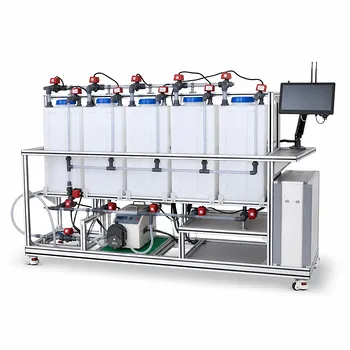
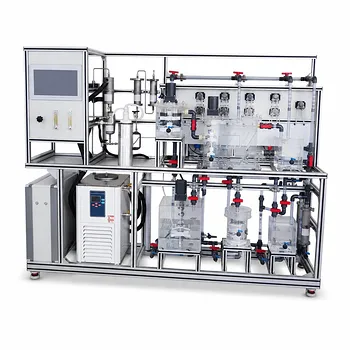
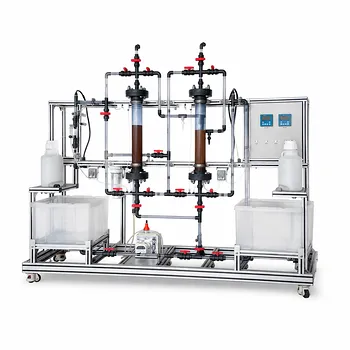
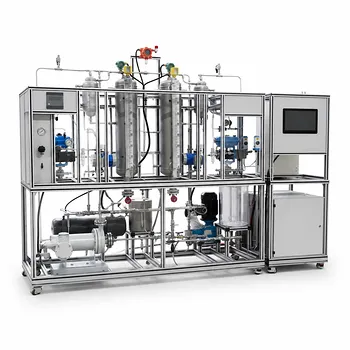
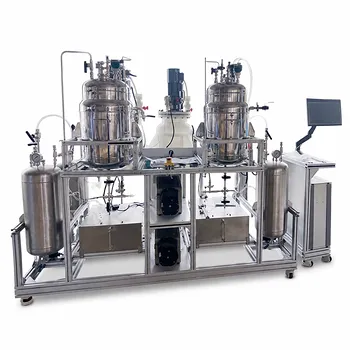
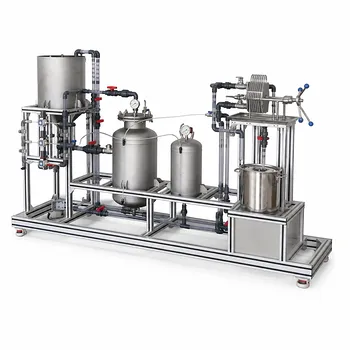
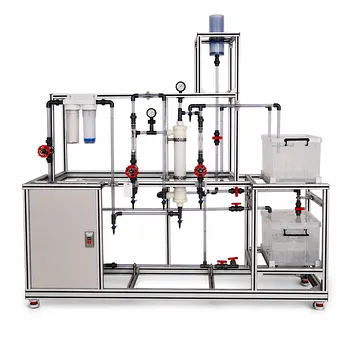
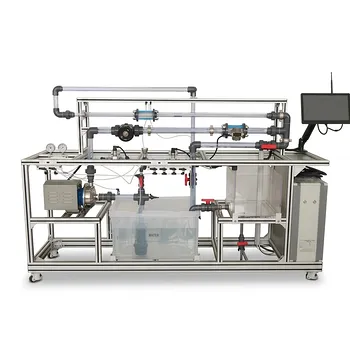
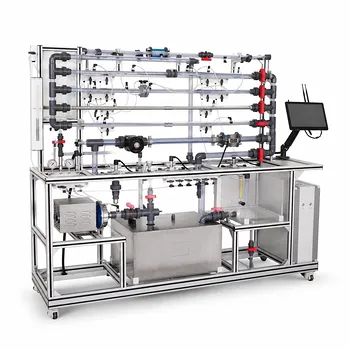
Here’s the core answer: A water treatment pilot plant demonstrates scale prevention by phosphate precipitation as a live, controllable experiment. It physically shows that injecting orthophosphate directly into the boiler drum—not the feed line—causes calcium and magnesium to form a soft, non-adherent hydroxyapatite sludge instead of hard, insulating scale. The pilot plant makes the invisible chemistry visible by letting operators observe how reaction location and timing determine whether you protect a system or accidentally plug a preheater.
Phosphate doesn’t simply “remove” hardness; it transforms the precipitation event. The pilot plant proves that if you force the reaction to happen in the bulk boiler water—specifically near the downcomer tubes—you create a dispersed, blowdown-friendly sludge. If you add the same chemical just a few meters upstream, you create a preheater-clogging disaster. The goal is not elimination of solids, but engineering the right kind of solid in the right place.
The Chemistry You’re Actually Watching
How Phosphate Converts Scale to Sludge
In a boiler, hardness ions like calcium (Ca²⁺) and magnesium (Mg²⁺) naturally want to form hard, adherent scale. When you introduce orthophosphate (PO₄³⁻) under high temperature and controlled pH, it intercepts those ions to form hydroxyapatite, a soft and poorly adherent complex.
The key transformation is from a crystalline growth habit that bonds to steel to one that grows as discrete particles in the bulk water. Instead of calcium carbonate (CaCO₃) baking onto tubes, you get a flowable precipitate that stays suspended long enough to be removed through blowdown.
Why This Is a Principle, Not a Recipe
The pilot plant shows that success depends on pH, temperature, and ionic ratio. At typical boiler pH (9.5–11), phosphate exists as a mix of PO₄³⁻ and HPO₄²⁻. The ratio of sodium to phosphate in the chemical feed directly influences whether you form hydroxyapatite or sticky, magnesium phosphate compounds that can still foul surfaces.
The lesson is subtle: phosphate treatment is a precipitation control strategy, not a dissolution miracle. The chemistry is the same whether you do it right or wrong—the pilot plant simply illustrates which conditions give you the outcome you want.
How a Pilot Plant Makes the Invisible Visible
Simulating the Critical Injection Point
The single most dramatic demonstration in any boiler feedwater pilot plant is the effect of injection location. The primary reference captures this perfectly: adding orthophosphate into the feedwater line ahead of the preheater causes immediate precipitation and plugging. But adding it directly into the boiler drum, near the downcomer tubes, protects the entire thermal system.
In the pilot plant, students can run back-to-back comparisons. With clear sight glasses, temperature sensors, and pressure taps, they watch differential pressure rise across the preheater when the chemical feed is mispositioned. This turns an abstract text-book warning into a visceral lesson on reaction kinetics and heat-transfer fouling.
Monitoring the “Sludge” in Real Time
Pilot plants typically include conductivity meters, pH probes, and blowdown sampling ports. By measuring turbidity and phosphate residuals, you directly observe the fate of the precipitate. A successful trial will show:
- A drop in soluble hardness.
- A rise in suspended solids that can be settled or filtered.
- No pressure increase across heat exchange surfaces.
The plant becomes a unit operations laboratory: you can vary flow, temperature, and dosing rate to find the window where the sludge remains dispersed and non-adherent.
Beyond Orthophosphate: The Bigger Phosphate Picture
The Threshold Effect of Condensed Phosphates
While orthophosphate creates a controlled precipitate, condensed phosphates like sodium hexametaphosphate (SHMP) work by a different mechanism—threshold inhibition. At very low concentrations (a few ppm), they adsorb onto the surface of incipient scale crystals and prevent them from growing large enough to settle or adhere.
A pilot plant can demonstrate this by dosing SHMP into hard water at ambient temperature and then gradually heating it. Without SHMP, scale forms quickly. With it, the solution stays clear far beyond what stoichiometry would predict. This teaches the critical principle that some anti-scalants work by distortion, not precipitation.
Controlling Silica with a Phosphate-adjacent Strategy
Silica scale is just as destructive as calcium scale, and phosphate chemistry alone won’t remove it. However, a pilot plant that includes a cold or hot lime softening stage can demonstrate how magnesium hydroxide precipitation scavenges silica in the presence of phosphate background.
That same sludge blanket operation also reinforces the main lesson: you engineer where and how the solid forms, rather than trying to keep everything dissolved. The phosphate program is one part of a broader approach that treats solids strategically.
Understanding the Trade-offs
Phosphate precipitation is not without risks, and a well-designed pilot plant highlights them clearly.
- Phosphate hideout: Under high heat flux, phosphate can become less soluble and temporarily plate out on tube surfaces, then redissolve when the heat load drops. This leads to erratic boiler water readings and corrosion risk. The pilot plant can simulate load swings to show how hideout masks your chemical control.
- Overfeed and carryover: Excess phosphate, especially at high pH, can create foaming or increase the sodium load. In the pilot plant, you can push the dosage until you see boiler water conductivity spike, teaching the limits of the treatment window.
- Magnesium phosphate mismatches: If magnesium is high and the pH is wrong, phosphate forms sticky compounds. The visible difference in sludge texture (from fluffy to gummy) in a pilot plant’s blowdown stream makes the point immediately.
These trade-offs are why the pilot plant is not just a teaching tool but a process optimization platform for real plants.
Making the Right Choice for Your Goal
Based on what a pilot plant can reveal, here’s how to apply the phosphate precipitation lesson.
- If your primary focus is maximizing scale prevention in a high-pressure boiler: Use orthophosphate injection directly into the drum, maintain a strict pH/PO4 ratio, and verify with real-time phosphate residual monitoring to avoid hideout.
- If your primary focus is protecting a preheater and economizer: Never inject orthophosphate upstream of the boiler. If you must treat the feedwater, use a sludge conditioner or a threshold inhibitor like SHMP and keep the phosphate for the drum.
- If your primary focus is teaching or training: Set the pilot plant to run a side-by-side trial: one circuit with correct drum injection and one with feedwater injection. The pressure-drop data, sludge appearance, and chemical residuals will communicate the principle faster than any lecture.
The ultimate lesson is that scale prevention is a matter of chemical timing and real-estate. A pilot plant lets you design your solid-formation strategy before it ever touches a million-dollar steam drum.
Summary Table:
| Treatment Type | Chemical Mechanism | Key Pilot Plant Demonstration |
|---|---|---|
| Orthophosphate Injection | Precipitates Ca/Mg as soft, flowable hydroxyapatite sludge | Shows why drum injection protects systems while feed line injection clogs preheaters. |
| Threshold Inhibition (SHMP) | Adsorbs onto crystal surfaces to distort and halt scale growth | Visualizes water clarity at high temperatures with sub-stoichiometric dosing. |
| Lime Softening | Scavenges silica via magnesium hydroxide precipitation | Demonstrates how solids are engineered and managed in a sludge blanket. |
Bring Hands-On Process Chemistry to Your Institution
Teaching complex chemical principles like scale prevention and precipitation kinetics requires real-world simulation. LABPARK provides advanced Educational and Vocational Unit Operations Pilot Plants in chemical engineering, bioprocess & biotech, and environmental & water treatment for universities, research institutes, and enterprises.
Help your students and researchers bridge the gap between theory and industrial practice. Contact LABPARK today to find the perfect pilot plant solution for your lab.
Related Products
- Electrochemical Water Treatment Educational Unit Operations Pilot Plant
- Thermal Desorption Exhaust Gas and Tail Water Treatment Educational Pilot Plant
- Ion Exchange Water Purification Educational Pilot Plant for Engineering Unit Operations
- Alkaline Membrane Water Electrolysis Educational Pilot Plant Unit Operations Training System
- Water Electrolysis Hydrogen Production and Storage Educational Pilot Plant
People Also Ask
- What design features do educational electrochemical pilot plants utilize to manage gas liberation and water loss?
- How can unit operations pilot plants show lead-acid concentration vs state of charge? Real-time monitoring guide.
- How do educational electrochemical pilot plants scale up electrolysis? Master industrial engineering.
- How to Estimate Sulfate in Water Treatment Pilot Plant Deposits: Gravimetric Guide
- How can foaming be managed during steam generation experiments in water treatment unit operations pilot plants? Tips