Fresh solvent at every stage: maximal purity, but a costly thirst.
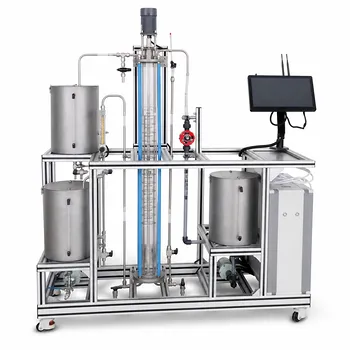
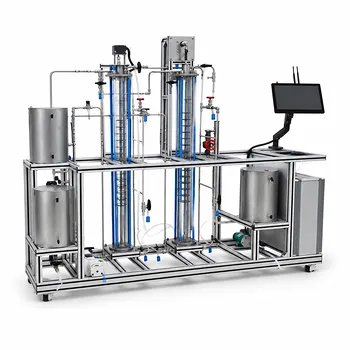
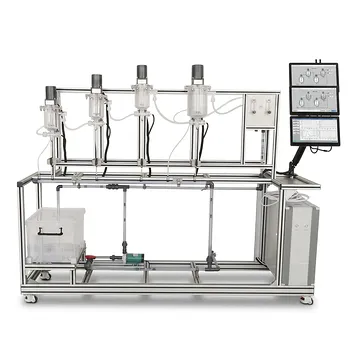
The multi-stage cross-current liquid-liquid extraction pilot plant physically embodies the foundational trade-off of separation processes. By feeding fresh solvent to each stage, the unit sustains a relentlessly high mass transfer driving force, slashing the solute concentration in the final raffinate. Yet that very performance comes at a steep price: the total volume of solvent consumed skyrockets. Students can experimentally verify that equal solvent flow rates across all stages minimize the total solvent requirement for a given separation target, directly watching the tension between extraction efficiency and operating cost play out in real time.
The cross-current pilot plant transforms an abstract economic trade-off into a measurable, tangible phenomenon. Operating the unit and sampling each stage teaches students that maximizing the driving force with fresh solvent inevitably inflates solvent usage—and that optimal process design often lies in balancing, not eliminating, this inefficiency.
The Classroom Becomes a Process: Seeing the Trade-off in Action
A multi-stage cross-current liquid-liquid extraction pilot plant is more than hardware; it is a live demonstration of how a simple chemical engineering principle creates an intense design dilemma.
Why Fresh Solvent at Every Stage Creates an Inescapable Tension
Fresh solvent enters each stage with zero solute content. This maintains the maximum possible concentration difference between the feed’s solute and the solvent, producing a consistently strong driving force for mass transfer.
The result is a raffinate with a remarkably low residual solute concentration—high extraction efficiency. However, each stage demands its own solvent stream. The total solvent consumption becomes the sum of the flows to all stages, often vastly exceeding what a counter-current configuration would require.
The extraction factor [(A_m = K \cdot S / B), where (S) is the solvent mass flow rate] quantifies this relationship. A high (S) raises (A_m), reducing the number of theoretical stages but directly increasing the solvent volume that must be recovered downstream. Cross-current operation naturally pushes (S_{total}) to high values, forcing students to confront the downstream cost of separation purity.
The Optimizer’s Paradox: Equal Flow Minimizes Total Consumption
A key pedagogical insight emerges when students are asked to adjust the solvent flow rate to each stage. The pilot plant reveals a counterintuitive optimum: for a set number of stages and a target raffinate composition, total solvent consumption is minimized when the solvent is distributed equally among all stages.
This hands-on verification of a theoretical minimization principle—often derived through calculus in a mass transfer course—cements understanding. Adding extra solvent to early stages yields diminishing returns on raffinate purity while sharply raising overall usage. The plant’s flow meters and concentration sampling ports transform an algebraic exercise into a visible, auditable result, bridging the gap between textbook optima and real unit performance.
Beyond the Hook: How the Pilot Plant Connects Theory to Industrial Reality
The cross-current pilot plant does not exist in isolation. Its true educational power is amplified when it is compared with other configurations and linked to classical design methods.
From Separatory Funnels to Continuous Operation
Traditional laboratory sessions often rely on a series of separatory funnels to simulate multi-stage extraction—a procedure that can require n+3 runs to approach phase equilibrium. A continuous cross-current pilot plant using mixer-settlers replaces this static sequence with a dynamic, flowing system.
Students can measure concentration profiles at each stage, plot operating lines against equilibrium curves (ternary phase diagrams), and directly calculate actual stage efficiency versus theoretical stages. This transition from batch simulation to continuous unit operation ingrains the reality of mass transfer limitations, residence time distributions, and the operational nuances that define industrial practice.
The Counter-Current Comparison: A Lesson in Economy
The cross-current pilot plant’s trade-off is most starkly illuminated when the same equipment—or a paired unit—can be configured for counter-current extraction. With the same total solvent consumption, a multi-stage counter-current arrangement can achieve dramatically higher separation efficiency (e.g., 97.97% recovery versus 88.96% for three-stage cross-current and 76.47% for a single stage).
Even more striking, counter-current configurations can match the cross-current extraction efficiency using up to 76% less solvent. When students run both modes on the same feed and analysis protocol, the graphs they generate become a brutally clear argument for process selection based on economic and environmental constraints.
Understanding the Trade-offs
Objective education demands a clear-eyed view of when cross-current extraction is a liability—and when it might be a deliberate choice.
The Cost of High Driving Force
The very feature that makes cross-current extraction efficient—fresh solvent at every stage—also creates its most significant burdens:
- High solvent inventory: Larger volumes require larger storage, piping, and pumps.
- Expensive downstream recovery: The dilute extract stream demands more energy-intensive distillation or evaporation to recover the solvent and concentrate the product.
- Environmental footprint: Greater solvent circulation increases the risk of losses and the load on regeneration systems.
These factors mean that, for bulk commodity separations, cross-current operation is usually economically unviable compared to a well-designed counter-current column.
Practical Limitations and When Cross-Current Makes Sense
Despite the inherent inefficiency, cross-current configurations persist in industry and education. They offer a simpler mechanical setup—a series of mixer-settlers with fresh solvent addition is easier to control and troubleshoot than a counter-current column. In pilot-plant education, this simplicity allows students to isolate the mass transfer phenomenon without being overwhelmed by column hydraulics.
Industrially, cross-current may be justified when:
- The solute is extremely high-value or hazardous, making the cost of residual contamination far exceed solvent recovery expenses.
- The solvent is inexpensive, readily available, and poses minimal environmental concern.
- The separation is so difficult (unfavorable equilibrium) that maintaining the maximum driving force at every stage is the only way to reach the required purity.
Making the Right Choice for Your Educational Goal
The cross-current pilot plant is a versatile teaching tool, but its impact depends on the learning objective you aim to achieve.
- If your primary focus is teaching process optimization: Assign students to find the equal solvent flow distribution that minimizes total solvent usage for a specified raffinate purity, connecting real-time data to calculus-based optimization theory.
- If your primary focus is demonstrating industrial relevance: Configure the plant (or a parallel unit) for both cross-current and counter-current operation and have students run a direct comparison, quantifying the dramatic solvent savings and extract concentration differences.
- If your primary focus is connecting theory to practice: Task students with performing graphical stage calculations (e.g., McCabe–Thiele or ternary diagrams) first, then let them measure actual concentration profiles on the pilot plant to calculate stage efficiencies and confront the disparities that pure equilibrium models overlook.
When students witness the numbers—solvent consumption, raffinate purity, extract concentration—emerge from real tanks, pumps, and analyzers, the trade-off ceases to be an abstract lecture slide. It becomes a design decision they understand deeply and can own.
Summary Table:
| Configuration | Solvent Consumption | Extraction Efficiency | Key Application |
|---|---|---|---|
| Cross-Current | High (Fresh solvent per stage) | Very High (Max driving force) | Teaching optimization & simple setups |
| Counter-Current | Low (Up to 76% less solvent) | High (97.97% recovery) | Bulk industrial separations |
Bring Industrial Reality to Your Lab with LABPARK
Are you looking to elevate your chemical engineering, bioprocess, or environmental curriculum? LABPARK provides state-of-the-art Educational and Vocational Unit Operations Pilot Plants designed specifically for universities, research institutes, and enterprises. Let your students gain hands-on experience with crucial mass transfer principles and process optimization.
Contact LABPARK today to find the perfect pilot plant solution for your lab!
Related Products
- Educational Rotary Disc Liquid-Liquid Extraction Pilot Plant
- Comprehensive Liquid-Liquid Extraction Pilot Plant for Engineering Education
- Gallium and Indium Selective Extraction Educational Pilot Plant
- Ternary Liquid-Liquid Equilibrium Educational Pilot Plant
- Multi-Modal Distillation Unit Operations Training Pilot Plant
People Also Ask
- How do density and IFT affect liquid-liquid extraction pilot plants? Optimize Column Performance
- How are ternary phase diagrams and LLE data applied in extraction experiments? Optimize Pilot Plant Scale-up
- In a liquid-liquid extraction pilot plant, how is a ternary-phase diagram utilized to determine solvent feed requirements?
- How Do Selectivity & Distribution Coefficients Influence LLE Pilot Plant Solvent Choice?
- How to Validate BIPs for LLE Pilot Plants? Steps to Align Simulations with Reality