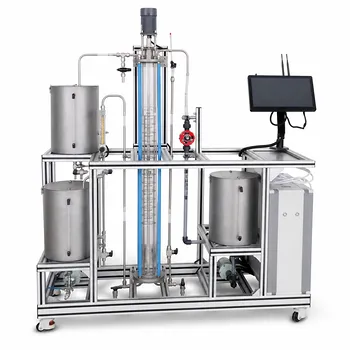
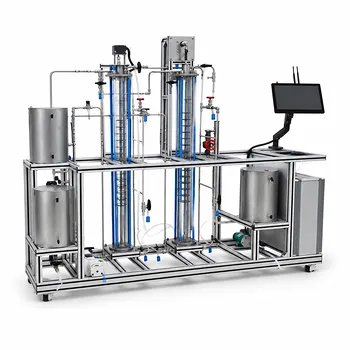
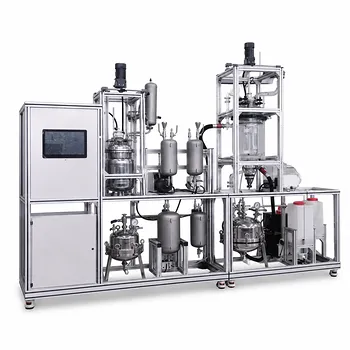
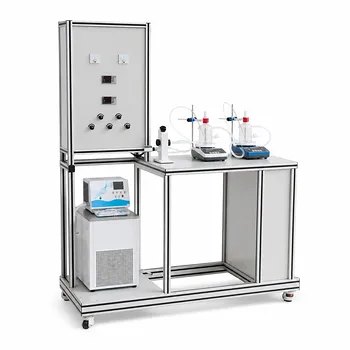
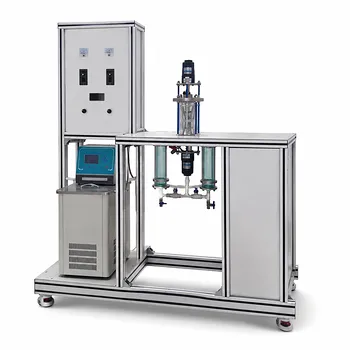
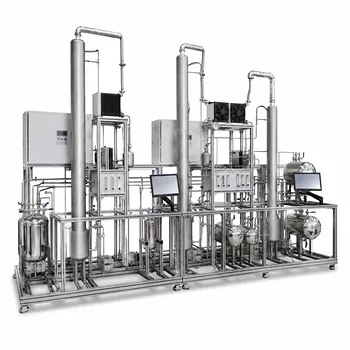
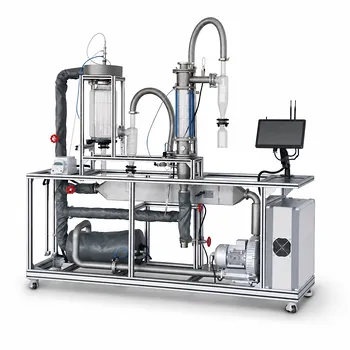
Separation without heat. A liquid‑liquid extraction (LLE) unit operations pilot plant demonstrates that the key to separating heat‑sensitive or azeotropic mixtures is not boiling point, but differential solubility. Operating at ambient temperatures and relying on partition coefficients, LLE preserves fragile biological molecules while circumventing the vapor‑liquid equilibrium constraints that make distillation impossible for azeotropes. This makes the pilot plant an indispensable platform for both research and education.
A liquid‑liquid extraction pilot plant proves that solubility‑driven separation is the elegant solution where distillation fails. For heat‑sensitive compounds, it offers gentle, low‑temperature processing; for azeotropes, it enables the selective extraction of one component, effectively breaking the azeotrope and enabling further purification. The pilot facility allows hands‑on evaluation of solvent selection, mass transfer, and phase behavior, bridging the gap between theory and industrial practice.
The Principle: Separation by Solubility, Not Boiling Point
In a distillation column, the driving force is relative volatility—how easily components evaporate. Azeotropes, where liquid and vapor compositions are identical, have zero relative volatility at the azeotropic point, halting further enrichment. Heat‑sensitive biomolecules like penicillin degrade rapidly at boiling temperatures.
An LLE pilot plant overcomes these limitations by exploiting partition coefficients. A feed liquid is contacted with an immiscible solvent. The target solute preferentially partitions into the solvent phase based on its chemical affinity, not its boiling point.
This solubility‑driven mechanism operates at ambient or low temperatures, completely avoiding thermal degradation. In the pilot plant, students can observe that temperature is used only gently—if at all—to improve mass transfer or solubility, never to vaporize the components.
Why Heat‑Sensitive Mixtures Demand a Non‑Thermal Approach
Gentle Processing at Ambient Temperatures
The primary reference highlights penicillin recovery as a classic example. Penicillin is unstable above 60°C; distillation would destroy it. An LLE pilot plant uses a water‑immiscible organic solvent at room temperature to extract the antibiotic from fermentation broth, preserving its bioactivity.
Because there is no vaporization, the process avoids exposing the product to high temperature gradients or prolonged thermal stress. This principle extends to proteins, natural products, and other biologics where even brief heating causes denaturation.
Demonstration of Low‑Temperature Mass Transfer
In a pilot‑scale mixer‑settler or extraction column, you can visually track the movement of the solute from the aqueous feed into the organic solvent. Mass transfer occurs through the liquid‑liquid interface by molecular diffusion, driven by the concentration gradient defined by the partition coefficient.
Students directly measure the effect of flow rates, agitation, and contact time on extraction efficiency—all at temperatures that keep the product safe. This hands‑on experience cements the concept that liquid‑liquid extraction is a cool (literally) alternative to distillation.
Breaking Azeotropes: How LLE Cheats Thermodynamics
Solvent Selection to Modify Relative Volatility
When a mixture forms an azeotrope, distillation alone cannot separate it because the vapor created has the same composition as the liquid. Liquid‑liquid extraction sidesteps this deadlock.
By introducing a selective solvent that has a strong affinity for one of the azeotropic constituents, the pilot plant extracts that component into the solvent phase. The extract stream now contains the targeted compound plus solvent—and critically, the residual raffinate is depleted of that component, often breaking the azeotrope.
The extracted component, once separated from the solvent (often by a downstream distillation that now works because the azeotrope is gone), can be recovered in high purity. This sequence—extraction followed by solvent recovery—is exactly what the pilot plant demonstrates when it routes the extract to a second unit operation.
Integrated LLE‑Distillation Sequences in a Pilot Plant
The supplementary references emphasize that the extracted components, now freed from the azeotropic constraint, exhibit large boiling point differences. The pilot plant can be connected to a distillation column to complete the purification. For example, an acetic acid–water mixture forms an azeotrope; extraction with a higher‑boiling solvent like ethyl acetate removes the acid. The extract is then distilled: the acid‑free solvent is recycled, and pure acetic acid is obtained.
In a modular pilot plant, students reconfigure piping and columns to run this integrated sequence. They observe firsthand that the LLE step does not vaporize the mixture, preserving energy and avoiding the need for entrainers, yet it makes the final distillation straightforward.
What the Pilot Plant Teaches You: Operational Insights
Evaluating Solvent Candidates and Partition Coefficients
The pilot plant is the ultimate tool for solvent screening. Students and researchers can test multiple solvents under identical hydrodynamic conditions, measuring distribution coefficients and selectivity. The best solvent is one that offers a high capacity for the target, is immiscible, easily recoverable, and chemically inert.
Key learning: A solvent that works in a bench‑top test tube may form an emulsion or be too viscous at pilot scale. The pilot plant reveals these real‑world challenges, essential for scale‑up.
Observing Phase Separation and Mass Transfer Rates
In mixer‑settlers, the mixture is agitated to create a large interfacial area, then allowed to separate by gravity. The rate of coalescence and clarity of the phases indicate the quality of the solvent system. Poor phase separation can lead to entrainment and product loss.
Extraction columns (packed or pulsed) show continuous counter‑current contact. By sampling along the column height, users construct operating and equilibrium lines, determine the number of theoretical stages, and link mass transfer theory to observable concentration profiles.
Understanding the Trade‑offs
The Challenge of Solvent Recovery and Cross‑Contamination
Liquid‑liquid extraction is not a one‑step miracle. The solvent‑laden extract must be processed to recover the product and recycle the solvent. Distillation is often used for this, which reintroduces heat—but only to a fraction of the stream, and at conditions well away from the azeotrope.
Solvent losses and cross‑contamination of the raffinate with solvent traces are real issues. The pilot plant quantifies these losses, teaching the importance of economic solvent management and environmental compliance.
Energy Intensity in Downstream Processing
Although the extraction step itself uses little heat, the overall energy balance must account for solvent regeneration. In some cases, the energy required to distill the extract can rival that of a direct distillation—especially if the solvent boils close to the product. The pilot plant allows a complete energy audit, enabling fair comparison with other technologies.
Scale‑up Considerations
A pilot plant mixer‑settler can be scaled by increasing cross‑sectional area and maintaining the same residence time, but emulsion stability and mass transfer efficiency may change. Observing these effects in the pilot unit is invaluable for avoiding costly mistakes at commercial scale. The pilot study also identifies potential solvent toxicity, fire hazards, or corrosion issues that may not be apparent from literature alone.
Making the Right Choice for Your Separation Goal
A liquid‑liquid extraction pilot plant demonstrates when solubility‑based separation offers a decisive advantage over distillation. Based on your focus, here is how to leverage the insights you gain:
- If your primary focus is protecting heat‑sensitive biologics: Choose LLE as the core separation step because it processes the feed at ambient or near‑ambient temperatures, preserving molecular integrity.
- If your primary focus is breaking an azeotrope without introducing complex entrainers: Use the pilot plant to identify a selective solvent that extracts one component, then follow with a simple distillation for solvent recovery—bypassing the azeotrope entirely.
- If your primary focus is teaching integrated process design: The LLE pilot plant, combined with a distillation module, provides a complete system for demonstrating how two unit operations work in synergy to solve an otherwise intractable separation.
A well‑designed LLE pilot study turns thermodynamic limitations into soluble opportunities, giving you the data and confidence to implement gentle, efficient separations where heat would fail.
Summary Table:
| Feature | Distillation | Liquid-Liquid Extraction (LLE) |
|---|---|---|
| Driving Force | Relative volatility (boiling point differences) | Partition coefficient (solubility affinity) |
| Operating Temp | High temperatures (requires vaporization) | Ambient or low temperatures (no heat damage) |
| Azeotropic Mixtures | Fails at the azeotropic point | Bypasses limits by selectively extracting components |
| Primary Application | Thermally stable liquids with distinct boiling points | Heat-sensitive biologics, proteins, and azeotropes |
Enhance Your Process Engineering Training with LABPARK
Bridge the gap between chemical theory and industrial reality. LABPARK provides premium Educational and Vocational Unit Operations Pilot Plants in chemical engineering, bioprocess & biotech, and environmental & water treatment for universities, research institutes, and enterprises.
Equip your laboratory with hands-on systems to demonstrate mass transfer, solvent selection, and low-temperature separations safely and effectively.
Contact LABPARK today to explore our custom pilot plant solutions!
Related Products
- Educational Rotary Disc Liquid-Liquid Extraction Pilot Plant
- Comprehensive Liquid-Liquid Extraction Pilot Plant for Engineering Education
- Gallium and Indium Selective Extraction Educational Pilot Plant
- Ternary Liquid-Liquid Equilibrium Educational Pilot Plant
- Liquid-Liquid Mass Transfer Coefficient Determination Educational Pilot Plant
People Also Ask
- How do density and IFT affect liquid-liquid extraction pilot plants? Optimize Column Performance
- How are ternary phase diagrams and LLE data applied in extraction experiments? Optimize Pilot Plant Scale-up
- In a liquid-liquid extraction pilot plant, how is a ternary-phase diagram utilized to determine solvent feed requirements?
- How Do Selectivity & Distribution Coefficients Influence LLE Pilot Plant Solvent Choice?
- How to Validate BIPs for LLE Pilot Plants? Steps to Align Simulations with Reality