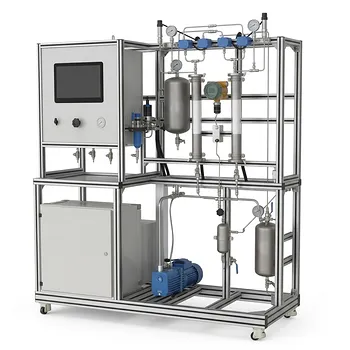
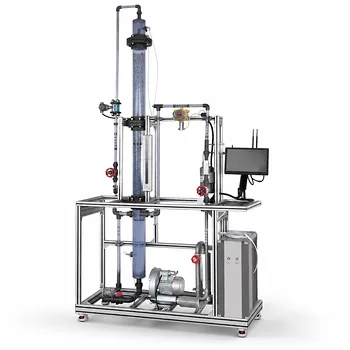
DAC columns solve the bed stability challenge that plagues traditional packed beds. By using a hydraulic piston to apply continuous, dynamic compression, Dynamic Axial Compression (DAC) systems eliminate the voids and channels caused by bed settling, maintaining a perfectly packed stationary phase over long campaigns. This same mechanism makes scale-up highly predictable—column efficiency becomes independent of diameter, so scaling is a matter of increasing flow and load proportionally to cross‑sectional area while keeping bed length and particle size constant.
Core insight: DAC’s continuous pressure turns bed packing from a fragile, one‑time procedure into a self‑healing, dynamic state. This removes the packing‑quality variable from scale‑up calculations, making pilot‑scale chromatography behave like a simple geometric extrapolation of a well‑packed lab column.
How Dynamic Axial Compression Achieves Packing Stability
The Piston as a Living, Breathing Seal
A DAC column compresses the chromatographic sorbent slurry with a hydraulic piston that maintains constant force throughout operation. As the bed naturally subsides—due to particle rearrangement, dissolution of fines, or mechanical vibration—the piston instantly advances, filling any nascent gaps before they become channels or voids. This continuous pressure eliminates the most common failure mode in large‑scale columns: packing-induced dead zones.
Why Static Beds Fail at Pilot Scale
In fixed‑bed columns, the packed bed is a static snapshot. After the slurry settles, the bed can no longer self‑correct. Shrinkage over time creates a headspace that permits bed movement, leading to cracks, channels, and uneven flow distribution. These defects degrade Height Equivalent to a Theoretical Plate (HETP) and ruin the concentration profile that is critical for high solute recovery and purity. DAC makes such bed degradation physically impossible.
Maintaining Efficiency Over Long Production Runs
Because the compression is dynamic, the packed bed remains uniformly dense and void‑free for the entire campaign. This preserves the original packing quality and ensures that the eddy diffusion contribution to band broadening stays minimal. The result is a stable HETP value that does not drift over time, which is essential for meeting purity specifications batch after batch.
The Secret to Predictable Scale‑up
Column Efficiency That Defies Diameter
The most valuable property of a DAC column for scale‑up is that efficiency becomes independent of column diameter. As long as the bed packing quality is maintained—which the piston guarantees—the plate count is determined solely by particle size and bed length. You don’t need to re‑optimize slurry concentrations, packing pressures, or distribution hardware every time you go up a pipe size.
The Scaling Rulebook
This independence translates into a simple, robust scaling algorithm:
- Keep the bed length and particle size identical to the lab column.
- Scale the volumetric flow rate and feed load proportionally to the column’s cross‑sectional area. In other words, double the diameter, quadruple the flow and load—and expect identical separation performance. No hidden correction factors, no risky over‑packing experiments on expensive large‑scale hardware.
Bridging the Gap Between Lab and Pilot Reality
The predictability that DAC offers is precisely why it is the dominant technology in pilot‑scale purification. Operators can move from a 2 cm ID lab column to a 20 cm ID pilot column and trust that the concentration profile shape will be preserved, provided the column length and resin particle size remain unchanged. This dramatically reduces the number of pilot trials needed and accelerates process development timelines.
Understanding the Trade‑offs and Practical Limitations
Mechanical Complexity is Non‑Trivial
A DAC column adds a hydraulic power unit, piston seals, and control systems to the chromatography skid. This increases capital cost and maintenance burden compared to a simple fixed‑bed column. For processes where bed subsidence is minimal (e.g., with rigid, fully swollen resins), the extra complexity may not be justified.
Diameter Independence Has Its Limits
While DAC ensures a uniform axial bed density, it does not solve all large‑diameter challenges. At very large scales, radial flow maldistribution can still occur due to wall effects or uneven inlet flow. Supplementary design elements—specialized distributor plates, baffles, or radial mixing structures—are often required to prevent axial dispersion from eroding the theoretical plate count. DAC’s promise of diameter‑independent efficiency holds only when these fluid distribution issues are adequately addressed.
Not a Substitute for Right‑Sized Particles
The hydraulic piston cannot compensate for poor particle size selection. A bed of fine particles will still generate high pressure drops, and a bed of coarse particles will still give poor resolution. DAC guarantees packing quality but does not alter the fundamental mass‑transfer kinetics. The stationary phase must still be chosen based on the required selectivity and throughput.
Making the Right Choice for Your Pilot‑Plant Goal
Choosing whether to adopt DAC technology depends on your priorities. Use this checklist to guide your decision.
- If your primary focus is minimizing HETP and achieving high‑resolution separations: DAC is highly recommended. Paired with an optimized particle size and good flow distributors, it eliminates packing‑induced band broadening and keeps your concentration profiles razor‑sharp.
- If your primary focus is predictable and rapid scale‑up: DAC is the best investment you can make. It turns column diameter into a simple process variable rather than a re‑optimization trigger, saving months of pilot‑scale trial‑and‑error.
- If your primary focus is long‑term operational stability with minimal hands‑on intervention: DAC’s self‑compensating piston drastically reduces the risk of bed failure over time, cutting down unplanned maintenance and production losses.
- If your primary focus is simplicity and lowest capital cost for a short‑term campaign: A conventional static column may suffice, especially when using rigid resins and short column lengths where bed subsidence is unlikely.
DAC columns turn chromatography scale‑up from an empirical art into a predictable science—your optimized small‑scale separation will translate reliably to pilot‑plant flows, giving you confidence in every larger run.
Summary Table:
| Feature | Dynamic Axial Compression (DAC) | Conventional Static Columns |
|---|---|---|
| Bed Stability | Continuous hydraulic compression self-heals voids & channels | Prone to settling, cracking, and headspace formation |
| Scale-Up Predictability | High; efficiency is independent of column diameter | Low; requires re-optimizing packing for each scale |
| System Complexity | High; requires hydraulic control units and seals | Low; simple mechanical construction |
| HETP Consistency | Stable HETP over long production campaigns | Degrades over time due to flow distribution drift |
Scale Up Your Chemical Engineering Operations with Confidence
Transitioning chromatography and separation processes from lab to pilot scale requires robust, predictable technology. LABPARK provides high-quality Educational and Vocational Unit Operations Pilot Plants in chemical engineering, bioprocess & biotech, and environmental & water treatment.
Designed specifically for universities, research institutes, and enterprises, our pilot plants bridge the gap between academic theory and industrial reality, giving your students and researchers hands-on experience with advanced systems like DAC columns.
Ready to elevate your training and research capabilities? Contact LABPARK today to find the perfect pilot plant solution for your facility!
Related Products
- Continuous Batch Extractive Distillation Educational Pilot Plant
- Dual-Mode Rectification Pilot Plant for Practical Training Unit Operations
- Absorption and Desorption Educational Unit Operations Pilot Plant
- Multi-Modal Distillation Unit Operations Training Pilot Plant
- Educational Rotary Disc Liquid-Liquid Extraction Pilot Plant
People Also Ask
- Wilson vs. UNIQUAC: How to Choose the Right Thermodynamic Model for Your Pilot Plant
- Why use non-ideal VLE calculations in distillation pilot plants? Ensure accurate scale-up & purity
- How does the feed thermal state influence distillation pilot plant design and utility consumption?
- How to Configure a Distillation Pilot Plant? Key Steps for Multi-Mode Setup
- How to Integrate Spectroscopy in Distillation Pilot Plants for Advanced Process Control