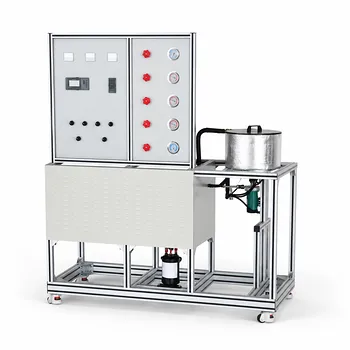
Air is the invisible saboteur of dry granulation.
In a unit operations trainer, a deaeration mechanism removes this air from the powder bed just before it enters the roller nip, using a porous plate connected to a vacuum source. This step prevents the chaotic release of trapped gas that can shatter or cap the forming ribbon, and it gives students a direct, hands‑on lesson in why venting is essential for both small‑scale experiments and full‑production roller compactors.
Deaeration in a dry granulation trainer uses a porous plate and vacuum to extract interstitial air before the powder is compacted. Mastering this concept teaches students why uncontrolled air causes ribbon defects and how process speed and ribbon density are inextricably linked—insights that transfer immediately to industrial roller compaction design and troubleshooting.
How the Deaeration Mechanism Works
The Porous Plate: A Breathable Wall
The heart of the system is a plate with microscopic pores that allow gas to pass but hold the powder back. As the feed screw moves material toward the rolls, the powder slides over this plate, and the residual air from the particle voids is pulled out.
The pore size is carefully selected to match the powder’s particle size distribution. This ensures efficient air removal without losing fine material or clogging the plate.
Vacuum Integration: Active Air Removal
A controlled vacuum is applied beneath the porous plate, creating a pressure gradient that actively draws air from the bulk powder. This is not passive venting; it is a deliberate, engineered step that makes the feed bed denser and more uniform before it ever reaches the nip.
Without the vacuum, the powder would carry a significant volume of interstitial air into the compaction zone, where it would be forced to escape violently during the rapid density increase.
Timing That Changes Everything
The deaeration happens immediately before the roller nip, after the screw has de‑agglomerated the powder but before the counter‑rotating rolls grab it. This precise placement means the powder enters the nip as a semi‑aerated, consistent mass rather than a two‑phase mixture of solids and compressed air.
The result is a stable, defect‑free ribbon because the air has already been removed where it can do no harm.
Why This Matters for Student Learning
Connecting Air Entrainment to Speed and Density
In a pilot‑scale trainer, students can vary vacuum levels, screw speeds, and roll pressures while observing ribbon density and surface quality. They quickly see that excess entrained air acts as a soft cushion, limiting the maximum density achievable at a given pressure and forcing a trade‑off between speed and ribbon integrity.
This tangible feedback teaches the fundamental truth that compaction is a gas‑removal process, not just a crushing operation.
Troubleshooting Real‑World Defects
When a ribbon shows capping (horizontal splitting) or edge fractures, students often assume a mechanical problem. The trainer reveals that air escape during compaction is one of the most common root causes. By adjusting the vacuum—or even turning it off—they can recreate and then solve these defects in minutes, building critical diagnostic skills.
This hands‑on experience makes the invisible visible, turning a textbook concept into an instinct.
Bridging the Gap to Industrial Granulation
Full‑scale roller compactors rely on precisely the same principle, though they often use larger vented hoppers or vacuum‑assisted feed systems. Understanding the trainer’s small‑scale deaeration system allows a student to design, operate, and troubleshoot machines where venting is the primary bottleneck to increasing throughput and maintaining ribbon quality.
The lesson is clear: if you ignore air removal at the pilot stage, you’ll never fix it when the stakes are a multi‑ton production line.
Understanding the Trade‑offs
The Risk of Over‑Reliance on Vacuum
While deaeration is critical, it is not a universal solution. Too high a vacuum can pull ultra‑fines into the plate, leading to blinding and a sudden loss of effectiveness. This forces students to appreciate that every parameter must be balanced, not pushed to its extreme.
The Interaction with Powder Properties
Some powders, particularly those with a broad particle size distribution, may segregate if air is pulled too aggressively, altering the blend uniformity. This teaches an essential caveat: the deaeration step must be tailored to the powder’s flow and cohesion characteristics. A setting that works beautifully for one formulation can ruin another.
Applying These Lessons to Your Development
- If your primary focus is mastering roller compaction fundamentals: Concentrate on how the vacuum level directly modifies the feed bulk density and, consequently, the ribbon’s tensile strength.
- If your primary focus is troubleshooting ribbon defects: Always check the deaeration circuit first—inspect the porous plate for blinding, verify the vacuum gauge, and run a test without vacuum to isolate air‑related causes.
- If your primary focus is preparing for industrial scale‑up: Document the relationship among vacuum pressure, screw speed, and ribbon density on the trainer; these benchmarking data will be the blueprint when specifying venting requirements for a full‑scale machine.
When you truly grasp the deaeration mechanism, you stop seeing a powder and instead see a fluid of particles and air—and that perspective is the foundation of every robust dry granulation process.
Summary Table:
| Deaeration Feature | How it Functions | Educational & Practical Value |
|---|---|---|
| Porous Plate | Micropores block powder while allowing trapped air to pass. | Teaches particle size matching to prevent plate blinding. |
| Active Vacuum | Creates a pressure gradient to draw out interstitial air. | Demonstrates how bulk density directly affects ribbon tensile strength. |
| Strategic Timing | Extracts air right before the roller nip. | Helps students troubleshoot real-world defects like capping and splitting. |
Elevate Your Practical Education with LABPARK
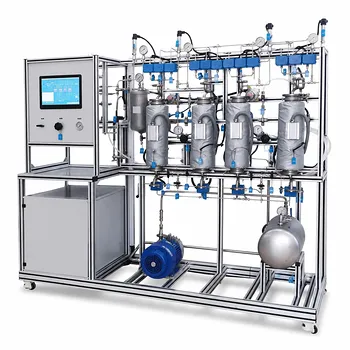
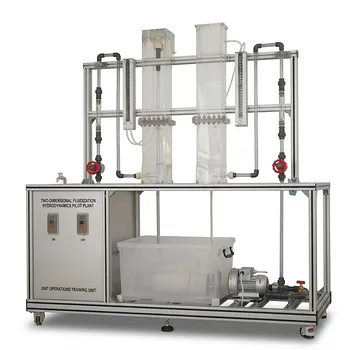
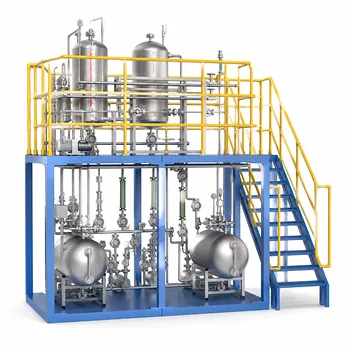
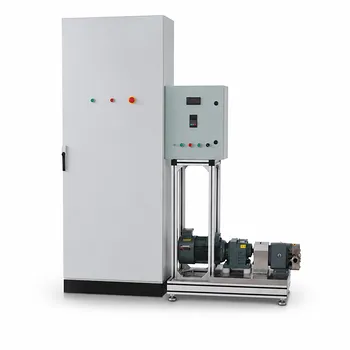
At LABPARK, we design and supply premium Educational and Vocational Unit Operations Pilot Plants across chemical engineering, bioprocess & biotech, and environmental & water treatment. Tailored for universities, research institutes, and enterprises, our systems provide hands-on experience with critical processes like powder compaction and deaeration.
Empower your students and researchers with industry-ready troubleshooting skills. Contact LABPARK today to find the perfect pilot plant for your institution!
Related Products
- Multi-Functional Drying Educational Unit Operations Pilot Plant
- Multimodal Absorption and Desorption Pilot Plant for Unit Operations Training
- Multi-Modal Distillation Unit Operations Training Pilot Plant
- Green Anhydrous Ethanol Purification Extractive Distillation Unit Operations Training Pilot Plant
- Natural Product Extraction Unit Operations Training Pilot Plant
People Also Ask
- How to study gasification in pilot plants? Compare exit gas composition & efficiency
- How do deviations in estimating latent heat impact pilot plant thermal systems? Avoid hardware mis-sizing.
- Why Use PTFE & Hastelloy in Chemical Pilot Plants? Prevent Corrosion & Ensure Safety
- Why is the chemical plant startup schedule crucial? De-risk scale-up with pilot plants.
- When to transition from PID to adaptive control in pilot plants? Key process indicators.