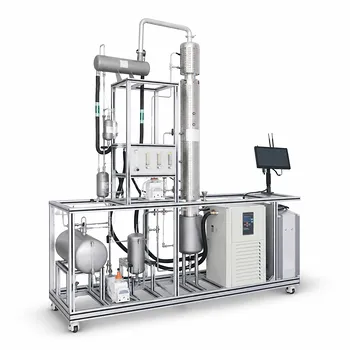
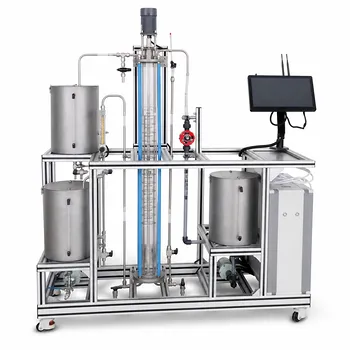
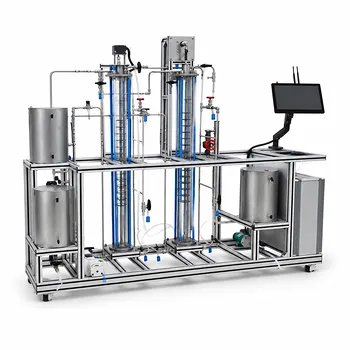
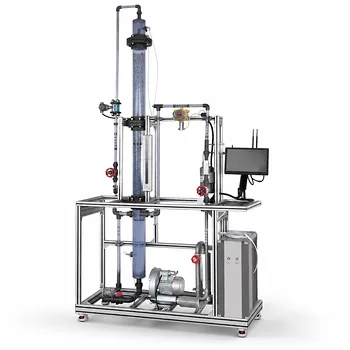
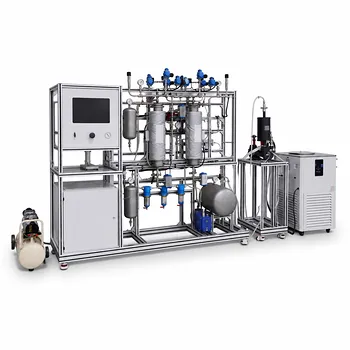
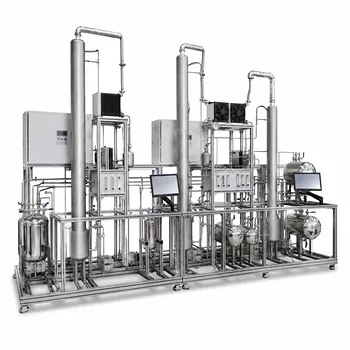
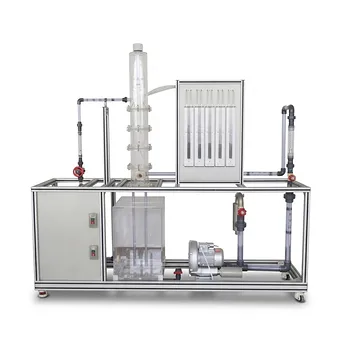
The core difference is in the timing and equipment. A batch distillation column pilot plant separates a multi-component mixture into its individual fractions one by one over time using a single column, whereas a continuous system separates the same mixture into exactly two streams simultaneously but would require multiple columns in series to achieve the same multi-stage purity.
The single greatest advantage of a batch column for a lab or pilot plant is its "many from one" capability: with one simpler, more robust system, you can sequentially isolate multiple high-purity products from complex mixtures. This makes it the superior choice for research, education, and small-scale production where recipe flexibility trumps steady-state throughput.
Unpacking the Sequential Separation Principle
The primary reference’s value proposition hinges on a single, powerful idea: a batch column does the work of a multi-column continuous train within a single vessel. This principle defines its suitability for pilot plants.
How a Single Column Replaces an Entire Train
In a continuous distillation setup, each column in a series performs one specific split. To separate a three-component mixture into three pure products, you need two columns. To separate five components, you need four columns.
A batch pilot plant bypasses this entirely. It processes a fixed charge of feed material. By controlling the reflux ratio over time, it first distills off the lightest component, then a middle fraction, then the heaviest residue. This is an unsteady-state process, where the composition inside the column changes dynamically, a feature that is a teaching tool in itself.
Demonstrating Dynamic Process Behavior
Unlike a continuous system that reaches a fixed operating point, a batch column at a constant reflux ratio shows a continuous decline in the purity of the overhead product over time. This transient behavior, directly highlighted in the references, is a core learning objective in a pilot plant. It forces students and researchers to master dynamic control strategies, not just static material balances.
When Pilot Plant Simplicity is a Strategic Advantage
The operational flexibility of a batch column extends far beyond its ability to handle multiple products. Its physical design makes it uniquely suited for the challenging, non-standard conditions often found in a research or training environment.
Handling Dirty and Difficult Materials
The supplementary references correctly highlight a major failure point for continuous pilot columns: fouling. If a research mixture contains suspended solids, polymers, or tars, these materials will quickly clog the feed preheaters, distribution plates, and downcomers of a continuous system.
A batch still has no complex internals to foul in the feed zone. The entire charge sits in a simple heated pot (the reboiler), making it inherently more resilient for processing crude reaction products, fermentation broths, or waste-solvent recovery directly.
Adapting to Varying Recipes and Batches
A pilot plant’s purpose is often to prove that a process works at all. Researchers frequently swap feedstocks or testing new reaction conditions, which changes the feed composition.
A continuous column is a rigid machine tuned for a consistent input. Changing the feed composition often requires redesigning the column internals. A batch system's flexibility is instantaneous: you simply change the charge in the pot and adjust the operating time or reflux profile to hit your new purity target. This aligns perfectly with vocational training scenarios where the feed variety and purity requirements change frequently.
Reduced Footprint and System Complexity
The supplementary references stress that a batch pilot plant requires less peripheral equipment. You eliminate the need for precision feed pumps, continuous feed preheaters, and complex level control cascades found in multi-column setups. For a university laboratory, this lower capital cost and physical footprint significantly reduce the barrier to entry for a fully functional, hands-on distillation teaching module.
The Learning Framework: Transient vs. Steady-State
Choosing between these pilot plant types is ultimately a choice between two fundamentally different educational and research paradigms.
Steady-State Science in a Continuous Plant
A continuous distillation unit locks in on a fixed condition, making it the perfect apparatus for teaching material and energy balances around a stable system. As noted in the supplementary references, this is ideal for simulating industrial reality. It also unlocks process intensification concepts like continuous reactive distillation, where chemical reaction and separation happen simultaneously in one column, eliminating downstream unit operations.
Dynamic Control Mastery in a Batch Plant
The educational power of a batch pilot plant lives in its unsteady state. The distillate composition changes continuously. This forces the operator to actively manage key variables, primarily the reflux ratio, to maintain product specifications as the lighter components are depleted. This hands-on, dynamic decision-making is impossible in a purely continuous setup, making the batch system a superior tool for imparting advanced process control intuition.
Understanding the Trade-offs
Any objective technical assessment must acknowledge where a solution falls short. The advantages of a batch pilot plant are not free.
The Inherent Energy Penalty
A continuous column recaptures heat internally; a hot stream entering the column preheats a cold stream leaving it. A batch column cycles thermally. You heat the entire charge, distill a fraction, cool everything down to remove the residue, recharge, and reheat from a cold start. This makes batch processing significantly less energy-efficient per kilogram of product. It is a non-trivial operational cost, even at the pilot scale.
The Distillation Time Issue
Separating a multi-component mixture in a single batch column takes a long time. The column is literally idling on the last 90% of the mixture while you wait to collect the final 10% of a heavy product. For production-focused pilot plants evaluating kilogram-per-day capacity, a continuous or even a hybrid approach should be evaluated.
Not a Perfect Industrial Proxy
If the goal of a pilot plant is to provide a direct scale-down model for a massive continuous petrochemical plant, a batch column does not mimic the steady-state fluid dynamics, temperature profiles, or control logic of the future production system. The operational excellence gained on a batch column won't directly translate to running its continuous counterpart, a critical consideration for vocational training aimed at specific employers.
Making the Right Choice for Your Goal
Your choice between a batch and continuous distillation pilot plant depends entirely on your core objective: maximum experimental flexibility or a faithful representation of continuous industrial processes.
- If your primary focus is flexibility for research and small-scale production: Choose a batch column. Its ability to separate multi-component mixtures with one column and handle difficult, fouling, or frequently changing recipes is unmatched.
- If your primary focus is teaching fundamental mass and energy balances: Choose a continuous column. It provides a clear, visual, and steady-state demonstration of core chemical engineering principles without the added complexity of transient control.
- If your primary focus is vocational training for petrochemical operators: Choose a continuous column. The pilot plant should explicitly mirror the steady-state control logic and unit operations the students will face in their future roles.
- If your primary focus is process intensification research: Choose a continuous reactive distillation setup. It demonstrates the modern industrial drive to combine reaction and separation into fewer, safer, and higher-throughput vessels.
Ultimately, the power of the batch column pilot plant is its problem-solving breadth; it won't be the most efficient simulator of a steady-state factory line, but it is the single most versatile tool for mastering the art and science of separation itself.
Summary Table:
| Feature | Batch Distillation Column | Continuous Distillation System |
|---|---|---|
| Separation Principle | Sequential separation over time (one column) | Simultaneous separation (multiple columns in series) |
| Operational Flexibility | High (handles variable recipes, dirty feeds, and solvent recovery) | Low (rigid design optimized for steady-state feed compositions) |
| Footprint & Complexity | Small footprint; minimal peripheral pumps & heaters required | Larger footprint; requires complex feed control & preheaters |
| Primary Educational Focus | Dynamic process control and transient state mastery | Material/energy balances and steady-state simulation |
Elevate Your Engineering Programs with LABPARK
Choosing the right pilot plant is critical for bridging the gap between academic theory and industrial reality. LABPARK provides premium Educational and Vocational Unit Operations Pilot Plants in chemical engineering, bioprocess & biotech, and environmental & water treatment for universities, research institutes, and enterprises.
Whether you need flexible batch distillation columns to teach dynamic control or continuous systems for steady-state simulation, our solutions are engineered for safety, durability, and academic excellence.
Contact our technical experts today to design your lab!
Related Products
- Continuous Batch Extractive Distillation Educational Pilot Plant
- Continuous Sieve-Plate Distillation Pilot Plant for Unit Operations Laboratory Education
- Multi-Functional Special Distillation Educational Pilot Plant
- Multi-Modal Distillation Unit Operations Training Pilot Plant
- Dual-Mode Rectification Pilot Plant for Practical Training Unit Operations
People Also Ask
- Wilson vs. UNIQUAC: How to Choose the Right Thermodynamic Model for Your Pilot Plant
- Why use non-ideal VLE calculations in distillation pilot plants? Ensure accurate scale-up & purity
- How does the feed thermal state influence distillation pilot plant design and utility consumption?
- How to Configure a Distillation Pilot Plant? Key Steps for Multi-Mode Setup
- How to Integrate Spectroscopy in Distillation Pilot Plants for Advanced Process Control