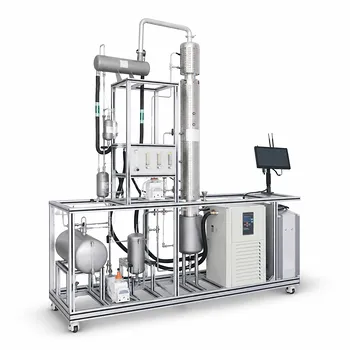
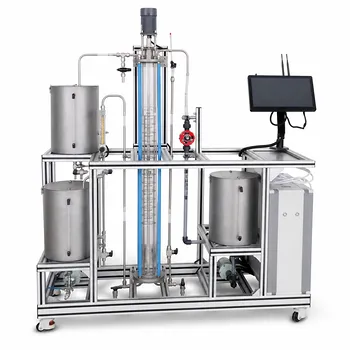
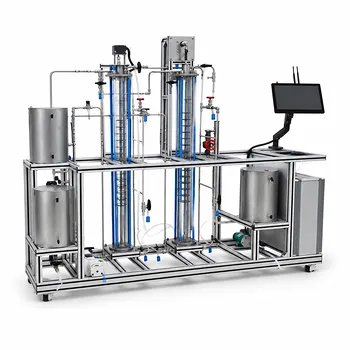
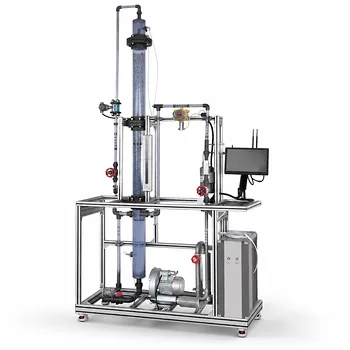
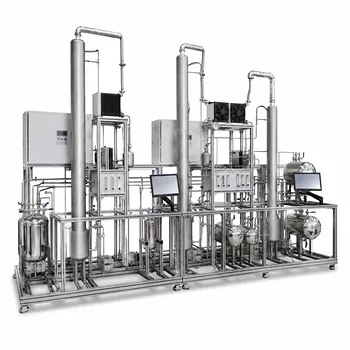
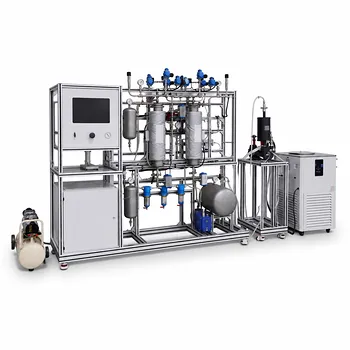
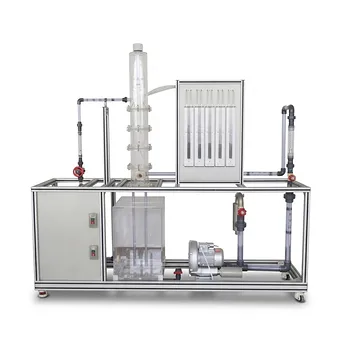
Teaching multi-component separation with pilot plants begins with a foundational rule: the minimum number of continuous distillation columns required to separate an (n)-component mixture into pure components is (n-1). With that number established, the instructor must then guide students through the choice of process flow scheme—typically the direct sequence (lightest component first) or the indirect sequence (heaviest component first)—using heuristics that balance energy use, product stability, and capital cost. Pilot plants make these abstract sequencing rules tangible, letting students observe how thermal sensitivity, concentration profiles, and reflux ratios shape the final configuration.
The core challenge in teaching multi-component distillation is moving from the theoretical “(n-1) columns” to a justified, optimal flow scheme. Pilot plants bridge this gap by demonstrating that while the direct sequence often wins on energy efficiency, practical constraints like corrosive intermediates or very unequal splits can demand a different strategy. The optimal flow scheme is the one that best satisfies product purity, equipment protection, and thermodynamic common sense—all of which can be tested and visualized in a well-designed unit operations lab.
The Fundamental Rules: Columns and Sequences
The ((n-1)) Column Rule
A continuous distillation column typically isolates a single pure product by splitting a feed into a distillate and a bottoms stream. To recover (n) pure components, you need (n-1) separation cuts. In conventional teaching, this means a train of (n-1) columns connected in series. A three-component mixture (A, B, C in order of decreasing volatility) needs two columns; a four-component system needs three, and so on.
This rule holds for any conventional distillation where no azeotropes or additional mass‑separating agents are introduced. It provides the minimum number of columns—the starting point from which students can explore why real‑world processes sometimes use different configurations, such as batch distillation or extractive distillation.
Direct vs. Indirect Sequencing
With two columns for a ternary mixture, the feed can be routed in two fundamentally different ways. The direct sequence takes the most volatile component A overhead in the first column, sending the B/C mixture to a second column where B is recovered as distillate and C as bottoms. The indirect sequence reverses this: the first column removes C as the heavy bottoms, and the A/B mixture is then split in a second column.
The direct sequence often emerges as the preferred base case because it vaporizes the lightest component only once, whereas the indirect sequence can require re‑vaporization of the already‑separated lighter species in later columns, increasing total energy input. However, the indirect sequence avoids repeatedly boiling a heat‑sensitive heavy component, which can be crucial when the heaviest fraction is thermally unstable or corrosive.
Heuristics That Guide the Optimal Flow Scheme
Remove High‑Volume Components Early
In a pilot plant, a feed dominated by one component can overwhelm downstream columns if that component is not separated first. Removing the most abundant species in the initial column reduces the hydraulic and thermal load on every subsequent stage, lowering both equipment size and utility consumption. Students can directly compare two sequences with the same feed composition and watch the reboiler and condenser duties change.
Isolate Corrosive or Unstable Components Quickly
If a component is corrosive, polymerizes at high temperatures, or is otherwise harmful to sensors and internals, the flow scheme must isolate it at the earliest possible column. This protects downstream hardware and ensures that process control data remain reliable. In pilot‑scale teaching, a thermocouple or pressure sensor failure vividly underscores why corrosive‑first sequencing is not just a recommendation—it is a requirement.
Perform Difficult Separations Last
Separations with low relative volatility demand high reflux ratios and many theoretical stages. By pushing these “hard splits” to the final columns, you minimize the volume of material subjected to extreme conditions. This reduces the overall reflux‑related heat duties and keeps the larger, earlier columns operating in a more forgiving regime. Students can test this heuristic by reversing the order and observing the spike in energy demand for a column with both high throughput and a difficult split.
Aim for Equimolar Splits
Thermodynamically, a distillation column operates most efficiently when the molar flows of distillate and bottoms are roughly equal. Sequences that split the feed into extremely unequal product streams tend to have higher irreversible mixing losses. A well‑designed flow scheme tries to achieve near‑equal splits at each step, further reinforcing the preference for direct sequences in many ternary systems.
How Pilot Plants Bring the Theory to Life
Observing Energy and Purity Trade‑Offs
With a pilot column that can be reconfigured, students can run the same feed through both a direct and an indirect sequence, recording energy consumption (via steam and cooling water flows) and product purity (via online analyzers or offline sampling). The difference in total heat duty becomes measurable, not just theoretical. This hands‑on comparison is the most effective way to teach why the direct sequence often wins and when it does not.
Exploring Batch vs. Continuous Operation
A single batch distillation column can separate a multi‑component mixture without multiple vessels. Students stabilize the column under total reflux, then collect distillate cuts sequentially—lightest first, transition fractions in between, heaviest last. This demonstrates that the (n-1) rule applies to continuous trains, while batch operation offers a one‑column path, albeit with lower throughput and the need for recycle loops. It deepens understanding of flexibility versus capacity.
Connecting Column Internals to Sequence Decisions
The choice of sequence influences tray or packing requirements. A column handling a corrosive component early in the sequence may need special metallurgy or a packed bed that is easier to replace. In pilot plants, students can measure pressure drop, weeping, and flooding points, linking the column’s hydraulic design back to the sequencing decision. This holistic view of “selecting the optimal process flow scheme” extends beyond mere connectivity to the hardware itself.
Understanding the Trade‑offs
Every sequence that looks good on a whiteboard has a downside once equipment and materials enter the picture. The direct sequence minimizes energy for many light‑heavy splits, but if the lightest component is present in minute concentrations, the first column becomes a massive vaporizer for almost the entire feed—a costly choice. The indirect sequence may protect a heat‑sensitive heavy component, yet it subjects the already‑volatile light fractions to repeated condensation and vaporization, which can degrade thermally labile lights.
Capital cost also factors in. Fewer theoretical stages and lower reflux in later columns can reduce column height and shell diameter, but a sequence that shifts a corrosive component forward may demand an expensive alloy, negating the energy savings. Pilot plants allow students to experience that “optimal” is never absolute; it is a balance between energy, safety, product quality, and hardware protection that must be justified for each specific mixture.
Making the Right Choice for Your Teaching Goal
How you introduce multi‑component sequencing in the lab depends on what you want the students to internalize. Tailor the experimental plan to the learning objective.
- If your primary focus is teaching fundamental sequencing logic: Start with a simple ternary mixture (e.g., methanol/ethanol/water) and have students configure, run, and compare the direct and indirect sequences on the same pilot plant, measuring product purity and utility usage.
- If your primary focus is energy optimization: Provide a feed with a large concentration imbalance and challenge students to apply the “remove high‑volume first” heuristic; let them quantify the energy savings by reconfiguring the column train and recording steam consumption.
- If your primary focus is safety and material sensitivity: Introduce a surrogate organic acid or heat‑sensitive tracer and require the students to justify a sequence that avoids repeated distillation of the unstable component, reinforcing the “corrosive/unstable first” rule.
- If your primary focus is flexibility and batch operations: Use a single batch column to separate the same ternary mixture, then contrast the cut‑point strategy and recycle management with the continuous column train, highlighting the trade‑offs in throughput, purity, and capital footprint.
A well‑designed pilot‑plant exercise does more than confirm the (n-1) rule—it equips students with the heuristic decision‑making framework and the physical intuition to select and defend a process flow scheme for any multi‑component separation they will encounter in industry.
Summary Table:
| Heuristic | Rule of Thumb | Pilot Plant Application |
|---|---|---|
| Remove High-Volume First | Reduces hydraulic/thermal load downstream | Measure change in reboiler/condenser duties |
| Isolate Corrosive/Unstable | Protects downstream columns and sensors | Observe impact of hardware wear and failures |
| Difficult Separations Last | Minimizes volume of material under extreme reflux | Track energy spikes during hard splits |
| Aim for Equimolar Splits | Maximizes thermodynamic efficiency | Compare utility consumption across sequences |
Ready to bring complex distillation theory to life in your lab? LABPARK provides high-quality Educational and Vocational Unit Operations Pilot Plants in chemical engineering, bioprocess & biotech, and environmental & water treatment. Specifically designed for universities, research institutes, and enterprises, our pilot plants enable hands-on mastery of multi-component separation.
Contact LABPARK today to upgrade your engineering curriculum or research facility!
Related Products
- Continuous Sieve-Plate Distillation Pilot Plant for Unit Operations Laboratory Education
- Multi-Functional Special Distillation Educational Pilot Plant
- Multi-Modal Distillation Unit Operations Training Pilot Plant
- Continuous Batch Extractive Distillation Educational Pilot Plant
- Dual-Mode Rectification Pilot Plant for Practical Training Unit Operations
People Also Ask
- How does catalyst water concentration affect distillation pilot plant design? Key separation train choices.
- What are the primary reflux ratio control strategies? Master Distillation Unit Operations
- How can real-time carbon number prediction improve distillation pilot plants? Optimize control.
- How to select the right activity coefficient model (Wilson, NRTL, UNIQUAC) for distillation pilot plants?
- Why is vacuum operation capability an essential feature for a distillation unit operations pilot plant? Unlock Efficiency