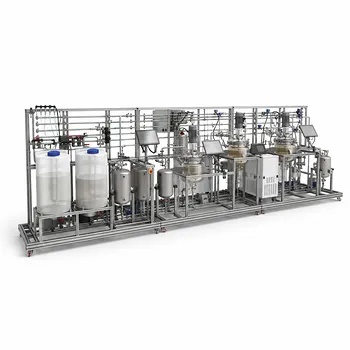
Theory becomes tangible. Unit operations pilot plants transform process integration from a purely mathematical exercise into a concrete, physical challenge. By providing configurable heat exchanger networks with real hot and cold streams, these systems allow students to experimentally calculate pinch temperatures, determine minimum utility targets, and then physically build and test heat exchanger networks that maximize recovery. The result is an immediate, data-driven understanding of how strategic stream matching and bypassing cut steam and cooling water demand.
A pilot plant is the missing link between a textbook pinch diagram and the operational reality of an industrial process. It forces learners to confront real-world losses, thermodynamic constraints, and the critical trade-offs that define viable heat integration strategies.
Bridging the Gap Between Equations and Reality
Textbook pinch analysis gives you targets. A pilot plant challenges you to achieve them. This tension is where deep learning happens.
From Stream Data to Physical Insight
In a typical lab exercise, students first gather real-time temperature, flow rate, and heat capacity data from multiple streams. They then construct composite curves and locate the pinch point using spreadsheet tools. But unlike a static simulation, the physical plant doesn't lie—if the measured temperatures don’t match the theoretical targets, it’s a signal to account for heat losses, sensor lag, or valve limitations.
The Power of Hands-On Network Design
Once the pinch is identified, the true test begins. Students must physically configure the heat exchanger network using actual piping, valves, and exchangers—often shell-and-tube or plate types. They learn to respect the golden rules of pinch design (e.g., CPh ≤ CPc above the pinch, CPh ≥ CPc below it) not because a textbook says so, but because violating them immediately shows up as a penalty in utility consumption or an inability to meet target temperatures.
How Pilot Plants Unlock Pinch Analysis in a Lab Setting
A well-designed thermal pilot plant is essentially a physical flowchart. It provides the flexibility to reroute streams, split flows, and add bypass loops, mirroring the iterative nature of industrial HEN synthesis.
Visualizing the Energy Cascade
By adjusting flow rates and monitoring the inlet and outlet temperatures of every exchanger, students can construct a real temperature-enthalpy (T-H) diagram for the system. The physical plant makes abstract concepts like “process-to-process heat recovery across the pinch” visible. They can literally watch the hot composite curve cool down while the cold composite warms up, understanding where energy is being cascaded.
Testing the “What If” Scenarios
The true educational value comes from the ability to break things on purpose. A group might deliberately place a stream match above the pinch or undersize a heat exchanger. The pilot plant will then reveal the consequence: a spike in external utility flow or an unmet target temperature. This immediate feedback loop cements the thermodynamic rationale behind the design rules far more effectively than any simulation.
Demonstrating Heat Recovery as a Physical Event
Heat recovery is not just a cost-saving line on a spreadsheet; it’s a physical event that can be measured. Pilot plants bring this home with force.
Quantifying Utility Reduction in Real Time
The plant’s heaters (steam or electric) and coolers have flow meters and temperature sensors. Students can run the system with a fully integrated network, record utility usage, then systematically reduce integration by opening bypass valves. The measured jump in steam or cooling water demand directly demonstrates the financial and environmental impact of poor heat recovery.
Uncovering Unexpected Thermal Losses
No process is perfectly adiabatic. In a real pilot plant, students confront heat losses from poorly insulated pipes, thermal inertia in exchangers during startup, and residual heat that can’t be fully recovered. These observations build a realistic sense of efficiency that is missing from idealized theoretical exercises.
Tackling Batch Processes and Indirect Heat Recovery
Process integration isn’t just for continuous plants. Batch processes pose a unique scheduling challenge that pilot plants can simulate effectively.
Simulating Thermal Storage Loops
The primary reference notes that pilot plants can simulate batch process scheduling to demonstrate indirect heat recovery. By incorporating intermediate hot water loops or thermal storage tanks, students learn that heat from a batch that has just finished heating can be stored and used to preheat a subsequent cold batch. This addresses the temporal mismatch that pure pinch analysis can overlook.
Understanding the ΔT_min Trade-off
The plant makes the concept of a minimum temperature driving force (ΔT_min) an operational reality. Setting ΔT_min too low reduces utility usage but requires enormous, uneconomic exchanger areas and risks approach temperature violations during transient conditions. By physically observing how a small ΔT_min leads to unstable control loops and fouling-prone conditions, students internalize the balance between capital and operating cost.
The Critical Role of Data Validation and Process Control
A pilot plant is a noise factory. It teaches a lesson that no textbook can: your analysis is only as good as your data.
Closing the Mass and Energy Balance
Operating multiple unit operations forces students to reconcile measured inputs with outputs. If the energy balance doesn’t close, they must diagnose why. Is there a hidden heat leak? A sensor drift? A vented stream carrying energy away? This forensic process is fundamental training for any process engineer.
Comparing Models to Measured Reality
The heart of the educational method is the comparison between the pinch-calculated minimum utility target and the actual measured utility consumption. The gap between them becomes the object of study. Students can refine their models by accounting for heat losses, exchanger efficiency (NTU method), and non-ideal mixing, thereby developing a nuanced understanding that pure simulation alone cannot provide.
Understanding the Trade-offs and Limitations
A pilot plant is a powerful teacher, but it is not a minimized copy of an industrial plant. Drawing incorrect conclusions from its results is a common pitfall.
Scale and Heat Loss Discrepancies
Small-scale pilot plants have a much higher surface-to-volume ratio. Heat losses are disproportionately high, and measured overall heat transfer coefficients can be misleading. Students must learn to scale results correctly and avoid treating lab efficiency numbers as direct industrial guarantees.
Capital Cost Blindness
A pilot plant easily reconfigures network topology with flexible hoses. An industrial plant cannot. The educational exercise often fails to capture the exorbitant capital cost, pressure drop penalties, and spatial constraints that dominate real HEN design. Without careful instructor framing, students may over-prioritize maximum heat recovery over economic viability.
Transient Behaviour as a Second Teacher
Batch startups and load changes cause thermal inertia and off-spec operation. While this teaches operational reality, it can also obscure the pure pinch analysis learning objectives. Educators must design experiments that isolate steady-state behavior before introducing transients.
How to Get the Most Educational Value from a Pilot Plant
The plant is just a tool. The learning outcome depends on how you use it.
- If your primary focus is teaching fundamental thermodynamics: Start with steady-state, perfectly mapped streams. Use the plant to demonstrate that the pinch point is a physical discontinuity in the heat transfer cascade, not just a mathematical construct.
- If your primary focus is building operational engineering skills: Introduce deliberate faults—sensor drift, fouling simulation, and limited utility pressures. Ask students to rediagnose the pinch point and redesign the network under uncertainty.
- If your primary focus is process integration research: Use the batch scheduling capability with thermal storage to test novel indirect recovery algorithms or validate dynamic pinch analysis models against measured thermal profiles.
By forcing a physical manifestation of the second law, a well-designed unit operations pilot plant does not merely teach pinch analysis—it makes it unforgettable.
Summary Table:
| Teaching Concept | Textbook / Simulation Theory | Pilot Plant Reality |
|---|---|---|
| Pinch Temperature | Mathematical target calculation | Physical stream matching & real thermodynamic constraints |
| Utility Consumption | Idealized calculations | Real-world utility demand, sensor lag, & heat losses |
| Network Design | Static curves & diagrams | Hands-on piping, valves, & physical heat exchanger configurations |
| Process Dynamics | Steady-state assumptions | Dynamic thermal inertia, fouling simulations, & transient behavior |
Bring Industrial Reality to Your Lab with LABPARK
Are you looking to bridge the gap between thermodynamic theory and hands-on engineering for your students or researchers?
LABPARK provides state-of-the-art Educational and Vocational Unit Operations Pilot Plants in chemical engineering, bioprocess & biotech, and environmental & water treatment. Designed specifically for universities, research institutes, and enterprises, our pilot plants allow learners to physically configure heat exchanger networks, test real pinch analysis targets, and master process integration in a controlled, real-world setting.
Contact LABPARK today to discover how our customizable pilot plants can elevate your training and research capabilities!
Related Products
- General Purpose Cosmetics Production Unit Operations Training Pilot Plant
- Multi-Functional Drying Educational Unit Operations Pilot Plant
- Multi Pump Fluid Transport Process Piping Unit Operations Training Pilot Plant
- Fixed-Bed Chemical Reaction and Gas Dust Tar Removal Unit Operations Pilot Plant
- 100L Continuous Loop Hydrogenation Educational Unit Operations Pilot Plant
People Also Ask
- How do deviations in estimating latent heat impact pilot plant thermal systems? Avoid hardware mis-sizing.
- Why is the chemical plant startup schedule crucial? De-risk scale-up with pilot plants.
- When to transition from PID to adaptive control in pilot plants? Key process indicators.
- Why Compare Predicted and Experimental Excess Enthalpy? Key to Accurate Pilot Plant Scale-up
- How to study gasification in pilot plants? Compare exit gas composition & efficiency