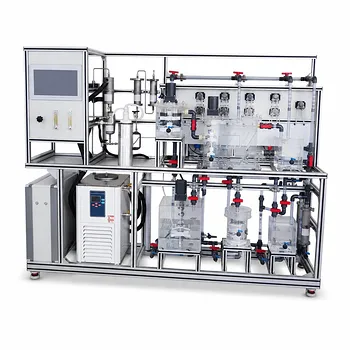
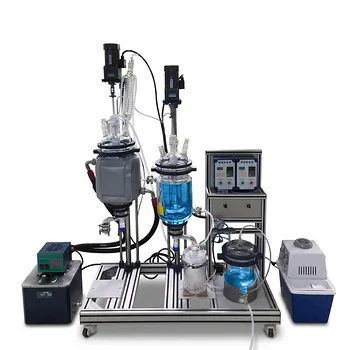
The moment you introduce a high-boiling solvent into your pilot column, you fundamentally break the conventional balance between liquid and vapor flows. This hydraulic distortion immediately slashes tray efficiency to roughly half that of a standard distillation unit. Because the solvent constitutes the largest mass stream, even a tiny drift in its feed temperature will trigger massive internal flow disturbances, making strict, unwavering temperature control the single most critical operational requirement for stable separation performance.
An extractive distillation pilot plant lives or dies by its solvent management. The unavoidable liquid-dominated hydraulics mean efficiency will always be compromised, but the operator’s real battle is to prevent thermal instability from the solvent stream, which can collapse separation in minutes.
The Hydraulic Imbalance: Why Liquid Floods the Column
The Solvent’s Dominant Role
In extractive distillation, the separating agent is fed at a rate that far exceeds the main feed mixture. This is by design—the high-boiling solvent must saturate the liquid phase to sufficiently alter the relative volatilities of the key components. The result is an internal liquid flow rate that dwarfs the vapor flow rate. You are no longer operating in the familiar flow regime where vapor and liquid loads are roughly comparable.
Vapor-Liquid Contact Disruption
This gross mismatch immediately cripples the column’s mass transfer performance. Trays or packing depend on intimate mixing of rising vapor with a thin, well-distributed liquid film. When liquid overwhelms the vapor, the contact pattern degrades. You get liquid channeling, severe backmixing, and incomplete vapor dispersion, all of which prevent the tray from doing its job.
The 50% Efficiency Penalty
Pilot-plant data and design heuristics confirm that overall tray efficiency in such a liquid-heavy regime drops to about 50% of a conventional distillation column. This means you will need roughly twice the number of theoretical stages—or a significantly taller column—to achieve the same separation. For an educational or research pilot plant, this is not a flaw but a built-in characteristic that students and engineers must anticipate and compensate for during design and operation.
The Critical Control Variables
Solvent Feed Temperature: The Biggest Lever
The large solvent volume acts as an enormous thermal reservoir. Any minor variation in the solvent’s entry temperature instantly injects a massive amount of heat (or removes it) into the column internals. This causes the internal liquid flow rate to fluctuate wildly as local viscosity, density, and vaporization rates shift. Separation becomes erratic. The only remedy is to pre-heat (or pre-cool) the solvent to a precisely controlled setpoint and maintain that temperature with maximum stability, using dedicated trim heaters, in-line temperature sensors, and tight feedback loops.
Solvent Flow Rate Precision
While temperature is the dominant disturbance variable, solvent flow rate itself must be tightly regulated. Even a 1–2% drift in a massive solvent stream can push the column into weeping or entrainment terrain. Use a mass flow controller or a positive displacement pump with high turndown capability, and avoid relying on simple rotameters for this critical stream.
Operating Below the Weep Point?
With such a high liquid load, the vapor velocity needed to keep trays from weeping becomes a delicate balancing act. If you reduce the boil-up to limit pressure drop, the vapor rate may fall below the weep point—causing liquid to dump through the tray perforations instead of flowing down the downcomer. This further destroys efficiency. Your operating window shrinks; you must maintain the vapor rate just above the minimum weep threshold while ensuring the liquid downcomers can handle the enormous liquid volume without flooding.
Understanding the Trade-offs and Pitfalls
Efficiency vs. Separation Capability
The 50% efficiency penalty is the price you pay to break an azeotrope or separate close-boiling components. You accept that your pilot column will need more stages or more reflux, but the net result—a successful separation that cannot be achieved by ordinary distillation—justifies the investment. Never try to “fix” the low efficiency by pushing vapor rates beyond their limits, as that merely triggers entrainment flooding.
The Ripple Effect of Thermal Disturbances
In a pilot educational setting, this sensitivity teaches a profound lesson: thermodynamics and hydraulics are inextricably linked. A temperature disturbance in the solvent feed does not stay local; it propagates through the entire column, shifting the temperature profile, altering the effective solvent-to-feed ratio on every tray, and potentially moving the pinch point. Control strategy must recognize this systemic coupling.
Avoiding Common Pilot Plant Mistakes
- Neglecting Solvent Preheating: Introducing cold solvent creates a powerful internal reflux that destabilizes the bottom section.
- Using Inadequate Tray Designs: Single-pass crossflow trays are standard for columns under 2.2 meters, but you must check that the downcomer area is large enough to handle the extreme liquid loads without choking.
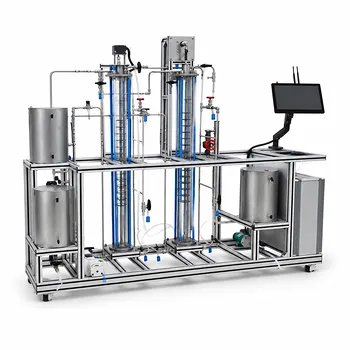
- Ignoring Visual Cues: In glass-walled pilot columns, you can witness the liquid-dominated regime directly. If you see liquid backing up into the downcomers, you are already close to flooding. Use these observations to build intuition, but back them up with pressure-drop measurements.
Making the Right Choice for Your Pilot Plant Goals
The flow distribution characteristics of extractive distillation transform the column into a unique teaching and research platform. Your control philosophy must prioritize solvent thermal stability above all else.
- If your primary focus is educational demonstration: Emphasize the dramatic visual evidence of the liquid/vapor imbalance and let students measure the 50% efficiency firsthand. Use the temperature sensitivity as a vivid lesson in process dynamics.
- If your primary focus is process development or scale-up: Treat the pilot column as a hydraulic validation tool. Characterize the weeping and entrainment boundaries under solvent-rich conditions, and never assume conventional efficiency correlations hold; always generate your own data.
- If your primary focus is achieving a specific product purity: Design with the efficiency penalty in mind from the start. Install high-precision solvent feed temperature and flow controllers, and include ample column height or number of trays to compensate for the inherent mass transfer limitations.
Master the management of the solvent stream—its temperature first, its flow rate second—and you will tame the operational complexities that make extractive distillation pilots uniquely challenging and uniquely powerful.
Summary Table:
| Parameter | Impact on Pilot Plant | Control & Design Strategy |
|---|---|---|
| Solvent Feed Temp | Causes massive internal flow & thermal fluctuations | Precise preheating, trim heaters & tight loop control |
| Liquid-Vapor Ratio | 50% tray efficiency drop, channeling, and backmixing | Design column with double the stages; enlarge downcomers |
| Solvent Flow Rate | Risk of weeping/flooding; narrow operating window | Use mass flow controllers & positive displacement pumps |
Elevate Your Chemical Engineering Lab with LABPARK
Optimizing complex processes like extractive distillation requires robust equipment and precise controls. LABPARK provides state-of-the-art Educational and Vocational Unit Operations Pilot Plants in chemical engineering, bioprocess & biotech, and environmental & water treatment.
Designed specifically for universities, research institutes, and enterprises, our pilot plants deliver the accuracy and stability needed to master thermal control and hydraulic balancing.
Ready to upgrade your laboratory capabilities? Contact our experts today to find the perfect pilot plant solution for your educational or research needs.
Related Products
- Green Anhydrous Ethanol Purification Extractive Distillation Unit Operations Training Pilot Plant
- Continuous Batch Extractive Distillation Educational Pilot Plant
- Multi-Functional Special Distillation Educational Pilot Plant
- Green Anhydrous Ethanol Refining Practical Training Pilot Plant
- Continuous Sieve-Plate Distillation Pilot Plant for Unit Operations Laboratory Education
People Also Ask
- How can energy balance equations for condensers & reboilers be validated experimentally? Guide
- Fugacity vs Activity Coefficient: How to Choose VLE Models for Distillation Pilot Plants
- How can real-time carbon number prediction improve distillation pilot plants? Optimize control.
- Why is vacuum operation capability an essential feature for a distillation unit operations pilot plant? Unlock Efficiency
- How Reflux Ratio Affects Distillation Pilot Plant Separation Efficiency & Limits