The physical properties of the extraction solvent, above all else, dictate whether your pilot plant achieves clean separation or stalls into an emulsion. Density difference, interfacial tension, and viscosity are not abstract numbers—they directly control phase separation speed, column flooding limits, and the size of the equipment you need. A larger density difference drives rapid settling, moderate surface tension balances dispersion with coalescence, and low viscosity keeps droplets mobile, together defining the safe operating window for your pilot unit.
The core challenge is a hydrodynamic balancing act: you must create enough droplet surface area for mass transfer without making the dispersion so stable that phases refuse to separate. Density difference, interfacial tension, and viscosity set the boundaries of this balance, directly determining column diameter, settler size, and the maximum throughput before flooding.
The Critical Role of Density Difference
The Driving Force for Phase Separation
A larger density difference between the two liquid phases creates a stronger gravitational settling force. Under gravity, the terminal velocity of a droplet is proportional to this density difference. When the heavy phase is significantly denser, droplets rapidly exit the continuous phase, preventing accumulation that leads to flooding. This is why a high-density contrast is consistently the first property engineers look for in solvent selection.
Avoiding Flooding and Entrainment
If the density difference is too small, droplets move sluggishly, and the dispersed phase holdup inside the column rises dangerously. As holdup increases, the local flow area for the continuous phase shrinks, causing friction and eventually blocking the countercurrent flow entirely—this is the flooding point. A low density difference also makes phase interface control extremely sensitive, causing one phase to be entrained as fine droplets into the outlet of the other, contaminating your extract or raffinate.
The Double-Edged Sword of Interfacial Tension
Too High: Poor Dispersion, Reduced Mass Transfer
A high interfacial tension acts like a tight skin that resists droplet breakup. When droplets are too large, the specific interfacial area available for mass transfer collapses, directly lowering the rate according to $n_A = k_{OC} a (c_A^* - c_A)$. You end up needing far more column height or stage numbers to reach the same extraction efficiency, or you must invest significantly more mechanical energy (via pulsation or agitation) to force smaller droplets. The pilot plant thus demands either longer columns or more complex internals.
Too Low: Emulsion Formation and Separation Nightmares
If interfacial tension is too low, the system becomes an emulsification risk. Droplets shatter into micron-sized fines that refuse to coalesce, forming a stable rag layer or haze. This can happen even in simple systems if surfactants are present. The result is a settler that fails to clarify, cross-contaminated product streams, and a pilot campaign spent chasing phase-separation failures rather than collecting meaningful scale-up data.
How Viscosity Amplifies the Challenge
High solvent viscosity works against you in two directions. First, it retards droplet motion during settling, compounding the problems of a low density difference. Second, it dampens turbulence inside the column, making it harder to break droplets into smaller sizes for mass transfer. The result is a viscous solvent that yields both slow phase separation and poor dispersion, a combination that quickly pushes a pilot column toward flooding at lower throughputs. This is why low-viscosity solvents are heavily preferred in industrial extraction.
The Combined Effect on Column Hydrodynamics and Design
Dictating Flooding Limits and Throughput
The flooding point is a direct function of the balance between gravity (density difference) and frictional/coalescence resistance (interfacial tension, viscosity). In pilot-scale pulsed, packed, or rotating disc columns, these properties define the maximum throughput. Operators study this by increasing flow rates stepwise while monitoring the phase interface position and pressure drop. Once the interface becomes erratic or moves abruptly, the flood limit is reached, and that limit is lower for solvents with unfavorable physical properties.
Sizing Settlers and Column Diameter
The required settler cross-sectional area is inversely proportional to the settling velocity of droplets. A solvent with a 10% smaller density difference might need a settler 30% larger to prevent carryover. Similarly, column diameter is driven by the need to keep total liquid velocity below the flooding constraint. When viscosity or low interfacial tension increases holdup, the only remedy without changing the solvent is to increase column diameter, reducing throughput per cross-section. These property-driven sizing decisions appear from the first feasibility calculation.
Influencing Mass Transfer Area via Droplet Size
The Sauter mean diameter $d_{32}$ of droplets is determined by the balance between disruptive forces (agitation, turbulence) and cohesive forces (interfacial tension). For a given mechanical energy input, higher interfacial tension yields larger droplets, reducing $a = 6\phi_D / d_{32}$. To compensate, you can increase agitation speed, but that increases droplet breakage into fines that may coalesce poorly. Your pilot plant design—whether you choose a static packed bed or a mechanically agitated column—is a direct response to the droplet-making capability of your solvent’s physical properties.
Understanding the Trade-offs
No single solvent property can be optimized in isolation; pilot plant design is a game of trade-offs. A solvent with an exceptionally high density difference and low viscosity might guarantee easy phase separation, but if its interfacial tension is also very high, you will struggle to create adequate mass transfer surface unless you introduce pulse units or rotary agitators. Conversely, adding a subtle co-solvent or surfactant to lower interfacial tension and improve dispersion can easily overshoot and emulsify the system, forcing you to install coalescer packs or centrifuges.
Another trade-off appears in solvent recovery economics. A solvent that gives perfect extraction hydraulics might form an azeotrope with the solute or have a high latent heat of vaporization, making downstream distillation energy-intensive. Your pilot plant design must therefore integrate the hydraulic and thermodynamic properties seamlessly, as a brilliant extraction column is worthless if solvent regeneration is impossible at scale. Additionally, pushing solvent rates to reduce column height by steepening the operating line often demands a larger column diameter, illustrating how physical properties intersect with flow ratios to set the final equipment dimensions.
Making the Right Choice for Your Pilot Plant Goal
Your specific objective drives how you should prioritize these physical property impacts.
- If your primary focus is maximizing throughput and minimizing settler size: Select a solvent with the largest attainable density difference and the lowest viscosity, and avoid any additives that reduce interfacial tension below the typical 1–47 mN/m range for your system.
- If your primary focus is achieving high mass transfer efficiency in a short column: Tolerate a moderate reduction in interfacial tension to boost dispersion and interfacial area, but plan for enhanced coalescing surfaces or additional settler volume to prevent entrainment.
- If your primary focus is accurately simulating a commercial system with a known solvent that has borderline properties: Methodically map the flood line by varying flow rates and agitation, and use the pilot data to determine exactly how much safety margin to incorporate into the full-scale design.
- If your primary focus is vocational or educational demonstration: Build in transparent column sections and adjustable internals so operators can directly observe how a deliberate change in phase interface level, droplet size, or rag-layer thickness correlates with the underlying physical properties being studied.
Pilot plant success hinges on respecting what the solvent’s physical properties tell you—listen to the phase separation behavior, and you will design a unit that operates reliably and scales predictively.
Summary Table:
| Physical Property | Operational Impact | Design Implication |
|---|---|---|
| Density Difference | Drives phase settling speed; prevents flooding & entrainment. | Determines settler cross-sectional area and column diameter. |
| Interfacial Tension | Balances droplet dispersion (mass transfer) vs. coalescence (settling). | Influences column height, agitation power, and internal designs. |
| Viscosity | Low viscosity aids droplet movement; high viscosity slows separation. | Lowers overall throughput limit; requires larger equipment volumes. |
Scale Up Your Extraction Projects with LABPARK
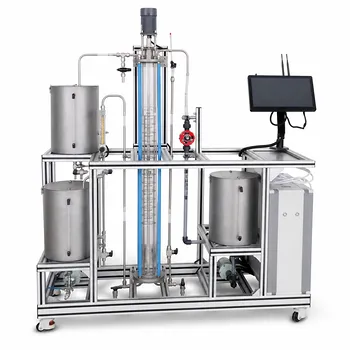
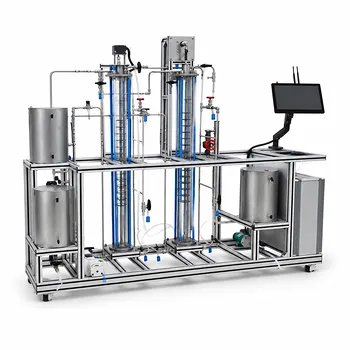
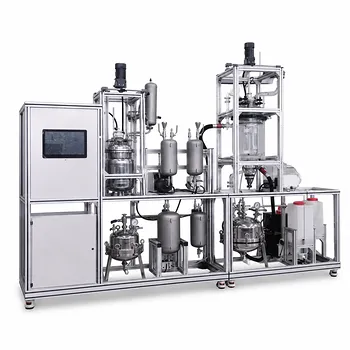
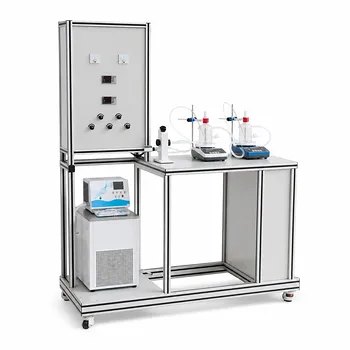
Transitioning from lab scale to pilot scale requires a deep understanding of fluid dynamics. LABPARK provides premium Educational and Vocational Unit Operations Pilot Plants in chemical engineering, bioprocess & biotech, and environmental & water treatment for universities, research institutes, and enterprises.
Our pilot plants are designed to help you precisely study the effects of density, viscosity, and surface tension on liquid-liquid extraction. By partnering with LABPARK, you gain access to robust, transparent, and highly adjustable systems that ensure accurate scale-up data and hands-on training success.
Ready to optimize your extraction process? Contact LABPARK today to consult with our engineering experts!
Related Products
- Educational Rotary Disc Liquid-Liquid Extraction Pilot Plant
- Comprehensive Liquid-Liquid Extraction Pilot Plant for Engineering Education
- Gallium and Indium Selective Extraction Educational Pilot Plant
- Ternary Liquid-Liquid Equilibrium Educational Pilot Plant
- Liquid-Liquid Mass Transfer Coefficient Determination Educational Pilot Plant
People Also Ask
- How do density and IFT affect liquid-liquid extraction pilot plants? Optimize Column Performance
- How are ternary phase diagrams and LLE data applied in extraction experiments? Optimize Pilot Plant Scale-up
- In a liquid-liquid extraction pilot plant, how is a ternary-phase diagram utilized to determine solvent feed requirements?
- How Do Selectivity & Distribution Coefficients Influence LLE Pilot Plant Solvent Choice?
- How to Validate BIPs for LLE Pilot Plants? Steps to Align Simulations with Reality