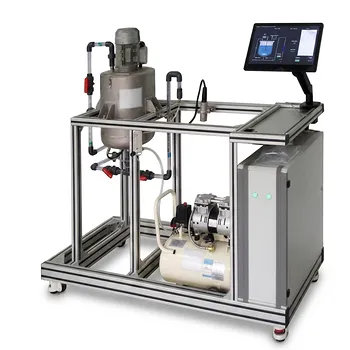
Molecular DNA replication mechanisms inform pilot-rig training by connecting cellular events to measurable process outcomes. DNA polymerase III, DNA polymerase I, and DNA ligase maintain genome and plasmid integrity during microbial growth, while replication errors or plasmid loss can change biomass performance and product consistency. On a biotechnology unit operation pilot rig, trainees use this knowledge to understand why inoculum quality, nutrient control, oxygen transfer, temperature, sampling, and genetic monitoring matter across upstream processing.
The central lesson is that pilot rigs do not directly display DNA replication, but they expose the process conditions that support or disrupt it. Training becomes more meaningful when operators link molecular fidelity to cell growth, plasmid maintenance, recombinant expression, and batch-to-batch consistency.
Why DNA Replication Matters in Bioprocess Training
Replication Determines Which Cells Populate the Process
Microbial DNA replication allows cells to divide and expand during seed-train development and production culture. The quality of that replication affects the physiological state and genetic composition of the population entering each subsequent unit operation.
DNA polymerase III extends new DNA in the 5'-to-3' direction and uses 3'-to-5' exonuclease proofreading to correct many incorporation errors. This high-fidelity mechanism helps preserve the chromosome and, where relevant, engineered genetic constructs.
Replication Supports Product Consistency
In recombinant microbial processes, the desired product depends on a host cell retaining the genetic information required for production. Changes in that information can alter expression levels, growth behavior, metabolic burden, or product quality.
Training should therefore treat genetic stability as an operational concern rather than a purely theoretical biology topic. A culture can meet a basic biomass target while still losing the characteristics needed for reliable production.
Plasmids Create an Additional Stability Concern
Plasmids may replicate separately from the bacterial chromosome and can be distributed unevenly during cell division. Without appropriate selection and process control, plasmid-bearing cells may be outcompeted by cells that no longer carry the production construct.
This makes plasmid stability relevant to inoculum preparation, culture duration, media strategy, and the interpretation of declining product formation. The pilot rig provides the physical setting in which trainees can observe the consequences of those biological pressures.
Translating Enzymatic Roles Into Rig Training
DNA Polymerase III and Growth Kinetics
DNA polymerase III is the primary bacterial chromosome-replication enzyme. Its activity is part of the cellular machinery that enables population expansion during the exponential phase.
On a pilot rig, trainees can connect this principle to specific growth rate, biomass accumulation, viable cell measurements, substrate uptake, and culture age. These measurements do not directly quantify polymerase activity, but they provide operational evidence of how effectively the population is growing.
DNA Polymerase I and Primer Processing
DNA replication begins from RNA primers. DNA polymerase I removes these primers and fills the resulting gaps with DNA, helping complete the newly synthesized strands.
This role illustrates why replication is a coordinated sequence rather than the action of a single enzyme. In training, it supports discussion of how multiple molecular steps contribute to viable cell production and why disruptions to cellular physiology can affect culture performance even when one measured parameter appears normal.
DNA Ligase and Lagging-Strand Completion
Because DNA synthesis proceeds only in the 5'-to-3' direction, the lagging strand is assembled as Okazaki fragments. DNA ligase seals the remaining breaks between these fragments to produce a continuous DNA strand.
This mechanism is useful pedagogically because it demonstrates the importance of coordination, timing, and completion in biological systems. The same systems-thinking approach applies to pilot operations, where agitation, aeration, feeding, temperature, pH, and sampling must work together rather than be managed as isolated settings.
Applying the Biology to Pilot-Plant Unit Operations
Seed-Train Operation
The seed train determines which cells are transferred into the production stage and in what physiological condition. Excessive passage time, poor control, or inappropriate transfer criteria can increase the opportunity for genetic or phenotypic drift.
Practical training should require trainees to define transfer criteria using more than elapsed time. Relevant criteria can include growth phase, biomass concentration, viability where applicable, substrate status, and evidence that the intended production phenotype is being retained.
Bioreactor Control
DNA replication and cell division depend on a suitable cellular environment. Pilot-rig exercises should therefore show how pH, temperature, dissolved oxygen, agitation, gas flow, and nutrient availability influence growth and recombinant production.
The molecular mechanism provides the rationale for control. The rig provides the practical discipline of monitoring trends, responding to deviations, documenting interventions, and evaluating whether a correction restored the culture to an acceptable state.
Feeding and Nutrient Management
Replication requires building blocks and energy, while recombinant expression can impose additional metabolic burden. An inadequate or excessive feed can change growth rate, oxygen demand, by-product formation, and the balance between biomass formation and product synthesis.
Trainees should learn to interpret feeding as a biological control strategy. The goal is not simply to add nutrients, but to maintain conditions that support the desired relationship between cell replication, culture health, and product formation.
Sampling and In-Process Analytics
Molecular fidelity is usually assessed indirectly or through dedicated analytical tests rather than by observing replication on the rig. Training should distinguish between process indicators, such as biomass and oxygen demand, and genetic or product-quality measurements, such as plasmid retention or expression assays.
This distinction prevents overinterpretation. A stable dissolved-oxygen trend does not prove genetic stability, and a high cell density does not prove that every cell retains the production construct.
Scale-Up and Scale-Down Exercises
At pilot scale, changes in mixing, oxygen-transfer capacity, heat removal, and feeding response can create different cellular environments from those in a laboratory vessel. These differences may alter growth and expression even when nominal setpoints are similar.
Replication biology helps trainees ask the right scale-up questions: Is the culture receiving adequate oxygen? Are nutrients distributed uniformly? Are local conditions causing stress? Is the production population maintaining its intended genetic state?
Designing Training Around Observable Evidence
Start With a Molecular Map
A useful exercise begins by mapping each replication function to a process consequence:
- DNA polymerase III proofreading: supports genetic fidelity and stable cellular behavior.
- DNA polymerase I: completes primer replacement and contributes to viable chromosome duplication.
- DNA ligase: joins Okazaki fragments and completes lagging-strand replication.
- Plasmid replication and segregation: influence retention of recombinant production capability.
The map should then identify which consequence can be measured directly, which requires laboratory analysis, and which must be inferred from a pattern of process data.
Use Controlled Deviations
Pilot-rig training is strongest when learners analyze defined deviations rather than only operate under ideal conditions. Examples include oxygen limitation, temperature excursions, delayed feeding, extended culture duration, or an inoculum transferred outside its intended growth phase.
The exercise should connect the deviation to expected effects on growth, metabolic state, plasmid retention, expression, and product consistency. This teaches causal reasoning without claiming that a single process variable directly measures a specific replication enzyme.
Combine Operations With Laboratory Confirmation
A complete training module can pair rig data with off-line or at-line analysis. Biomass, substrate, and dissolved-oxygen trends can be compared with plasmid-retention results, expression measurements, or product assays where those methods are available.
This reinforces an important operational principle: process control and molecular characterization answer different questions. The rig shows how the culture was operated; analytical testing helps determine what the cells and product became.
Assess Decisions, Not Memorization
Trainees should be evaluated on whether they can explain and act on relationships such as:
- Why a healthy-looking culture may still have lost plasmid-bearing cells.
- Why inoculum history affects production performance.
- Why scale-up changes can affect cell physiology without changing the recipe.
- Why genetic stability data should be interpreted alongside process trends.
- Why corrective actions require documented evidence of recovery.
This approach turns enzyme functions into practical engineering judgment.
Understanding the Trade-offs
High Biomass Is Not Always the Best Outcome
Maximizing cell density may increase the amount of biological material available, but it can also increase oxygen demand, heat generation, metabolic stress, and expression burden. A dense culture is not automatically a genetically stable or high-yielding culture.
Training should distinguish between biomass productivity, product productivity, and product quality. The preferred operating point depends on the process objective.
Selection Can Affect Process Interpretation
Maintaining selective pressure may help retain plasmid-bearing cells, but selection strategy can influence growth rate, media composition, waste generation, and downstream considerations. It should be treated as part of the process design rather than assumed to be a neutral safeguard.
Trainees should understand both the benefit of maintaining the intended population and the operational implications of the selected strategy.
Indirect Indicators Have Limits
Growth rate, oxygen uptake, carbon dioxide evolution, and product titer can suggest that the population has changed, but none of them alone establishes the mechanism. A change may result from genetic instability, nutrient limitation, contamination, measurement error, or another physiological shift.
The correct response is to use these signals to trigger investigation and targeted confirmation, not to assign a molecular cause prematurely.
Pilot Results Do Not Automatically Predict Production Scale
A pilot rig can reveal scale-dependent behavior, but it does not reproduce every aspect of a full-scale system. Differences in mixing time, gas dispersion, sampling, control-loop response, and local concentration gradients may change the cellular environment.
Training should include explicit discussion of what has been demonstrated at pilot scale and what remains to be verified during scale-up.
Common Training Pitfalls to Avoid
Treating Enzymes as Isolated Facts
Listing the functions of polymerase III, polymerase I, and ligase is insufficient if learners cannot connect them to cell growth and process performance. Each enzyme should be presented as part of a coordinated replication system that supports population expansion and genetic continuity.
Claiming Direct Measurement Without Evidence
Routine pilot-rig instruments generally measure physical, chemical, and biological process variables rather than individual replication-enzyme activities. Instruction should use precise language such as “supports,” “correlates with,” or “may indicate” unless a validated molecular assay provides direct evidence.
Ignoring Population Composition
Bulk measurements can conceal a mixed population. Cells that retain a production plasmid and cells that have lost it may contribute differently to growth and product formation while appearing similar in total biomass.
Where genetic stability is important, training should include a sampling and testing plan capable of detecting population-level changes.
Separating Upstream Operation From Product Quality
Replication fidelity, plasmid retention, and cell physiology can influence the amount and consistency of the final product. Upstream training should therefore show how decisions made during inoculum preparation and cultivation propagate into downstream performance and quality evaluation.
Making the Right Choice for Your Goal
The molecular content should be scaled to the decisions trainees must make on the pilot rig.
- If your primary focus is operator competence: Teach replication mechanisms as the biological rationale for controlling inoculum state, pH, temperature, oxygen transfer, feeding, and culture duration.
- If your primary focus is genetic stability: Add plasmid-retention and expression testing to process-trend analysis, while distinguishing direct assays from indirect indicators.
- If your primary focus is scale-up readiness: Use pilot data to evaluate how mixing, oxygen transfer, heat removal, and control response affect the cellular environment.
- If your primary focus is product consistency: Link replication fidelity and population composition to biomass, expression, product titer, and quality attributes across multiple batches.
- If your primary focus is training assessment: Evaluate whether learners can interpret deviations, identify plausible biological causes, select confirmatory measurements, and document defensible corrective actions.
Effective pilot-rig training connects molecular fidelity to operational evidence, enabling teams to control not only the equipment but also the biological system inside it.
Summary Table:
| Training focus | Pilot-rig evidence | Confirmatory analysis | Operational value |
|---|---|---|---|
| Inoculum and seed train | Growth phase, biomass, viability, culture age | Genetic stability or expression testing | Transfers the right cell population into production |
| Bioreactor control | pH, temperature, dissolved oxygen, agitation, gas flow | Biomass, substrate, and product assays | Supports healthy growth and consistent expression |
| Feeding strategy | Nutrient trends, oxygen demand, by-product formation | Metabolite and product analysis | Balances cell replication, metabolic burden, and yield |
| Plasmid stability | Changes in growth or product formation | Plasmid-retention testing | Detects loss of recombinant production capability |
| Scale-up readiness | Mixing, oxygen transfer, heat removal, control response | Cross-scale process and quality comparison | Identifies conditions that may alter cell physiology |
| Deviation response | Process trends before and after an excursion | Targeted molecular or product testing | Links corrective actions to documented recovery |
Build More Effective Biotechnology Pilot-Rig Training
Contact LABPARK to discuss Educational and Vocational Unit Operations Pilot Plants for your university, research institute, or enterprise. LABPARK helps training teams connect molecular biology with practical operation of bioprocess and biotechnology rigs, including inoculum preparation, seed-train development, bioreactor control, feeding, sampling, scale-up, and process troubleshooting.
Our systems help learners and operators evaluate measurable process evidence such as biomass, dissolved oxygen, pH, temperature, nutrient use, and product formation while understanding where plasmid-retention, expression, and genetic-stability assays are required. Build hands-on competency, strengthen process-control judgment, improve product-consistency training, and prepare teams for more reliable scale-up decisions with LABPARK.
Related Products
- Bio-fermentation Ethanol Production Practical Training Unit Operations Pilot Plant
- Multi-Modal Distillation Unit Operations Training Pilot Plant
- Multi Pump Fluid Transport Process Piping Unit Operations Training Pilot Plant
- Three-Tube Heat Transfer Educational Pilot Plant for Unit Operations Training
- Constant Pressure Filtration Educational Unit Operations Pilot Plant
People Also Ask
- Why Use PTFE & Hastelloy in Chemical Pilot Plants? Prevent Corrosion & Ensure Safety
- Why Compare Predicted and Experimental Excess Enthalpy? Key to Accurate Pilot Plant Scale-up
- Why is the chemical plant startup schedule crucial? De-risk scale-up with pilot plants.
- Why Does a Pilot Plant Solver Return a Singular Matrix Error, and How Can You Resolve It?
- How can pilot plants demonstrate a control strategy in a design space? Practical QbD implementation.