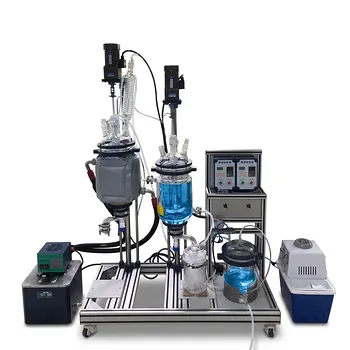
The common ion effect increases precipitation yield by suppressing solubility, while the salt effect can silently erode it. In crystallization and precipitation pilot plants, these two chemical phenomena are constantly at odds. The common ion effect allows engineers to drive reactions toward completion by adding an excess of a shared ion. However, the same strategic overdosing risks elevating the overall ionic strength, triggering the salt effect that increases solubility. Successful process optimization depends on finding the narrow operating window where the common ion effect's benefits are maximized before the salt effect's losses take over.
The core challenge in pilot-plant precipitation is not just adding enough reagent, but adding exactly the right amount. A slight excess of a common ion can slash residual concentration, but too much excess—especially in a matrix rich with non-common salts—can raise ionic strength and actually dissolve your product. Pilot runs are the only reliable way to map this delicate balance.
The Dual Forces at Play in Precipitation
Precipitation in a pilot plant never behaves exactly like the textbook solubility product. Two competing forces dictate whether your product forms and settles, or remains stubbornly dissolved.
The Common Ion Effect: Driving Precipitation to Completion
The common ion effect is your primary lever for yield. When you add an excess of one of the constituent ions of a sparingly soluble salt, the equilibrium shifts to favor the formation of more solid. This directly reduces the solubility of the target compound.
For example, in a pilot-scale barium sulfate precipitation, dosing extra sodium sulfate—which shares the sulfate ion—forces the reaction toward solid BaSO₄, lowering the dissolved barium concentration far below what stoichiometric addition would achieve. This principle is critical for meeting tight environmental discharge limits from wastewater treatment pilot plants.
The Salt Effect: The Hidden Yield Eroder
Any non-common strong electrolyte present in the feed can activate the salt effect. These spectator ions increase the solution's ionic strength, generating an "ionic atmosphere" around the reacting ions. This shielding restricts free movement and decreases the activity coefficients of the precipitating ions.
The result is an increase in apparent solubility. Even if you’ve added a theoretically sufficient amount of precipitant, a high background of salts—common in industrial brines or process water—can leave more target metal dissolved than your Ksp calculations predict. This is a frequent source of yield shortfall in pilot runs.
Optimizing Reagent Dosage in Pilot Plants
Understanding these two effects is only the start. The real optimization work lies in translating them into a practical dosing strategy that works with real, variable feed streams.
Avoiding the Over-Dosage Trap
Adding too much precipitant can backfire in more than one way. While a moderate excess uses the common ion effect to boost yield, an over-dosage can push the ionic strength high enough that the salt effect dominates, re-dissolving precipitate. Additionally, a large excess may form soluble complexes with the target ion—an effect that further increases apparent solubility, as noted in the primary reference. Pilot runs are used to pinpoint the "sweet spot" before these losses kick in.
Accounting for Real-World Feed Composition
Theoretical Ksp calculations assume dilute, ideal solutions with controlled ion concentrations. Industrial feeds rarely cooperate. High concentrations of non-common background ions (sodium, chloride, nitrate) can dramatically lower activity coefficients. Engineers must characterize the feed's full ionic profile and use pilot-scale experiments to measure actual residual concentrations, not just rely on spreadsheet chemistry.
Bridging the Gap Between Theory and Pilot Results
In educational and R&D pilot plants, instructors use this very discrepancy to teach a critical lesson. When students run a barium sulfate precipitation and find higher dissolved barium than predicted, the salt effect explains the gap. By measuring the actual ionic strength and applying activity corrections, the results align. This habit of critically evaluating real vs. ideal behavior is what transforms a bench-scale recipe into a robust pilot-plant procedure.
Understanding the Trade-offs
Optimization is never one-sided. Every decision you make to suppress one problem may amplify another.
The Delicate Balance of Excess Reagent
- More precipitant improves recovery, up to a point. That point is where the ionic strength rise—from the excess reagent itself and from any associated counter-ions—begins to outweigh the common ion advantage.
- Economic and environmental trade-offs exist. Over-dosing wastes chemicals and can create a disposal problem if the excess reagent itself becomes a contaminant in the treated effluent. Pilot plants must test multiple stoichiometric ratios to find the lowest residual target ion at the lowest reagent cost.
Complexity from Co-existing Ions
Real feeds often contain multiple metal ions or anions that can form competing precipitates. Adding a common ion for one target may inadvertently introduce a non-common ion for another target, triggering a salt effect for that second species. This cascade requires careful mapping of the entire ion matrix during piloting to avoid solving one yield problem while creating another.
Making the Right Choice for Your Goal
The optimal strategy depends entirely on what you are prioritizing in your pilot plant run. Use these goal-oriented approaches to guide your decisions.
- If your primary focus is maximizing product yield: Start with a slight stoichiometric excess of the common ion, then incrementally increase it while monitoring the solution's ionic strength. Stop at the dosage where residual concentration flattens or begins to rise.
- If your primary focus is minimizing chemical waste and cost: Determine the minimum excess that still meets your purity or discharge target. Use pilot data to plot a yield vs. reagent cost curve and operate at the economic inflection point.
- If your primary focus is meeting a strict regulatory discharge limit: Account for both the common ion effect and the opposing salt effect in your pilot protocol. Always measure real activity coefficients using feed samples, and validate the process under worst-case background salt conditions.
- If your primary focus is process robustness against variable feed quality: Pilot test the precipitation across a range of background ionic strengths representative of your plant's expected feed fluctuations. This ensures your dosing recipe has a built-in safety margin against salt effect losses.
Ultimately, pilot plants are the essential translators between chemical theory and plant reality. The common ion effect gives you the lever; the salt effect sets the cost of pulling it too hard. Measure, don't guess.
Summary Table:
| Feature | Common Ion Effect | Salt Effect |
|---|---|---|
| Effect on Solubility | Decreases solubility (increases yield) | Increases solubility (decreases yield) |
| Underlying Mechanism | Shifts equilibrium toward solid formation | Increases ionic strength, lowering activity coefficients |
| Key Trigger | Adding an excess of a shared/constituent ion | High concentration of non-common background ions |
| Optimization Focus | Dosing a moderate excess of precipitant | Monitoring total ionic strength and feed quality |
Optimizing chemical precipitation and crystallization processes requires hands-on validation. LABPARK provides state-of-the-art Educational and Vocational Unit Operations Pilot Plants in chemical engineering, bioprocess & biotech, and environmental & water treatment. Designed specifically for universities, research institutes, and enterprises, our systems allow you to accurately model chemical effects, train future engineers, and optimize industrial recipes.
Ready to elevate your research and teaching capabilities? Contact LABPARK today to explore our customizable pilot plant solutions!
Related Products
- Multi Functional Membrane Crystallization Educational Unit Operations Pilot Plant
- Potassium Salt Thermal Dissolution and Crystallization Separation Educational Unit Operations Pilot Plant
- Rising and Falling Film Evaporation Educational Unit Operations Pilot Plant
- Natural Product Extraction Unit Operations Training Pilot Plant
- Dual-Mode Rectification Pilot Plant for Practical Training Unit Operations
People Also Ask
- Control Crystallization Pilot Plant Secondary Nucleation: 4 Key Adjustments
- Why is precise temperature control critical in crystallization pilot plants? Key to Scale-Up Success
- What key factors should be considered when configuring a crystallization unit operations pilot plant?
- How Crystal vs Amorphous Solids Guide Crystallization Pilot Plant Objectives
- What are the benefits of integrating online PAT tools like ATR-FTIR into crystallization unit operations pilot plants?