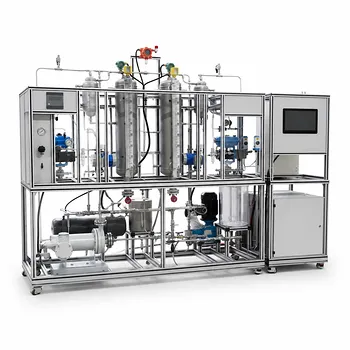
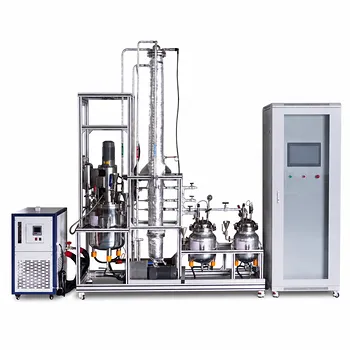
A standard P&ID is the most powerful teaching and management tool in a pilot plant, far more than just a static drawing. For students, these diagrams turn a maze of pipes and tanks into a decipherable blueprint, teaching them the universal language of industrial process design. For lab managers, the same document becomes an indispensable operational map for maintaining safety, troubleshooting faults, and planning system upgrades with minimal downtime.
By simultaneously serving as a student's textbook and a manager's maintenance manual, a P&ID transforms an educational pilot plant into a cohesive, real-world engineering laboratory. Its true value lies not just in its symbolic representation, but in how it directly links design intent to physical operation.
How P&IDs Bridge the Gap Between Theory and Practice for Students
The primary educational challenge in a water or environmental treatment lab is helping students connect abstract control theory to the physical hardware humming before them. The P&ID is the master key that unlocks this connection.
Decoding the Industrial Language
Before students can innovate, they must learn to read. P&IDs introduce them to the standardized symbology of pumps, control valves, sensors, and logic loops.
This is the same symbolic language used in full-scale municipal and industrial plants. By mapping symbols like an orifice plate or a level transmitter to their real-world counterparts, students build career-transferable skills in interpreting industrial blueprints.
Hands-On Verification: From Symbol to Sensor
The learning deepens when students physically trace a signal line from a differential pressure transmitter on the P&ID to the impulse tubing on the actual skid. This act of verification bridges the gap between 2D design and 3D reality.
This hands-on tracing cements their understanding of instrumentation and control. It eliminates the ambiguity of theory and replaces it with the certainty of a validated physical system.
Understanding Process Dynamics Through Live Control
A modern pilot plant integrated with a PLC-SCADA system allows a student to do more than just observe. They can actively manipulate a control valve and watch, in real-time, the resulting pressure drop and flow change appear on a trend screen.
They can then return to the P&ID to understand how that single change rippled through the entire defined control loop. This direct feedback loop transforms the diagram from a static document into a dynamic model for understanding process stability, PID control, and safety interlocks.
How P&IDs Serve as the Lab Manager’s Operational Backbone
For the lab manager, the P&ID is not a teaching aid—it is a mission-critical administrative tool that dictates the safety, reliability, and adaptability of the facility.
A Single Source of Truth for Maintenance
Maintenance without documentation is guesswork. The P&ID provides a definitive, controlled single source of truth for the exact location and specification of every component.
When a solenoid valve fails or a pump seal needs replacement, the manager uses the P&ID to instantly identify the correct part number, its process function, and its isolation points, preventing costly procedural errors.
Rapid Troubleshooting and Root Cause Analysis
Process upsets in water treatment systems can be complex. A P&ID allows a lab manager to methodically diagnose issues by tracing the logical sequence of operations.
If a tank is failing to reach the correct level, the P&ID immediately shows the manager the linked level transmitter, its associated controller, and the final control valve. This systematic approach reduces downtime and is a critical lesson in logical fault-finding for observing students.
Planning for Integration and Upgrades
A dynamic lab environment often requires integrating new sensors or running experiments with different pipework. The P&ID is the starting point for all “Management of Change” procedures.
It shows how existing utilities and control wiring interface with the process, allowing the manager to assess the feasibility of modifications safely. Without it, any future integration risks damaging equipment or creating unanticipated safety hazards.
Understanding the Limitations: Where P&IDs Fall Short
While indispensable, a P&ID is a simplified model of reality. Relying on it dogmatically without acknowledging its limitations can lead to operational mistakes.
The Danger of Outdated Documentation
The most common pitfall is a P&ID that no longer reflects the physical plant. A field modification made during a student project might not be captured in the master drawing.
If a technician follows an outdated P&ID to isolate a line, they may breach an unmarked, live connection. A P&ID must be treated as a living document, requiring strict revision control to remain a trusted safety tool.
The Risk of Information Overload for Novices
For a new student, the sheer density of a full P&ID can be paralyzing. The tangle of instrument bubbles, logic gates, and pipe specs can obscure the core process flow.
The educational solution is to initially pair a simplified Process Flow Diagram (PFD) with the P&ID. Starting with the PFD’s high-level view allows a student’s brain to build a mental scaffold before diving into the P&ID’s intricate details.
When the Diagram Isn’t Enough: The Need for Physical Inspection
A P&ID shows the logical intent, but not the physical scale, vibration, or material condition of a pipe. It cannot show a partially blocked strainer or a cavitating pump.
Effective training and management require a rule: always pair a desktop P&ID review with a physical walk-down of the system. This combination is what breeds true operational competence and prevents a blind reliance on potentially incomplete documentation.
Making the Right Choice for Your Educational or Operational Goal
The way you implement and use P&IDs should directly reflect your primary objective, whether it's deep learning or safe, efficient operations.
- If your primary focus is developing student intuition for process control: Use the P&ID as a live exercise sheet. Have students predict the effect of a valve closure, execute the action on the SCADA system, and then mark up the diagram with the observed results.
- If your primary focus is streamlining lab maintenance and safety: Build your entire asset management system, from work orders to safety lock-out/tag-out procedures, around the tag numbers defined on the master P&ID. Treat this document as legally binding.
- If your primary focus is teaching rigorous documentation standards: Assign a project where students must physically audit the pilot plant and produce an “as-built” P&ID, correcting an intentionally outdated version. This teaches the critical engineering discipline of configuration management.
Ultimately, a well-maintained P&ID isn’t just a drawing—it’s the connective tissue that makes a pilot plant a safe, authentic, and deeply instructive engineering environment.
Summary Table:
| Feature | Role in Student Instruction | Role in Lab Management |
|---|---|---|
| Primary Use | Bridges theory with hands-on practice; teaches industrial symbology. | Acts as a single source of truth for maintenance & safety. |
| Key Benefit | Decodes process dynamics via live control & PLC-SCADA integration. | Enables rapid troubleshooting, root cause analysis, & safe upgrades. |
| Limitations | Information overload for novices (requires PFD pairing first). | Risk of outdated documentation causing safety issues. |
Empower Your Engineering Programs with LABPARK
Are you looking to bridge the gap between engineering theory and hands-on practice? LABPARK provides state-of-the-art Educational and Vocational Unit Operations Pilot Plants in chemical engineering, bioprocess & biotech, and environmental & water treatment.
Designed specifically for universities, research institutes, and enterprises, our pilot plants come equipped with industry-standard documentation like P&IDs to streamline student instruction and simplify facility management.
Contact us today to discover how our tailored pilot plant solutions can elevate your educational and research capabilities!
Related Products
- Electrochemical Water Treatment Educational Unit Operations Pilot Plant
- Thermal Desorption Exhaust Gas and Tail Water Treatment Educational Pilot Plant
- Ion Exchange Water Purification Educational Pilot Plant for Engineering Unit Operations
- Water Electrolysis Hydrogen Production and Storage Educational Pilot Plant
- Alkaline Membrane Water Electrolysis Educational Pilot Plant Unit Operations Training System
People Also Ask
- What design features do educational electrochemical pilot plants utilize to manage gas liberation and water loss?
- How can unit operations pilot plants show lead-acid concentration vs state of charge? Real-time monitoring guide.
- How do educational electrochemical pilot plants scale up electrolysis? Master industrial engineering.
- How to Estimate Sulfate in Water Treatment Pilot Plant Deposits: Gravimetric Guide
- How can foaming be managed during steam generation experiments in water treatment unit operations pilot plants? Tips