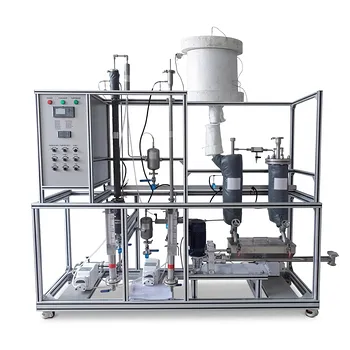
Slim tube and sand pack displacement pilot plants are the definitive physical simulators for evaluating oil recovery efficiency. These experimental systems force carbon dioxide through a porous medium—either a bead-packed narrow tube or a consolidated core—at carefully controlled pressures, directly measuring how much oil is displaced. By tracking the exact point of CO2 breakthrough and the resulting recovery percentage, they transform a complex subsurface process into a repeatable, quantifiable engineering test.
The core value lies in their ability to generate a pressure-versus-recovery curve. This curve reveals the minimum miscibility pressure (MMP)—the injection pressure at which CO2 and oil become a single phase and recovery jumps sharply. That single data point, validated by physical observation, becomes the anchor for every mathematical model used to design field-scale projects.
How Displacement Pilot Plants Replicate a Reservoir
These systems are not arbitrary. They are engineered to strip away field-scale complexity while preserving the pore-scale physics that govern oil displacement. This allows students and engineers to isolate and measure specific mechanisms.
The Essential Geometry of a Slim Tube
A slim tube is a long, narrow coil packed with unconsolidated glass beads or sand. Its length-to-diameter ratio exceeds 100, creating a flow path that is essentially one-dimensional along the axis. This geometry ensures that injected CO2 moves as a piston, minimizing gravity override and viscous fingering—phenomena that would cloud the raw miscibility signal. The high ratio forces the fluids to interact intimately, revealing the true thermodynamic limit of recovery.
The Role of Sand Packs and Core Holders
While a bead-packed slim tube provides a generic, ideal porous medium, a consolidated core holder uses an actual reservoir rock sample. The sand pack or bead pack offers a clean, reproducible baseline—the standard reference for MMP determination. The consolidated core introduces real-world rock properties like natural fractures and mineralogy, which influence displacement efficiency differently. By comparing results from both, an engineer can distinguish fluid-behavior limits from rock-specific effects.
The Injection Process and What It Reveals
The test begins by saturating the medium with crude oil at reservoir temperature. CO2 is then injected at a constant, elevated pressure. As the CO2 front advances, oil is produced from the outlet. The test is repeated at progressively higher injection pressures. At each pressure, the final oil recovery percentage is recorded. The critical moment is CO2 breakthrough—when the first gas emerges at the outlet, signaling that the displacement front has traversed the entire medium. Recovery before breakthrough indicates stable displacement; a sudden rise in recovery at a specific pressure marks the onset of miscibility.
From Raw Data to Operational Decisions
The measurements from a single pilot run are far more than a single number. They create a foundational dataset that feeds directly into the digital twins used for field development.
Measuring Oil Recovery Efficiency
Recovery efficiency is calculated as the volume of oil produced divided by the original oil in place. By plotting this value against injection pressure, you get a sigmoidal curve. Below the MMP, recovery is moderate because CO2 and oil flow as separate phases, leaving oil trapped by capillary forces. Above the MMP, the interfacial tension vanishes, and recovery plateaus at a high level, often exceeding 95% of the initial oil in the slim tube. This is the efficiency target for a perfectly miscible flood.
Detecting CO2 Breakthrough and Its Significance
Breakthrough is detected using a sight glass or gas analyzer at the outlet. The breakthrough point on the recovery curve is not just a timestamp; it defines the volume of CO2 needed to sweep the medium. A late breakthrough relative to injected volume indicates a stable, piston-like displacement—the hallmark of a near-miscible process. Early breakthrough, with only moderate recovery, warns of channeling or immiscible conditions, telling the engineer that pressure must be increased.
Identifying the Optimum Flooding Pressure
The optimum flooding pressure is not necessarily the highest pressure tested. It is the lowest pressure that achieves maximum recovery without wasting compression energy. The pilot run data pinpoints the MMP—the pressure at which the recovery-vs-pressure curve breaks upward. Operating slightly above the MMP ensures miscibility across the reservoir despite small pressure gradients. This experimental number becomes a hard constraint in the compositional simulator, which then predicts how the flood will perform across an entire 3D field.
The Deep Need: Grounding Simulation in Physical Reality
Students often ask why we still build physical models when powerful computer simulators exist. The answer is foundational. Compositional simulators solve complex equations of state and multi-phase flow, but their predictions are only as good as their input parameters. The experimental data from a slim tube test provides the irreducible truth—the actual MMP and recovery at true miscibility. Without this anchor, a simulator can produce beautifully rendered but dangerously wrong forecasts.
From Pilot Plant to Compositional Model
The measured recovery at each pressure, along with the breakthrough volume, is used to history-match the simulator. Parameters like relative permeability and the equation-of-state model are tuned until the simulator replicates the slim tube results. Once validated against the physical experiment, the simulator can be scaled up to predict production rates, CO2 storage, and economic viability for a field-scale project. The pilot plant thus serves as the calibration standard.
Understanding the Trade-offs
Physical simulation is not a perfect mirror of the reservoir. Its limitations must be understood to avoid overconfidence when scaling up.
- Idealized Flow Geometry: A slim tube creates a 1D flow path. Real reservoirs are three-dimensional, with vertical permeability layers that cause gravity segregation. This can lead to earlier breakthrough in the field than in the lab, even at similar pressures.
- Homogeneous Porous Medium: Bead packs lack the micro-scale heterogeneities of natural rock, such as dead-end pores and mineral dissolution reactions. Consolidated core holders mitigate this but cannot replicate the kilometer-scale variability of a reservoir body.
- Isolation from Dynamic Field Conditions: Lab tests are isothermal, steady-state, and do not simulate the pressure depletion, water influx, or wellbore effects that dominate field operations.
- Scale-Up Distortions: Viscous fingering is suppressed in a slim tube but can be significant in the field. Recovery in a slim tube represents the thermodynamic maximum, not the practical recovery factor of a real project, which is often 10–30% lower due to sweep inefficiencies.
Acknowledging these gaps is not a criticism of the method. It is the precise reason why both physical experiments and simulation are used together—one validates the other’s mechanisms before scale-up introduces new complexities.
Making the Right Choice for Your Goal
Your specific objective determines which pilot plant configuration and focus area will deliver the most actionable insight.
- If your primary focus is determining the minimum miscibility pressure for a new fluid pair: Use a bead-packed slim tube. It provides the industry-standard benchmark, with minimal confounding factors, allowing direct comparison to decades of published MMP data.
- If your primary focus is understanding how rock-fluid interactions will affect recovery in your specific reservoir: Run the test in a consolidated core holder with actual reservoir rock. This reveals wettability effects, clay swelling, or dissolution that can alter sweep efficiency even under miscible conditions.
- If your primary focus is calibrating a compositional simulator before field-scale investment: Run a suite of slim tube tests at multiple pressures to generate a robust recovery curve. Use the results to tune your equation of state until the simulator output matches the experimental breakthrough and recovery, then scale with confidence.
Ultimately, these pilot plants give you the power to hold a physical piece of the reservoir’s behavior in your hand, transforming abstract equations into a concrete, trusted foundation for decisions.
Summary Table:
| Feature | Slim Tube (Bead-Packed) | Consolidated Core Holder |
|---|---|---|
| Primary Goal | Determine Minimum Miscibility Pressure (MMP) | Evaluate rock-fluid interactions |
| Flow Path | 1D piston-like flow (minimizes fingering) | Complex, multi-directional flow |
| Medium | Homogeneous glass beads or sand | Heterogeneous reservoir rock sample |
| Best For | Fluid-behavior benchmarking | Real-world rock properties analysis |
Empower Your Research and Training with LABPARK
Are you looking to bridge the gap between thermodynamic theory and practical reservoir engineering? LABPARK provides premium Educational and Vocational Unit Operations Pilot Plants in chemical engineering, bioprocess & biotech, and environmental & water treatment.
Tailored for universities, research institutes, and enterprises, our pilot plants offer:
- Hands-on Learning: Equip students with industry-grade systems for physical simulation.
- Accurate Model Calibration: Generate high-fidelity physical data to validate mathematical models.
- Robust Engineering: Reliable, safe, and scalable setups designed for advanced research.
Ready to upgrade your laboratory or training facility? Contact LABPARK today to discuss your customized pilot plant solution!
Related Products
- Dual-Mode Rectification Pilot Plant for Practical Training Unit Operations
- Natural Product Extraction Unit Operations Training Pilot Plant
- Green Anhydrous Ethanol Refining Practical Training Pilot Plant
- Multi-Modal Distillation Unit Operations Training Pilot Plant
- Multi-Functional Special Distillation Educational Pilot Plant
People Also Ask
- How does polyphosphate hydrolysis affect scale and corrosion in pilot plants? Essential Monitoring Guide
- How do predictive thermodynamic models integrate into pilot plants? Bridging Theory and Practice
- How do utility requirements influence pilot plant selection? Avoid Costly Lab Integration Mistakes
- Why Unit Operations Pilot Plants Are Critical for Nanotech Integration: Scale-Up Secrets
- What role do unit operations pilot plants play in scaling up gas-solid noncatalytic reactors? Key De-risking Steps