Knowledge Chemical Engineering Education How do non-isothermal heat effects impact the absorption efficiency and operation of packed tower pilot plants? Guide
Author avatar

Tech Team · LABPARK

Updated 1 month ago

How do non-isothermal heat effects impact the absorption efficiency and operation of packed tower pilot plants? Guide


Non-isothermal heat effects directly undermine absorption efficiency in packed tower pilot plants by raising the solvent temperature, which shifts the equilibrium and shrinks the mass transfer driving force. Exothermic gas absorption releases heat that warms the liquid phase as it flows down the column. This temperature rise reduces the solute gas’s solubility, forcing you to either increase the liquid-to-gas flow ratio or add packing height to meet the same removal target. Pilot plants equipped with temperature sensors reveal these thermal profiles in real time, providing the data needed to understand, model, and compensate for the heat effects before scaling up.

The core challenge of non-isothermal absorption is a shifted equilibrium curve: higher temperatures make the gas less soluble, which narrows the difference between the actual gas concentration and its equilibrium value ((y - y^*)). To maintain performance, you must adjust the operating conditions—typically by raising the liquid-to-gas ratio ((L/V)) or using a taller packed section. In pilot plants, tracking the thermal profile along the column is essential for accurate scale-up and for deciding whether to add cooling.

The Thermodynamic Root of the Problem

Exothermic Absorption and Solvent Heating

Many industrial gas-liquid absorption processes release substantial heat of dissolution or reaction. In a packed column, this energy transfers into the liquid solvent, causing its temperature to rise progressively from the top to the bottom. The magnitude of the temperature rise depends on the heat of absorption, the gas concentration, and the liquid flow rate.

The Shift in Gas-Liquid Equilibrium

Gas solubility in a liquid is strongly temperature-dependent. As the solvent temperature increases, the equilibrium curve shifts upward: for a given solute concentration in the liquid, the equilibrium gas-phase concentration ((y^)) becomes higher. This directly narrows the driving force for mass transfer, expressed as ((y - y^)), which is the engine of absorption. Without intervention, the column will achieve less removal per unit of packing height.

How Heat Effects Reshape Efficiency and Operation

A Reduced Mass Transfer Driving Force

The immediate consequence of a narrower ((y - y^*)) is a slower absorption rate. Since mass transfer is proportional to this driving force, the packing can only support a fraction of the separation it could achieve under isothermal (constant low temperature) conditions. This is why a column designed without accounting for the temperature rise will consistently underperform.

Essential Operational Adjustments

To compensate for the lost driving force, you have two primary levers:

  • Increase the liquid-to-gas ratio ((L/V)). A higher liquid flow raises the operating line, partially restoring the driving force and absorbing more heat without an extreme temperature rise.
  • Use a taller packing section. More packing provides additional contact time and surface area, allowing the column to achieve the target removal despite the reduced instantaneous driving force.

In a pilot plant, discrete temperature sensors placed along the column height are invaluable. They allow you to construct a non-isothermal operating line that captures the real temperature-dependent equilibrium along the column. Without this data, you are forced to rely on oversimplified isothermal assumptions that can mislead scale-up.

The Moderating Role of Pressure

While rising temperature reduces solubility, operating at higher total pressure pushes the equilibrium in the opposite direction, increasing solubility. In many pilot plants, maintaining an elevated pressure is a practical way to offset some of the thermodynamic penalty from exothermic heating. However, pressure adjustments come with their own equipment, safety, and cost constraints.

Understanding the Trade-offs

The Hidden Cost of a Higher (L/V)

Pushing the liquid-to-gas ratio upward may restore efficiency, but it is not free. A greater liquid load increases pumping energy costs and pushes the column closer to flooding. It also dilutes the rich solvent exit stream, which can raise the energy demand for downstream regeneration or solvent recovery.

Active Cooling vs. Adiabatic Operation

You can directly combat the temperature rise with cooling jackets or interstage coolers that remove heat from the column. While this keeps the operation closer to the favorable isothermal case, it adds complexity and capital cost. Adiabatic operation—letting the temperature rise naturally—is simpler but demands a taller column. The decision shapes not only the pilot plant design but also the viability of the full-scale process.

Pitfalls in Scale-Up

A small-diameter pilot column often exhibits a smaller temperature rise than a large industrial tower because of higher wall heat loss. If you ignore this effect and treat the pilot data as truly isothermal, you risk severe under-design of the commercial unit, where near-adiabatic operation is more likely. Credible scale-up demands that you record the thermal profile and validate a non-isothermal model against it.

Making Informed Decisions in Your Pilot Plant

Your response to non-isothermal heat effects must align with your primary objective. Use the following guidance to choose the right approach.

  • If your primary focus is maximizing absorption efficiency: Run at the lowest practical temperature and the highest allowable pressure, and seriously evaluate adding interstage cooling or a cooling jacket to suppress the solvent temperature rise and keep the driving force high.
  • If your primary focus is generating reliable scale-up data: Instrument the column with multiple temperature sensors. Use the measured thermal profile to fit a non-isothermal model, then extrapolate the required packing height and (L/V) for an industrial tower that will operate with a larger adiabatic temperature rise.
  • If your primary focus is education and demonstration: Allow the column to run with a natural temperature rise. Vary the (L/V) ratio and show how the operating line responds, giving students a visible, quantifiable lesson in the real-world tension between equilibrium thermodynamics and column operation.

By actively managing thermal data and understanding the equilibrium consequences, you transform a seemingly troublesome non-ideality into the key that unlocks accurate, scalable absorption column design.

Summary Table:

Key Factor Impact on Pilot Plant Operation Recommended Solution
Temperature Rise Shifts equilibrium, reduces gas solubility Increase liquid-to-gas ($L/V$) ratio
Reduced Driving Force Lowers absorption rate and efficiency Increase packing height or add active cooling
Scale-Up Bias Small column heat loss masks adiabatic effects Monitor thermal profiles & use non-isothermal models

Optimize Your Process Scale-Up with LABPARK

Bridge the gap between theory and industrial reality. LABPARK provides state-of-the-art Educational and Vocational Unit Operations Pilot Plants in chemical engineering, bioprocess & biotech, and environmental & water treatment. Specifically tailored for universities, research institutes, and enterprises, our pilot plants feature precise temperature profiling to help you accurately analyze heat effects and optimize column performance.

Ready to elevate your research and training capabilities? Contact LABPARK today for a custom pilot plant solution!

Related Products

People Also Ask

Related Products

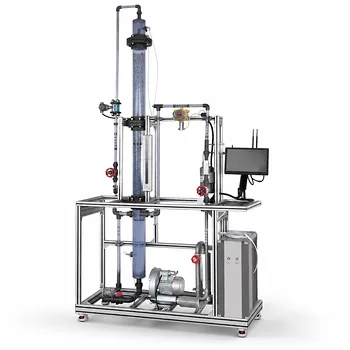
Packed Bed Absorption Educational Unit Operations Pilot Plant

Packed Bed Absorption Educational Unit Operations Pilot Plant

Study gas-liquid absorption, pressure drop, flooding, and mass transfer coefficients with this pilot plant. Transparent packed column, industrial touchscreen, real-time sensor data, automated analysis. Investigate two-phase flow, loading points, column efficiency. Comprehensive data logging and assessment software included.

Multimodal Absorption and Desorption Pilot Plant for Unit Operations Training

Multimodal Absorption and Desorption Pilot Plant for Unit Operations Training

Multimodal absorption and desorption pilot plant for higher education labs. Bridges theory and industrial practice with transparent packed columns, three operational modes (real-material, simulated, semi-physical), and SCADA control. Students explore mass transfer, column hydraulics, and process control. Customizable.

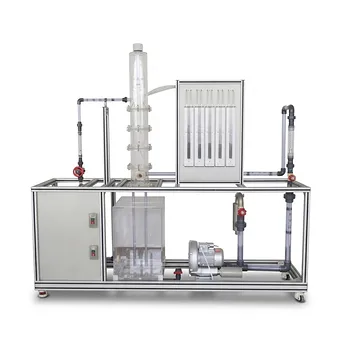
Absorption and Desorption Educational Unit Operations Pilot Plant

Absorption and Desorption Educational Unit Operations Pilot Plant

Dual packed column absorption and desorption pilot plant for chemical engineering education, offering real-time mass transfer coefficient measurement, durable mobile frame, industrial touch-screen interface, and customizable design for varied laboratory curricula, enabling hands-on study of gas absorption and stripping.

High-Gravity Emulsification and Mass Transfer Educational Pilot Plant

High-Gravity Emulsification and Mass Transfer Educational Pilot Plant

This integrated educational pilot plant utilizes rotating packed bed technology to demonstrate high-gravity emulsification and mass transfer, providing engineering students with hands-on experience in process intensification and unit operations through a modular, customizable design with digital monitoring.

Micro-Scale Gas-Solid Catalytic Reaction Educational Pilot Plant

Micro-Scale Gas-Solid Catalytic Reaction Educational Pilot Plant

Explore heterogeneous catalysis with this micro-scale gas-solid catalytic reaction educational pilot plant. Designed for university labs, it enables hands-on study of reaction kinetics and transport phenomena in a benchtop packed bed reactor with high-precision flow control and touchscreen automation.

Rising and Falling Film Evaporation Educational Unit Operations Pilot Plant

Rising and Falling Film Evaporation Educational Unit Operations Pilot Plant

Hands-on educational pilot plant for studying rising and falling film evaporation, flow regimes, and heat transfer. Customizable for university labs with industrial instrumentation and data acquisition. Enables comparative evaluation of evaporation modes and energy efficiency.

Multi-Reactor Educational Pilot Plant for Reaction Engineering Unit Operations

Multi-Reactor Educational Pilot Plant for Reaction Engineering Unit Operations

Integrated bench-scale educational pilot plant for chemical engineering teaching featuring fixed bed fluidized bed and stirred tank reactors with web-based digital twin controls and safety interlocks for hands-on unit operations and reaction engineering comparative studies in one compact system.

Supercritical High-Gravity Flash Evaporation Educational Unit Operations Pilot Plant

Supercritical High-Gravity Flash Evaporation Educational Unit Operations Pilot Plant

Bench-scale integrated teaching system for advanced separation and mass transfer, combining supercritical high-gravity flash evaporation with heating, chemical reaction, and material collection, featuring modular design, Stainless Steel 316L construction, transparent visualization, touchscreen control, and safety systems for chemical engineering education.

Plate Column Hydrodynamics Tray Demonstration Educational Pilot Plant

Plate Column Hydrodynamics Tray Demonstration Educational Pilot Plant

Advanced transparent educational pilot plant for chemical engineering labs demonstrates plate column hydrodynamics with industrial sieve bubble cap serrated valve trays for visual observation of gas-liquid contact pressure drop measurement and operational limit analysis including flooding weeping entrainment

Polymerization Granulation and Pellet Processing Educational Unit Operations Pilot Plant

Polymerization Granulation and Pellet Processing Educational Unit Operations Pilot Plant

Integrated pilot plant for teaching polymer processing from polymerization to pelletizing. Includes 30L reactor, hydrolyzer, extruder-granulator, vibration dryer, crusher, and sieve. Atmospheric pressure operation for safety, corrosion-resistant SS, customizable for chemical and polymer engineering education. Ideal for university labs.

Multi Pump Fluid Transport Process Piping Unit Operations Training Pilot Plant

Multi Pump Fluid Transport Process Piping Unit Operations Training Pilot Plant

Industrial-scale multi-pump pilot plant for unit operations training in fluid transport and process piping, featuring real-material and semi-physical simulation modes, comprehensive pump and flowmeter calibration, and safety-enhanced two-tier platform, bridging academic theory and industrial practice for chemical engineering education.

Natural Product Extraction Unit Operations Training Pilot Plant

Natural Product Extraction Unit Operations Training Pilot Plant

Integrated natural product extraction pilot plant for chemical engineering training bridges theory and industrial practice with modular extraction and evaporation/concentration units, hybrid touchscreen and manual control, realistic process simulation, and self-contained softened water and vacuum utilities.

Constant Pressure Filtration Educational Unit Operations Pilot Plant

Constant Pressure Filtration Educational Unit Operations Pilot Plant

Hands-on educational pilot plant for constant pressure filtration. Classic plate and frame filter press allows students to study kinetics, determine specific cake resistance, perform cake washing and evaluate washing rates. Ideal for chemical engineering curriculum. Mobile, customizable, safety-compliant design.

Multi-Functional Special Distillation Educational Pilot Plant

Multi-Functional Special Distillation Educational Pilot Plant

Versatile multi-functional special distillation pilot plant for chemical engineering education. Supports continuous, vacuum, azeotropic, reactive, extractive distillation. Transparent glass columns enable real-time visual observation of hydrodynamics and separation processes.

Bench Scale Dual Column Gas Separation and Capture Educational Pilot Plant

Bench Scale Dual Column Gas Separation and Capture Educational Pilot Plant

This dual-column educational pilot plant provides hands-on teaching of gas adsorption, separation, and capture processes. It features stainless steel columns, regeneration up to 400°C, and a 15.6-inch touchscreen PLC for TSA and PSA studies in chemical engineering curricula, process simulation.

Dual-Mode Rectification Pilot Plant for Practical Training Unit Operations

Dual-Mode Rectification Pilot Plant for Practical Training Unit Operations

Industrial-scale dual-mode rectification pilot plant for chemical engineering practical training. Features real-material and simulated-material operation modes, sieve-plate column with sight glasses for visual observation of hydrodynamics, and customizable SCADA control for safe, hands-on learning of unit operations and mass transfer.

Fixed-Bed Chemical Reaction and Gas Dust Tar Removal Unit Operations Pilot Plant

Fixed-Bed Chemical Reaction and Gas Dust Tar Removal Unit Operations Pilot Plant

Integrated educational pilot plant for studying catalytic gas-solid reactions and downstream gas purification. Features dual fixed-bed reactor, three-stage heating, and touchscreen control for hands-on engineering training. Ideal for chemical and environmental engineering curricula.

Continuous Batch Extractive Distillation Educational Pilot Plant

Continuous Batch Extractive Distillation Educational Pilot Plant

Versatile pilot plant for continuous, batch, and extractive distillation training. High-borosilicate glass column for visualizing hydraulics, 15.6-inch touchscreen with data logging, precise reflux ratio control 1-99, and durable corrosion-resistant frame. Ideal for chemical engineering education and process research.

Multi-Modal Distillation Unit Operations Training Pilot Plant

Multi-Modal Distillation Unit Operations Training Pilot Plant

Multi-modal distillation pilot plant for practical unit operations training in chemical engineering education. Features real, analog, and semi-physical simulation modes, industrial construction, customizable for university labs. Hands-on fractionation columns, SCADA control, safety systems. Includes sight glasses, sampling ports, closed-loop recycling.

100L Continuous Loop Hydrogenation Educational Unit Operations Pilot Plant

100L Continuous Loop Hydrogenation Educational Unit Operations Pilot Plant

This 100L continuous loop hydrogenation pilot plant is designed for chemical engineering education, featuring 316 stainless steel construction, advanced gas-liquid mass transfer components, explosion-proof safety systems, and a 15.6-inch touchscreen with 5G connectivity, cloud data logging, bridging theory and industry.


Leave Your Message