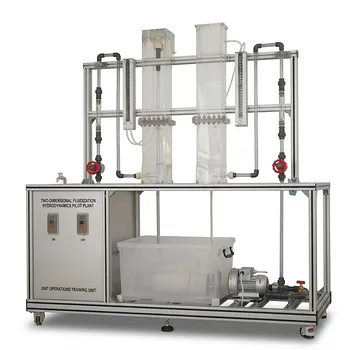
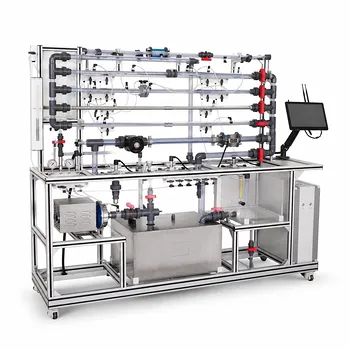
Micro-structured mixing doesn't stop at the milliliter scale. Modern unit operations pilot plants directly demonstrate the transition from benchtop micro-mixing to industrial production by incorporating large-capacity microstructured mixers and heat exchangers. These systems feature advanced geometries—multi-laminating interdigital, turbulent interdigital, and split-and-recombine structures—that deliver throughputs up to several cubic meters per hour with pressure drops below 10 bar. By operating these scaled-up devices in an integrated pilot environment, students and engineers study the exact fluid dynamics, pressure drops, and heat transfer behavior that determine success at commercial scale, turning abstract scale-up theory into measurable risk management.
The core insight: The transition is not theoretical—it’s physically demonstrated by scalable microstructured apparatus that replicate industrial process intensification inside a pilot plant. This allows hands-on evaluation of mixing, heat transfer, and control strategies under near-production conditions, so the jump from lab to plant is validated, not guessed.
The True Gap Between Lab Micro‑Mixing and Industrial Production
Laboratory microfluidic devices excel at precise mixing in channels measured in micrometers, but they operate comfortably in the milliliters‑to‑liters‑per‑hour range. Commercial chemical production demands throughputs thousands of times larger while maintaining the same mixing quality and thermal control.
Scale‑dependent physics are the hidden adversary. Heat transfer, mass transfer, and fluid dynamics do not linearly follow a recipe when dimensions increase. A pilot plant provides the intermediate scale where these phenomena can be observed and tamed before committing to a full‑size facility.
Risk accumulates silently between benchtop success and factory construction. Unknown reaction enthalpies at scale, unforeseen material corrosion, solids handling issues, and the slow death of catalysts over weeks of continuous operation can only surface in a realistic closed‑loop system. Pilot plants expose these weaknesses while the financial stakes are still manageable.
How Pilot Plants Embody the Transition with Large‑Capacity Microstructured Apparatus
The Hardware That Makes the Leap Possible
The heart of modern demonstration plants is not a miniature glass chip—it is a large‑capacity microstructured mixer or reactor engineered to sustain industrial flow rates. These units contain internal channels designed with the same principles as lab‑scale microfluidics but scaled through numbering‑up rather than simple geometric enlargement.
Three mixing geometries define this generation of hardware. Multi‑laminating interdigital structures split and merge streams repeatedly to create extremely thin fluid layers. Turbulent interdigital designs harness controlled turbulence at higher Reynolds numbers. Split‑and‑recombine architectures multiply the interfacial area with each pass. All three can process up to several cubic meters per hour while keeping pressure losses beneath 10 bar, making them power‑efficient and industrially credible.
Heat transfer is built into the same microstructured philosophy. Thin, highly conductive walls separated by narrow channels allow pilot‑plant‑scale exchangers to remove or add heat almost instantly. This thermal agility prevents hot spots and runaway reactions—a decisive advantage over jacketed batch reactors when scaling exothermic or cryogenic processes.
Beyond the Device: The Plant as an Integrated Learning System
A pilot plant does not simply drop a big microreactor on a frame. It weaves the apparatus into a complete process ecosystem: docking platforms, bus systems, advanced sensorics, and process control interfaces. Students and researchers operate a condensed version of a real chemical plant, not just an isolated mixer.
Full‑process development replaces single‑unit thinking. Instead of studying mixing alone, pilot plant operators manage pumps, separators, recycle loops, and product collection. This exposes how impurities accumulate in recycle streams, how catalyst deactivation degrades performance over days or weeks, and how control logic keeps the plant within safe operating limits—exactly the problems that break a process at commercial scale.
Data credibility scales with realism. Flow meters, pressure transducers, thermocouples, and inline analyzers capture transient pressure drops, residence time distributions, and heat transfer coefficients under conditions that mirror production. The resulting dataset feeds engineering evaluations and economic validations that cannot be generated from a glass microreactor running on ultra‑pure reagents.
Understanding the Trade‑offs of Pilot‑Scale Microstructured Demonstration
Even a large‑capacity microstructured pilot plant is still a scaled‑down version of reality. It reduces but does not entirely eliminate scale‑up risk. Certain phenomena like large‑scale solids handling, acoustic vibrations in colossal ducts, or long‑term creep in structural materials may not fully manifest at pilot capacity.
Operational complexity increases to match the plant’s teaching mission. A pilot facility with integrated bus systems and advanced sensorics demands trained operators who understand both chemistry and automation. This can be a steep learning curve, but it is exactly the skillset needed for modern intensified plants.
Capital cost per unit throughput is higher than in a dedicated production unit. A vocational or research pilot plant prioritizes flexibility and instrumentation over raw economic efficiency; the trade‑off is accepted because the value lies in process knowledge, not product output.
Making the Right Choice for Your Scale‑Up Goal
How you use a unit operations pilot plant depends on whether you are proving a chemistry, training a team, or developing a commercial design.
- If your primary focus is validating fluid dynamics and mixing: Prioritize pilot plants equipped with interchangeable large‑capacity microstructured mixers that allow you to directly measure pressure drop and residence time distribution at industrial flow rates.
- If your primary focus is thermal safety and heat transfer: Choose a system with integrated microstructured heat exchangers and high‑resolution temperature sensing across multiple points, so you can detect temperature gradients before they become thermal runaway events.
- If your primary focus is end‑to‑end process development and workforce training: Insist on a pilot plant that includes docking platforms, bus interfaces, and full‑scale process control software, turning the facility into a realistic factory‑floor simulator.
- If your primary focus is long‑term catalyst and impurity studies: Operate the plant in closed‑loop recycle for days or weeks, monitoring catalyst deactivation and by‑product buildup, which reveals the real lifetime performance of your chemistry.
When the right pilot plant meets the right objective, the transition from laboratory‑scale micro‑mixing to industrial microstructured production becomes not a leap of faith but a transparent, measured engineering progression.
Summary Table:
| Feature | Lab-Scale Micro-Mixing | Pilot-Scale Microstructured Plants |
|---|---|---|
| Throughput | Milliliters to liters per hour | Up to several cubic meters per hour |
| Scale-up Method | Single micro-channels / glass chips | Geometry scaling via numbering-up |
| Heat & Mass Transfer | Precise but limited to micro-volumes | Instant thermal control with thin walls |
| System Integration | Isolated single-unit devices | Integrated sensors, control systems & loops |
Scale Up Your Chemical Processes with Confidence
Are you looking to bridge the gap between benchtop micro-mixing and industrial-scale production? LABPARK provides state-of-the-art Educational and Vocational Unit Operations Pilot Plants in chemical engineering, bioprocess & biotech, and environmental & water treatment.
Designed specifically for universities, research institutes, and enterprises, our pilot plants deliver the hands-on engineering insights and realistic process control environments needed to validate scale-up dynamics safely and efficiently.
Contact LABPARK today to find the perfect pilot plant solution for your institution!
Related Products
- General Purpose Cosmetics Production Unit Operations Training Pilot Plant
- Multi-Functional Drying Educational Unit Operations Pilot Plant
- Multi Pump Fluid Transport Process Piping Unit Operations Training Pilot Plant
- Fixed-Bed Chemical Reaction and Gas Dust Tar Removal Unit Operations Pilot Plant
- 100L Continuous Loop Hydrogenation Educational Unit Operations Pilot Plant
People Also Ask
- How do deviations in estimating latent heat impact pilot plant thermal systems? Avoid hardware mis-sizing.
- Why is the chemical plant startup schedule crucial? De-risk scale-up with pilot plants.
- When to transition from PID to adaptive control in pilot plants? Key process indicators.
- Why Compare Predicted and Experimental Excess Enthalpy? Key to Accurate Pilot Plant Scale-up
- How to study gasification in pilot plants? Compare exit gas composition & efficiency