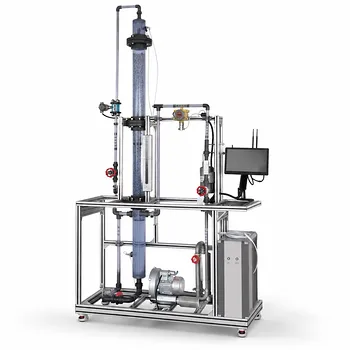
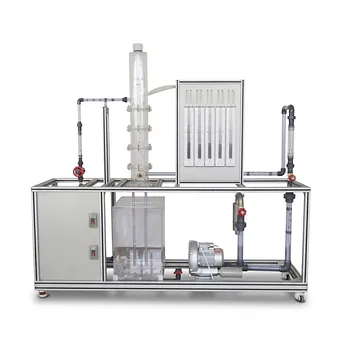
A 5% error in vapor pressure can cascade into a 33% mistake in the required height of a distillation column.
This dramatic sensitivity is exactly what happens when the limitations of a correlation like Chao-Seader go unrecognized during fractional distillation design. In a chemical engineering pilot plant, relying on such imprecise thermodynamics not only yields a physically underperforming column, but also corrupts the educational outcome—hiding the real link between phase equilibrium and separation performance.
The Chao-Seader method’s failure to accurately reproduce pure-component vapor pressures under saturation is a design-critical vulnerability. For close-boiling systems, a tiny prediction error can cause a 33% deviation in theoretical trays, undermining both the experiment and the learning process. The solution is non-negotiable: robust equations of state like Soave-Redlich-Kwong or Peng-Robinson are mandatory for accurate pilot-scale distillation.
The Fragile Link Between Vapor Pressure and Column Design
Why a 5% Error Causes a 33% Discrepancy
The number of theoretical stages depends exponentially on the relative volatility (α) , which itself is a strong function of pure-component vapor pressures.
For close-boiling mixtures such as isopentane and n-pentane, a mere 5% error in one component’s vapor pressure shifts α significantly, causing the calculated minimum trays (via Fenske) to balloon by over 33%.
Because capital cost varies roughly as (ln α)^-1, this miscalculation means the pilot column you build is either far too tall or dangerously too short.
The Chao-Seader Method’s Core Weakness
Chao-Seader was built on empirical mixing rules and a limited temperature/pressure correlation structure.
Its most critical shortcoming is that it cannot reproduce saturated pure-component vapor pressures with sufficient fidelity, especially for light hydrocarbons and near-critical conditions.
The result is skewed K-values that propagate through every tray calculation, leaving a column designed on a foundation of sand.
How This Affects Pilot Plant Design and Operation
Physical Consequences in a Pilot-Scale Column
If a student or researcher trusts a Chao-Seader-based simulation, the actual physical column will show degraded separation.
A planned top-product purity may be impossible to reach, forcing higher reflux ratios and greater energy consumption just to compensate—exactly the over-design that a pilot plant is meant to eliminate.
The lesson becomes a false one: “we need more trays” or “distillation is inefficient,” when the real culprit is the thermodynamic model.
The Funneling Effect and Phase Boundary Errors
A particularly dangerous Chao-Seader behavior is the funneling effect.
The correlation can generate bubble-point and dew-point predictions beyond the mixture’s true critical region before the convergence algorithm fails entirely.
In a pilot plant, this can trick an operator into running a flash at a pressure where no vapor exists—attempting separation in a homogeneous liquid, wasting time and obscuring the real phase envelope.
Systems That Break the Model Completely
Associating compounds like acetic acid dimerize in the vapor phase, creating strong non-ideality.
Chao-Seader has no mechanism to account for this; standard equations of state will also give nonsensical stage calculations and convergence failures.
In these cases, only a rigorous treatment—such as the Hayden-O’Connell virial equation combined with chemical theory—can deliver correct fugacity coefficients and allow the pilot column to function as designed.
Bridging Theory and Reality – Why This Matters for Training
Teaching the “Why” Behind Model Selection
When a pilot column fails to match a Chao-Seader simulation, the learning moment is immediate and visceral.
Students see that a number on a screen can mislead an entire design.
This transforms a limitation into a powerful pedagogical tool: it forces the user to scrutinize thermodynamic data banks before trusting a shortcut, a habit that prevents costly mistakes at full scale.
Generating Your Own VLE Data
Experimental VLE data for multicomponent and heavy hydrocarbon systems is often scarce or non-existent.
The pilot plant then becomes a data-generation engine.
Students and researchers can take precise temperature, pressure, and composition measurements, verify thermodynamic consistency via the Van Ness method, and directly calibrate binary interaction parameters—closing the gap between a flawed correlation and physical reality.
Understanding the Trade-offs
Precision vs. Conservatism
Decades ago, engineers compensated for thermodynamic imprecision by over-designing—extra trays, oversized reboilers, and conservative reflux ratios.
While safe, this approach masks inefficiency and wastes energy.
Today’s accurate equations of state let you design precisely, but they reward only those who invest in thorough mixture characterization and rigorous model validation.
Model Complexity and Ease of Use
Chao-Seader was popular because it was computationally cheap and gave plausible answers for many refinery streams.
For introducing VLE concepts, such simplicity has merit; but as soon as a system deviates from ideal behavior, that simplicity becomes a liability.
The pilot plant is where the trade-off becomes tangible: a few mouse clicks to switch from Chao-Seader to Peng-Robinson can mean the difference between a column that works and one that doesn’t.
The Danger of Over-Reliance on a Single Correlation
No single thermodynamic framework can cover all chemical families and operating regions.
The funneling effect and dimerization failures are stark reminders that blind faith in a correlation leads directly to catastrophic design.
The pilot plant, with its ability to expose these weaknesses, is the ultimate truth detector—it reveals when a model must be discarded and a more appropriate one adopted.
Making the Right Choice for Your Pilot Plant Goals
Align your thermodynamic model with your specific research or educational objective.
- If your primary focus is training students on distillation fundamentals: Use a simple correlation to introduce VLE, but schedule a dedicated experiment that proves its failure on a non-ideal mixture—cementing why robust equations of state are essential.
- If your primary focus is validating a scale-up process: Never trust Chao-Seader as the final design basis. Use Soave-Redlich-Kwong or Peng-Robinson, and whenever possible, generate pilot-plant VLE data to refine binary interaction parameters for your specific feed.
- If your primary focus is handling associating or azeotropic mixtures: Incorporate advanced subroutines like the Hayden-O’Connell model into your simulation, and use pilot-column trials to confirm stable convergence and achievable separation before scaling up.
- If your primary focus is minimizing energy consumption: An accurate equation of state lets you optimize the reflux ratio and avoid the energy waste of over-design—a lesson best taught by comparing an old correlation’s conservative prediction with a validated EOS on the same pilot rig.
The pilot plant is not just a smaller version of an industrial column; it is a truth engine that exposes thermodynamic weaknesses and turns a limitation like the Chao-Seader method into a profound, career-long lesson.
Summary Table:
| Thermodynamic Model | Key Features & Limitations | Impact on Pilot Column Design |
|---|---|---|
| Chao-Seader | Poor pure-component vapor pressure accuracy; ignores association. | Can cause up to 33% error in required trays; risks column under-design. |
| SRK / Peng-Robinson | Robust equations of state for hydrocarbons & near-critical systems. | Delivers highly accurate stage calculations and optimized energy use. |
| Hayden-O’Connell | Models vapor-phase dimerization (e.g., acetic acid). | Prevents convergence failures and enables precise non-ideal separation. |
Bridge the Gap Between Thermodynamic Theory and Practical Engineering
At LABPARK, we provide state-of-the-art Educational and Vocational Unit Operations Pilot Plants in chemical engineering, bioprocess & biotech, and environmental & water treatment. Designed specifically for universities, research institutes, and enterprises, our systems turn complex chemical thermodynamics into hands-on, reliable learning and process validation.
Ensure your distillation columns and process rigs deliver accurate, repeatable results. Contact LABPARK today to explore our customizable pilot plant solutions!
Related Products
- Multi-Modal Distillation Unit Operations Training Pilot Plant
- Multi-Functional Special Distillation Educational Pilot Plant
- Continuous Sieve-Plate Distillation Pilot Plant for Unit Operations Laboratory Education
- Continuous Batch Extractive Distillation Educational Pilot Plant
- Dual-Mode Rectification Pilot Plant for Practical Training Unit Operations
People Also Ask
- How can energy balance equations for condensers & reboilers be validated experimentally? Guide
- How do distillation pilot plants validate VLE data? Achieve reliable solvent separation scale-up.
- How can real-time carbon number prediction improve distillation pilot plants? Optimize control.
- Why is the column performance diagram critical? Optimize distillation pilot plant safety & efficiency.
- What are the primary reflux ratio control strategies? Master Distillation Unit Operations