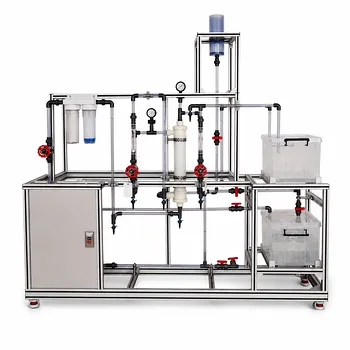
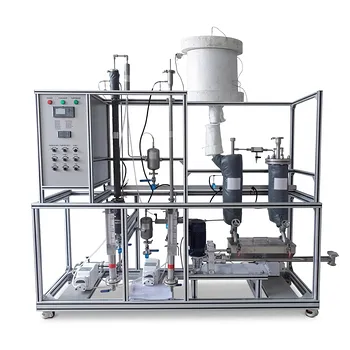
Protecting a water-sensitive azeotrope requires a separation process that runs entirely without liquid water. Hybrid pilot plants combine a distillation column with a vapor permeation membrane to split mixtures such as trimethyl borate (TMB) and methanol. The overhead vapor from the column, concentrating the azeotropic composition, is fed directly to a selective membrane. Methanol permeates the membrane, leaving purified TMB behind—all without ever introducing water that would hydrolyze the borate ester. This demonstrates a practical, energy-efficient route where conventional water washing or aqueous extraction would destroy the product.
The core demonstration is that integrating a vapor permeation membrane with distillation bypasses the thermodynamic azeotrope and eliminates the need for water entirely. By handling the mixture in the vapor phase, the pilot plant shields TMB from hydrolysis, achieving a separation that pure distillation or any water-based method cannot replicate.
Why Conventional Methods Fall Short
The Instant Hydrolysis Problem
TMB reacts rapidly with water to form boric acid and methanol. Even trace moisture can cause significant yield loss, corrosion, and product decomposition. Any process that uses liquid water—such as water washing, azeotropic distillation with water entrainers, or extraction with aqueous solvents—immediately degrades the TMB.
The Insurmountable Azeotrope
TMB and methanol form a homogeneous minimum-boiling azeotrope. Distillation alone cannot cross this barrier to produce pure components. Entrainer-based methods that avoid water are complex, and pressure swing distillation may be economically unviable or still introduce moisture. The separation demands a non-thermal, water-free driving force.
Inside the Hybrid Distillation-Membrane Pilot Plant
The Distillation Column’s Role
A pre-concentrated feed enters the column. The column operates to bring the overhead vapor composition as close to the azeotrope as possible. No attempt is made to break the azeotrope inside the column—traditional distillation stops where the azeotrope pins the composition.
The Vapor Permeation Membrane Module
The overhead vapor is sent directly to a membrane unit. This is vapor permeation, not pervaporation with a liquid feed. Keeping the stream completely in the vapor phase eliminates any chance of condensation and the water contact that would come with it.
The membrane selectively permeates methanol—the smaller, more polar molecule—while retaining TMB. Separation relies on differences in solubility and diffusivity through the membrane’s selective layer, not on vapor–liquid equilibrium.
The Closed, Water-Free Loop
On the permeate side, a vacuum or sweep gas draws the methanol vapor out. This methanol is condensed and can be recycled or collected as a product. The retentate, now enriched in TMB, may be returned to the column or withdrawn as a high-purity stream. The entire loop operates without liquid water, preserving the sensitive ester.
What Students and Researchers See
Pilot-scale systems let operators vary membrane temperature, permeate pressure, and column reflux ratios. They directly observe how the hybrid setup uses membrane transport to break an azeotrope that distillation alone cannot touch. The demonstration proves that scale-up of water-free separations is possible.
The Principles That Make It Work
Bypassing Vapor-Liquid Equilibrium
Distillation is limited by VLE—the azeotrope forms where liquid and vapor compositions become identical. A membrane works by a solution-diffusion mechanism: methanol dissolves into the membrane and diffuses faster than the bulkier TMB. This mechanism operates independently of boiling points, sidestepping the azeotrope entirely.
Solvent-Free Selectivity
No third component—no entrainer, no salt—is added. The membrane’s molecular-level selectivity replaces chemical additives. This simplifies the flowsheet, avoids contamination of the borate ester, and eliminates the need for a solvent recovery column.
Energy Efficiency Gains
The hybrid route often consumes less energy than alternatives like extractive distillation with solvent regeneration or pressure swing distillation. The membrane does the work of shifting the composition while the column merely brings the mixture to the azeotrope, reducing the overall reboiler duty and cooling water load.
Understanding the Trade-offs
Membrane Stability and Lifetime
TMB and methanol can plasticize or swell polymer membranes, causing a gradual decline in selectivity. Pilot trials are essential to evaluate membrane materials—such as inorganic or cross-linked polymers—that can withstand aggressive vapor streams over hundreds of hours.
Tight Control of Temperature and Pressure
The overhead vapor temperature must stay within the membrane’s operating range. Too hot damages the active layer; too cold may cause condensation, which would bring liquid water near the TMB. Vacuum levels on the permeate side must be carefully maintained to prevent ambient moisture from leaking in.
Capital Cost vs. Operational Simplicity
Membrane modules and vacuum systems add upfront capital. However, they remove the need for azeotrope-breaking chemicals, corrosion-resistant metallurgy for water-rich sections, and extensive downstream purification. Over the lifetime of a water-sensitive process, the trade-off often favors the hybrid plant.
Not a Universal Fix for Every Azeotrope
Membrane performance depends heavily on the chemical nature of the pair. A pilot plant shows the potential for TMB–methanol, but the same module might be poorly selective for other azeotropes. Each mixture demands its own membrane screening.
Making the Right Choice for Your Goal
- If your primary focus is protecting a water-sensitive product like TMB: A hybrid distillation–vapor permeation pilot plant is the only safe path; it proves you can separate without ever exposing the mixture to liquid water, preserving yield and purity.
- If your goal is to teach the limits of distillation and the power of membrane integration: This setup vividly demonstrates how a solution-diffusion process breaks an azeotrope that pure distillation cannot, giving researchers hands-on insight into process intensification.
- If you are evaluating scalability: Running a pilot unit generates critical data on membrane flux, selectivity decline, and energy integration—answering whether a water-free hybrid scheme is ready for industrial production.
The TMB–methanol example shows that when water is the enemy, shifting separation from the liquid to the vapor phase via a selective membrane transforms an impossible separation into a clean, efficient, and demonstrable process.
Summary Table:
| Feature | Conventional Methods | Hybrid Distillation-Membrane |
|---|---|---|
| Separation Principle | Vapor-Liquid Equilibrium (VLE) | Solution-Diffusion + VLE |
| Water/Solvent Use | High (leads to TMB hydrolysis) | Completely water- and solvent-free |
| Azeotrope Barrier | Cannot bypass without entrainers | Bypassed easily in the vapor phase |
| Product Purity | Low due to chemical degradation | High (TMB is safely preserved) |
Advance Your Chemical Engineering Capabilities with LABPARK
Are you looking to demonstrate advanced process intensification and water-free separations in your lab? LABPARK provides state-of-the-art Educational and Vocational Unit Operations Pilot Plants in chemical engineering, bioprocess & biotech, and environmental & water treatment.
Designed specifically for universities, research institutes, and enterprises, our custom pilot systems allow students and researchers to get hands-on experience with complex separations, gathering critical scale-up data safely and efficiently.
Contact LABPARK today to find the ideal pilot plant solution for your institution!
Related Products
- Multi-Functional Special Distillation Educational Pilot Plant
- Multi Functional Membrane Crystallization Educational Unit Operations Pilot Plant
- Multi-Modal Distillation Unit Operations Training Pilot Plant
- Electrolyte Distillation Purification and Formulation Educational Pilot Plant
- Continuous Batch Extractive Distillation Educational Pilot Plant
People Also Ask
- How does operating pressure influence Methylal/Methanol VLE? Discover its impact on distillation
- Why does simple distillation yield higher efficiency than flash distillation? Key thermodynamic differences.
- How to Estimate Distillation Pilot Plant Tray Efficiency? O'Connell's Correlation Guide
- How to Integrate Spectroscopy in Distillation Pilot Plants for Advanced Process Control
- Why is the acentric factor important in pilot plants? Fluid property prediction.