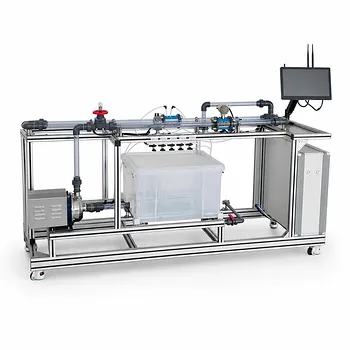
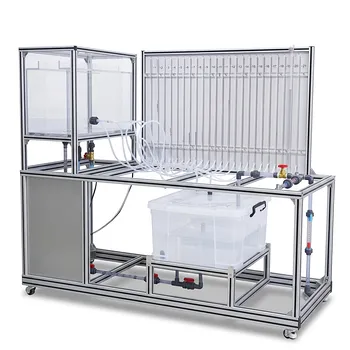
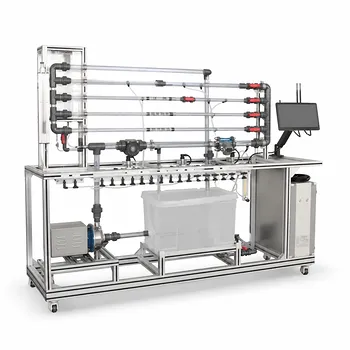
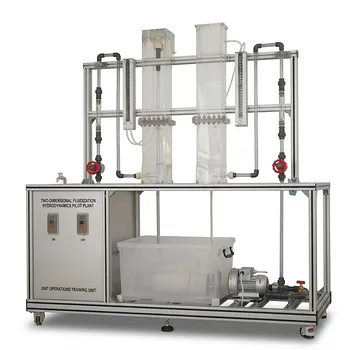
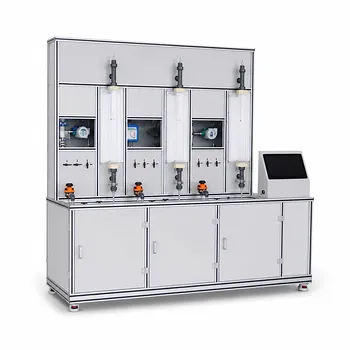
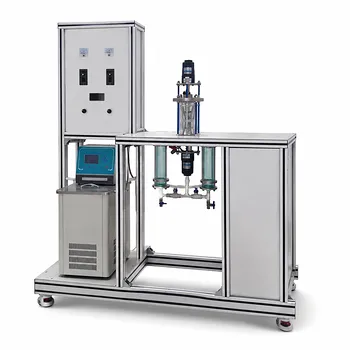
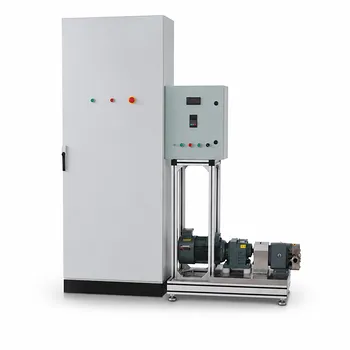
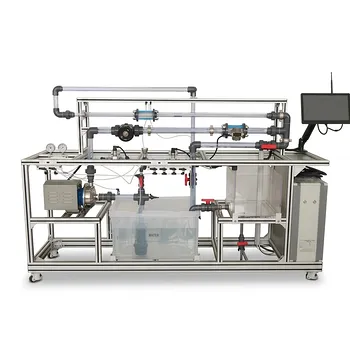
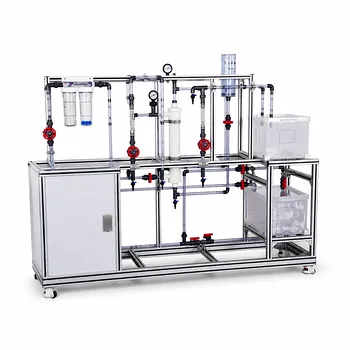
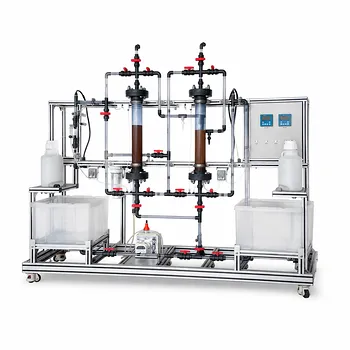
By allowing direct manipulation of channel geometry, fluid mechanics training systems provide a vivid, hands-on method to demonstrate the concept of the most efficient cross-section. These systems typically use flumes with interchangeable inserts or adjustable walls to test different channel shapes. Students can physically measure how a cross-section that minimizes wetted perimeter for a given area maximizes hydraulic radius, leading to greater discharge and velocity under consistent slope and roughness conditions.
The core insight: The most efficient open-channel cross-section is the one that minimizes the wetted perimeter for a fixed cross-sectional area. Training units turn this theory into a visible, measurable experiment, allowing users to confirm that for rectangular channels, the optimum occurs when width equals twice the depth, and for trapezoidal channels, a half-hexagon shape offers the ultimate efficiency.
The Fundamental Principle: Wetted Perimeter and Hydraulic Radius
Why Minimizing Wetted Perimeter Matters
The resistance to flow in an open channel is proportional to the length of its wetted perimeter—the surface where water touches the solid boundary. For a given cross-sectional area, a smaller wetted perimeter means less friction and a higher hydraulic radius (R = A/P). Since discharge increases with hydraulic radius, the shape with the smallest P for a given A is deemed the most efficient.
The Mathematical Ideal
In theory, the most efficient channel cross-section is a semicircle, as it has the smallest possible wetted perimeter for any given area. However, because semicircular channels are difficult to construct and maintain, practical engineering defaults to straight-sided shapes like rectangles and trapezoids. The challenge then becomes finding the geometric ratio that most closely approximates the semicircular advantage.
The Hands-On Approach: How Training Systems Demonstrate Efficiency
Interchangeable Inserts and Adjustable Flumes
Educational pilot plants feature flumes with removable channel inserts or adjustable side walls. By swapping inserts of different shapes—or by tilting walls to alter the side slope—students can rapidly transition between a wide, shallow channel and a deep, narrow one. This direct physical manipulation transforms an abstract optimization problem into a tactile experience.
Measurement and Verification
Using built-in flow meters, depth gauges, and slope controls, learners run water through each configuration at a controlled flow rate. They record water depth, calculate wetted perimeter and hydraulic radius, and measure discharge velocity. The collected data lets them plot the relationship between geometry and flow performance, directly confirming which shape yields the highest efficiency.
Validating Efficiency for Rectangular Channels
The B=2y Rule
For a rectangular channel, the most efficient cross-section occurs when the width (B) is exactly twice the flow depth (y). This relationship—B = 2y—minimizes the wetted perimeter for a given area. In the lab, students can set a fixed flow rate and slope, then adjust the channel’s width or control the depth until they observe the maximum discharge. The measured hydraulic radius at this point will be R = y/2.
Observing the Impact on Velocity and Discharge
When the B=2y ratio is deliberately violated—say, by making the channel excessively wide—the wetted perimeter increases dramatically. Students immediately see a drop in water depth for the same flow, along with a decrease in average velocity. The hands-on comparison cements the understanding that even a small deviation from the optimal proportion generates measurable hydraulic losses.
Exploring Trapezoidal Channel Efficiency
The Search for the Optimal Side Slope
Trapezoidal channels add the variable of side slope angle (θ). Training systems with adjustable side walls let users smoothly vary this angle while holding the cross-sectional area constant. As the side slope steepens, the wetted perimeter changes. Students discover that a specific balance between base width and side slope minimizes the perimeter.
The Half-Hexagon Discovery
The pinnacle of efficiency for a trapezoidal channel is achieved when the cross-section forms a half-hexagon. This occurs at a side slope angle of 30 degrees from the vertical (or a horizontal-to-vertical ratio of about 0.577). In this configuration, the wetted perimeter is equivalent to that of an inscribed semicircle, making it the most efficient straight-sided shape. By locking the flume’s walls at this angle and measuring the resulting discharge, the training system provides irrefutable proof of the design principle.
Understanding the Trade-Offs
Practical Constraints vs. Theoretical Purity
While the most efficient cross-section is a powerful design goal, training systems also illustrate its limitations. Slope stability, construction cost, and maintenance access often push engineers away from the mathematically optimal shape. A deep, narrow rectangular channel might minimize friction but could be impractical to excavate or line. The half-hexagon trapezoid requires side slopes that may not be stable in all soil types. These trade-offs become apparent when students attempt to build or modify the physical inserts, reinforcing that theoretical efficiency is only one part of the design equation.
When Efficiency Isn't Everything
In real-world applications, a “most efficient” cross-section can lead to problems like sediment deposition if velocities drop too low, or scour if they become too high near the boundaries. A training flume can demonstrate this by introducing light sediment and showing how the flow distribution in an ultra-efficient shape may create dead zones. This teaches that efficiency must be balanced with other hydraulic and environmental requirements.
Making the Most of Your Fluid Mechanics Lab
Your choice of experiment and geometry depends on the learning outcome you want to achieve. Use the following guide to focus your investigation.
- If your primary focus is understanding the fundamental principle: Start with rectangular inserts and systematically vary the width-to-depth ratio. Measure wetted perimeter and flow rate until you confirm the B=2y rule.
- If your primary focus is exploring design optimization: Use adjustable trapezoidal flumes to map how side slope changes affect discharge. Find the 30-degree angle that produces the half-hexagon and observe its superior performance.
- If your primary focus is bridging theory with real-world constraints: Deliberately introduce deviations from the optimum geometry and measure the resulting efficiency loss. Discuss how practical factors like construction cost or sediment transport might override pure hydraulic efficiency.
By transforming an abstract fluid mechanics concept into a tangible, measurable experiment, these training systems empower students and engineers to internalize the true meaning of hydraulic efficiency and its application boundaries.
Summary Table:
| Channel Shape | Optimal Geometric Relationship | Hydraulic Radius ($R$) | Efficiency Level |
|---|---|---|---|
| Semicircle | Theoretical Ideal (hard to construct) | $R = r/2$ | Maximum (Theoretical) |
| Rectangle | Width ($B$) = 2 × Depth ($y$) | $R = y/2$ | Practical Optimum |
| Trapezoid | Half-Hexagon ($30^\circ$ side slope) | Equivalent to inscribed semicircle | Best Straight-Sided |
Elevate Your Fluid Mechanics Laboratory with LABPARK
Bridge the gap between theoretical hydraulics and hands-on engineering. LABPARK provides state-of-the-art Educational and Vocational Unit Operations Pilot Plants in chemical engineering, bioprocess & biotech, and environmental & water treatment.
Designed specifically for universities, research institutes, and enterprises, our training systems empower students and researchers to visualize, measure, and master complex fluid dynamics concepts.
Ready to upgrade your lab's capabilities? Contact us today to request a quote or custom design!
Related Products
- Orifice and Venturi Flowmeter Calibration Educational Pilot Plant for Fluid Mechanics Laboratory
- Multi Pump Fluid Transport Process Piping Unit Operations Training Pilot Plant
- Comprehensive Fluid Mechanics Educational Unit Operations Pilot Plant
- Fluid Transport and Piping Dynamics Practical Training Unit Operations Pilot Plant
- Chemical Pipeline Assembly and Fluid Transport Practical Training Unit Operations Pilot Plant
People Also Ask
- What is the difference between static and stagnation pressure? Master Pilot Plant Flow Measurement
- How do pilot plants demonstrate siphon pressure variations? Visualizing Bernoulli's Energy Balance
- How do fluid mechanics training pilot plants facilitate the visualization and calculation of laminar and turbulent flows?
- How to update chemometric calibration models in pilot plants? Best practices for process engineers.
- Why are the laws of similitude critical in fluid flow pilot plants? Scale Up Safely