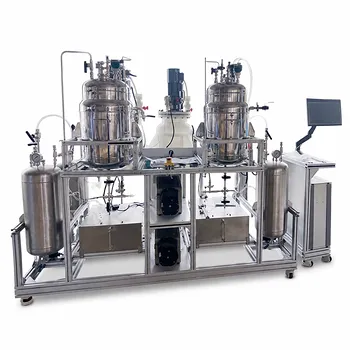
The laws of similitude are the non-negotiable bridge between a laboratory curiosity and a bankable industrial design. They are the scientific principles that allow you to take data from a small, benchtop fluid-flow pilot plant—often running water or air—and confidently predict how a massive, production-scale system will behave with hazardous, viscous, or high-temperature process fluids. Without geometric, kinematic, and dynamic similarity, a pilot plant cannot accurately forecast full-scale pressure drops, flow regimes, or energy requirements, rendering it useless as a modeling tool.
The entire predictive value of a fluid-flow pilot plant rests on similitude. It is the mathematical guarantee that the same ratios of inertia, viscosity, and geometry in your lab will replicate in a factory. This framework enables engineers to slash development costs, avoid catastrophic scale-up failures, and test with safe, convenient fluids.
The Fundamental Problem: Why You Can’t Just Shrink the Pipes
A pilot plant is not simply a smaller version of an industrial plant. Fluids, forces, and energy losses do not scale linearly. A pipe’s volume increases cubically with its diameter, while its surface area increases quadratically—meaning friction, heat transfer, and mixing behavior shift dramatically with size.
The Surface Need: Safe, Affordable Experimentation
You need to test process changes, fluid dynamics, and equipment performance without the immense cost and danger of a full-scale trial. Similitude is what makes this possible. It allows a university lab to characterize a new reactor’s pressure drop using chilled water at 20°C, rather than risking a steam explosion at a 10,000-gallon plant vessel.
The Deep Need: Replicating Physical Reality, Not Just Geometry
The deeper requirement is to reproduce the physics—the relative magnitude of forces acting on a fluid particle—so that the flow phenomenon itself is identical in model and prototype. This is why the laws of similitude are critical: they ensure that velocity profiles, turbulence, and energy dissipation are not just similar in shape, but are governed by the same force balances.
The Three Pillars of Similitude: A Chain of Dependencies
Scale-up is a hierarchical discipline. You must satisfy the first level before the next becomes meaningful, and each level builds toward full predictive fidelity.
Geometric Similarity: The Mandatory Starting Point
This is the simplest pillar. All physical proportions—ratios of impeller diameter to tank diameter (D/T), liquid level (Z/T), impeller clearance (C/T), and baffle width (B/T)—must be constant between model and prototype. Without this constant aspect ratio, no amount of flow adjustment can align the systems. It defines the boundary within which the fluid moves.
Kinematic Similarity: Matching the Flow Pattern
Once the boundaries are identical in shape (only differing in scale), the flow patterns themselves must match. This means the velocity vectors at every corresponding point must have the same direction and be proportional in magnitude. It guarantees the streamlines look the same.
Dynamic Similarity: The Core of Predictive Power
This is the decisive pillar for fluid-flow applications. It demands that the ratios of all relevant forces—inertia, viscous, gravitational, pressure—are identical in both systems. For incompressible flow in pipes and reactors, matching the Reynolds number (Re) is the single most critical scaling parameter. The Reynolds number directly dictates whether the flow is laminar or turbulent, determines the friction factor, and thus controls the system’s entire pressure-drop and pumping-power behavior.
The Critical Role of the Reynolds Number
The Reynolds number is not just a dimensionless figure; it is the diagnostic that defines the flow regime. The transition from laminar to turbulent flow fundamentally alters the flow resistance within a piping system. By matching Re between your pilot plant and the full-scale unit, you ensure that they operate on the same point on the Moody chart—meaning the friction factor and downstream mechanical energy losses will be identical.
From Classroom Theory to Plant-Wide Prediction
This is the bridge the supplementary references describe. Students and engineers apply conservation laws of mass, momentum, and energy to the pilot plant. They then use the experimentally determined friction factor (which is a function of the matched Re) to calculate pressure drops and pump power. If Re matches, the theoretical calculation from the pilot plant directly scales to the industrial unit.
Fluid Property Substitution: The Safety and Cost Advantage
Dynamic similarity enables the most profound benefit: fluid substitution. You can run your pilot plant with water or air to model a system that must ultimately handle hot oil, corrosive chemicals, or high-pressure steam. The primary reference highlights this directly: by matching the relevant dimensionless groups (primarily Re), the kinematic and dynamic performance of the safe fluid directly predicts the performance of the hazardous one.
Understanding the Trade-offs and the Non-Negotiable Limits
The laws of similitude are critical, but they are also unforgiving. A failure to respect their limitations leads to scaling disasters.
The Incomplete Promise of Geometric Similarity Alone
A vessel that is a perfect geometric replica but operated at the wrong Reynolds number will not deliver the right mixing intensity. As the supplementary references note, because volume scales with the cube of length while surface area scales with the square, maintaining only geometric similarity cannot guarantee identical fluid velocities or mixing power per unit volume. You must overlay dynamic criteria, such as equal power number or tip speed, to achieve truly representative mixing.
When Exact Reynolds Matching Is Impractical
Physical reality often frustrates perfect similitude. Matching Re exactly while using the same fluid can require impractically high velocities in a small pilot plant, or unattainably low velocities in a large one. The trade-off is that engineers must often prioritize the dominant force. In turbulent flow, inertia dominates and viscous forces matter less; geometrically similar models can then scale effectively even with an imperfect Re match. The critical pitfall is unknowingly operating a pilot plant in the turbulent regime while the full-scale plant will run in the transition or laminar regime—in that case, an unmatched Reynolds number invalidates all predictions.
The Danger of Extrapolating Beyond Validated Regimes
A pressure-drop correlation developed in a smooth pilot pipe cannot be blindly scaled to a rusted, industrial pipe with different relative roughness unless that roughness is also scaled geometrically. Partial similitude is a minefield, and the project’s fiduciary safety depends on knowing which pillar you can compromise and which you cannot.
Making the Right Choice for Your Scale-Up Goal
Your approach to similitude must be deliberately aligned with the engineering question you need the pilot plant to answer. A one-size-fits-all scaling law does not exist.
- If your primary focus is predicting pressure drop and pumping power: Match the Reynolds number and ensure geometric similarity of pipe roughness. This aligns the flow regime and friction factor, allowing direct calculation of energy requirements from the pilot data.
- If your primary focus is mixing or blending performance: Do not rely on geometric similarity alone. You must ensure dynamic similarity through constant power per unit volume (P/V) or tip speed, because the volume-to-surface-area disparity fundamentally changes mixing intensity across scales.
- If your primary focus is safety or feasibility demonstration with hazardous fluids: Leverage fluid substitution ruthlessly. Use similitude to select a safe surrogate fluid and operating conditions that replicate the target Re, thereby validating the process’s thermodynamic and hydraulic viability before a single drop of the real fluid is ever handled.
The laws of similitude are not just academic criteria; they are the engineering discipline that turns a small experiment into a guaranteed multi-million dollar outcome.
Summary Table:
| Pillar | Definition | Key Parameter / Focus |
|---|---|---|
| Geometric Similitude | Constant physical proportions and dimensions | Aspect ratios (e.g., $D/T, Z/T$), surface roughness |
| Kinematic Similitude | Matching fluid flow patterns and velocity vectors | Streamline shapes, velocity magnitude ratios |
| Dynamic Similitude | Identical ratios of forces acting on the fluid | Reynolds number ($Re$), force balances (inertia vs. viscosity) |
Scale Up Your Chemical Engineering Lab with LABPARK
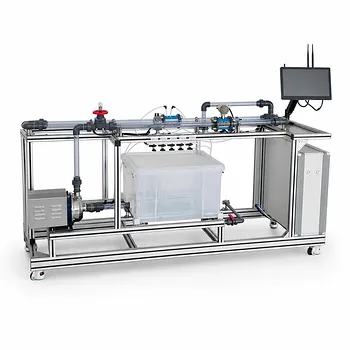
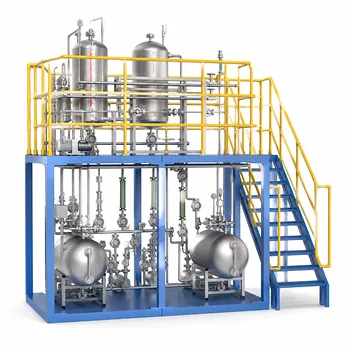
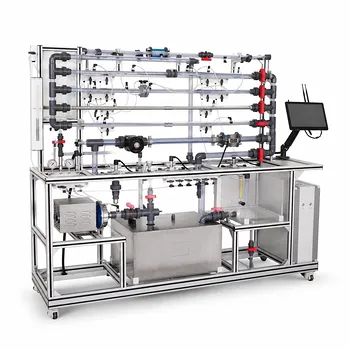
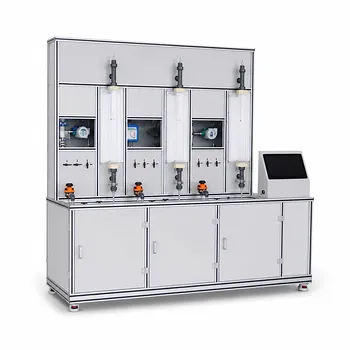
Bridge the gap between laboratory theory and industrial reality. LABPARK provides premium Educational and Vocational Unit Operations Pilot Plants in chemical engineering, bioprocess & biotech, and environmental & water treatment for universities, research institutes, and enterprises.
Ensure your students and researchers master the laws of similitude with hands-on, high-fidelity equipment. Contact LABPARK today to discuss your laboratory needs.
Related Products
- Orifice and Venturi Flowmeter Calibration Educational Pilot Plant for Fluid Mechanics Laboratory
- Fluid Transport and Piping Dynamics Practical Training Unit Operations Pilot Plant
- Comprehensive Fluid Mechanics Educational Unit Operations Pilot Plant
- Two Phase Flow Pattern Velocity Resistance Measurement Educational Pilot Plant
- Quantitative Dosing and Liquid Flow Control Educational Unit Operations Pilot Plant
People Also Ask
- What is the difference between static and stagnation pressure? Master Pilot Plant Flow Measurement
- How do pilot plants demonstrate siphon pressure variations? Visualizing Bernoulli's Energy Balance
- How do fluid mechanics training pilot plants facilitate the visualization and calculation of laminar and turbulent flows?
- How to update chemometric calibration models in pilot plants? Best practices for process engineers.
- Why do orifice flowmeters in educational unit operations laboratories require periodic calibration? Drift & Wear